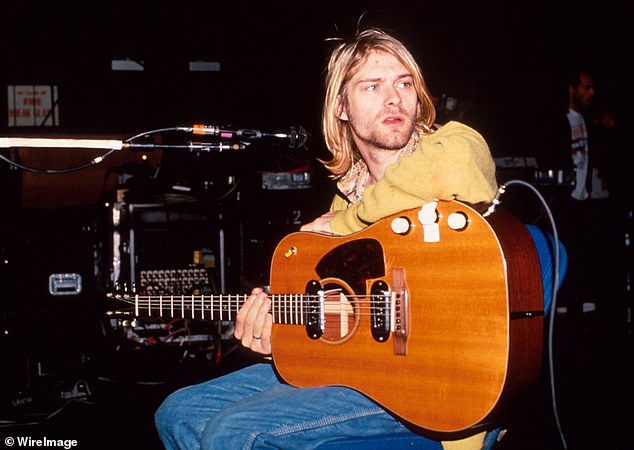

Kurt Cobain was found lifeless in a greenhouse attached to his Seattle home, and within a few hours, investigators declared his death a suicide.
Now, a retired Seattle Police captain has claimed that the physical evidence from the Nirvana frontman’s death scene ‘does not add up,’ alleging the case was mishandled and staged to look like a suicide.
Neil Low, who spent 50 years with the Seattle Police Department (SPD) and was asked by his chief to audit the Cobain case in 2005, told the Daily Mail he believes investigators failed to treat the rockstar’s death as a potential homicide properly.
‘I just am not buying that Kurt did that to himself,’ Low said, describing the SPD investigation as ‘botched.’ However, Low did not work on the initial investigation and the investigation was not conducted at his assigned precinct.
He cited what he described as anomalies in blood evidence, the violence of the shotgun wound and alleged inconsistencies in the scene.
Low, who retired in 2018, discussed inconsistencies within the autopsy and SPD reports, including missing notes, omitted witness observations and conflicting details about events leading up to Cobain’s death.
‘One thing about report writing is the human error factor: misheard, misunderstood, transposed thoughts, and forgotten details,’ said Low.
‘They were led astray. I might have fallen for it, too, but now I think it’s a homicide, and I do think the case should be reopened.’

Nirvana frontman Kurt Cobain was found dead on April 8, 1994. Authorities ruled it a suicide, but a retired Seattle Police captain believes the investigation was ‘botched’

Cobain’s body was found inside a greenhouse above a two-car garage at his Seattle home
When asked what processes were conducted to determine whether Cobain’s death was a suicide before the toxicology and autopsy were completed, the SPD told the Daily Mail: ‘Kurt Cobain died by suicide in 1994. This continues to be the position held by the Seattle Police Department.’
Cobain died on April 5, at age 27, from a shotgun wound to the head. His body was found three days later by an electrician installing security lighting at the house.
At the time, the King County Medical Examiner ruled his death a suicide by a Remington Model 11 20-gauge shotgun, as the weapon was found in his arms and a suicide note in a nearby potted plant.
That conclusion has been upheld for more than three decades, despite recurring alternative theories surrounding the rock star’s death, including a recent paper from a group of independent researchers which claims the evidence points to homicide.
While Low’s comments echo some of those theories, they are unusual coming from a senior law enforcement figure, and one who says he initially accepted the suicide ruling. The ex-cop was a commander for the South Precinct at the time of Cobain’s death, before being promoted to Captain about a decade later.
‘I’ve read the case, and I can tell you what the evidence says because that’s what I did for a living, and it does say not suicide,’ Low said.
The retired police captain was given full access to Cobain’s file and the evidence collected at his death scene during the 2005 audit.
During a case audit, a police officer or internal investigator conducts a thorough and objective review of an investigation, checking that procedures, evidence handling and records meet legal and departmental standards.

Medical records indicated that the amount of heroin found in Cobain’s system was roughly three times a lethal dose. Pictured is the heroine kit found near Cobain’s body

The autopsy mentions a handwritten note in black ink found in Cobain’s pocket referencing ammunition and the Remington shotgun

However, the official 1994 SPD report only noted a receipt for the gun with a friend’s name, Dillon Carlson, written on it
The process is designed to ensure accountability, highlight training needs, and confirm that the case can support a successful prosecution. However, the audit is not conducted to change the original ruling of the case.
‘I think they went in with their mind made up. It was a suicide,’ said Low, adding that Homicide units usually do not look at deaths ruled suicides.
The veteran police captain said the suicide narrative began at the crime scene, when SPD spokesperson Vinette Tishi left shortly after Cobain’s body was discovered.
Tishi was walking down the driveway with Medical Examiner Dr Donald Reay when reporters approached them for details.
‘It was obvious this man is dead from a shotgun wound to the head… Now there was a suicide note left inside the, then house,’ Tishi said in a recorded interview.
Such determinations, Low argued, should have come from the medical examiner’s office rather than police spokespeople.
Investigators, he added, must follow strict standards and avoid drawing evidentiary conclusions, like ruling the death a suicide or labeling a note a suicide note, without proper qualifications, because early assumptions shape the entire investigation.
Regarding the forensic details of the scene, Low pointed to photographs that appear to show Cobain’s hands unusually clean, a finding inconsistent with a self-inflicted shotgun wound.
‘The birdshot went into his skull and really did a number,’ said Low.
‘All the pellets were accounted for, but the impact would have been so forceful that it would have produced a significant spray, not just a little, a large spray.’
Additional photos of the chest and hands, he suggested, could help clarify blood patterns and indicate whether the scene was altered after death.
Independent researchers also note that discrepancies in police documentation have raised further questions.

Neil Low spent 50 years with the Seattle Police Department (SPD) and was asked by his chief to audit the Cobain case in 2005. Low is pictured with his wife Leslie Brinkman at his 2018 retirement party

Pictured is the receipt for the gun found in Cobain’s hands at his death scene. Police uncovered the receipt in his pocket
A 1994 SPD report described a Gray Top Cabs driver picking up a passenger from Cobain’s residence who ‘did not match with the residence,’ suggesting it may not have been Cobain.
The report also noted that the driver and passenger were unable to locate a store to buy ammunition.
In 2014, SPD released a report claiming to include previously unseen details of the case, but it omitted the passenger mismatch and the ammunition issue.
Other points of concern presented to Daily Mail included inconsistencies in the autopsy and police documentation.
The autopsy mentions a handwritten note in black ink found in Cobain’s pocket referencing ammunition and the Remington shotgun.

A 1994 SPD report described a Gray Top Cabs driver picking up a passenger from Cobain’s residence who ‘did not match with the residence. The report also noted that the driver and passenger were unable to locate a store to buy ammunition

In 2014, SPD released a report claiming to include previously unseen details of the case, but it omitted the passenger mismatch and the ammunition issue
However, the official 1994 SPD report only noted a receipt for the gun with a friend’s name, Dillon Carlson, written on it.
Independent researcher Michelle Wilkins, working with a team of forensic scientists, has been re-analyzing the case.
She said the discrepancies strengthen concerns about the thoroughness of the original investigation.
‘The original report explicitly says the passenger didn’t match the residence. That alone suggests it may not have been Kurt,’ Wilkins said.
She also noted that Cobain, an experienced gun owner, would likely have known where to buy ammunition, making the reported confusion unusual.
Low began questioning the case years after the death, after reviewing the investigation and watching documentaries that raised forensic questions.
Among his central concerns are the blood patterns and the condition of Cobain’s hands, as well as the violence of the shotgun wound.

The retired police captain raised concerns about whether proper forensic procedures were followed, such as collecting DNA, scraping Cobain’s nails or preserving the scene adequately. Pictured is Cobain’s body found at the scene

The former police captain believes authorities announced the suicide ruling too early. Pictured is Cobain’s suicide note found at the scene
‘Why do the shotgun-to-the-face thing?’ he asked. ‘He was not a violent person. I think he would have been satisfied with a less violent way.’
Medical records indicated that the amount of heroin found in Cobain’s system was roughly three times a lethal dose.
He said that for someone to inject that much, assistance would likely have been required, given the sheer volume involved.
Low criticized the original police response, arguing that the scene was not treated as a potential homicide.
He raised concerns about whether proper forensic procedures were followed, such as collecting DNA, scraping Cobain’s nails or preserving the scene adequately.
The situation, he said, resembled ‘prime scene tourism,’ with too many personnel allowed inside, potentially contaminating evidence. An SPD report shows that at least 12 officers went in and out of the room where Cobain’s body was found.