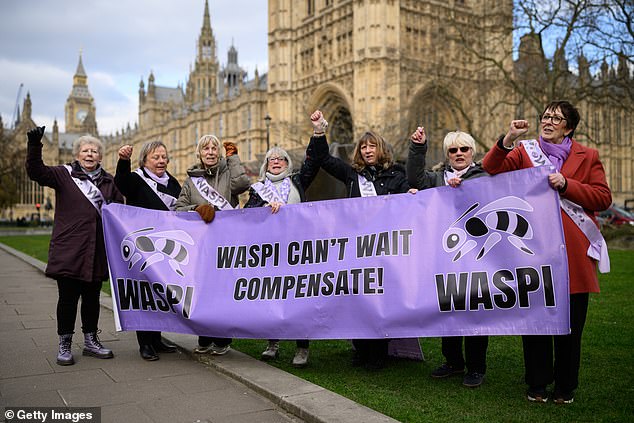

Ministers were accused of showing ‘contempt’ for so-called ‘Waspi’ women today as they again ruled out compensation.
Campaigners and Labour MPs voiced fury after Work and Pensions Secretary Pat McFadden announced that a review had confirmed payouts are not required.
He said there were ‘legitimate’ questions about whether the state pension age should have been increased, and repeated an apology for the failure to send notification letters earlier.
But he argued that the issue was whether there was ‘maladministration’ and whether women suffered ‘direct financial loss from the delay’.
‘The government has come to the same conclusion as… announced in 2024,’ Mr McFadden said.
The decision comes despite a host of senior Labour figures including Keir Starmer campaigning for a package – only to baulk at the £10billion pound cost when they entered government.
Labour MP Barry Gardiner was among those condemning the announcement in the Commons, while the Tories pointed out the hypocrisy from the government front bench.
However, pensions minister Torsten Bell – who also works for Rachel Reeves in the Treasury – seemed to be struggling to stay awake as the bad news was delivered by Mr McFadden.

So-called ‘Waspi’ women have been fighting for compensation for many years. Pictured, a protest at Parliament last year

Pensions minister Torsten Bell (right) seemed to be struggling to stay awake as the bad news was delivered to WASPI women

Keir Starmer is among a host of ministers who campaigned for compensation – only for Labour to backtrack in government

Labour MP Sarah Champion was among those condemning the decision
The women – born in the 1950s – claim they were not properly informed about increases to the state pension age, leaving their retirement income lower than anticipated.
In December 2024 the then-Work and Pensions Secretary Liz Kendall declared that there would be no compensation.
However, in November her successor Mr McFadden admitted the conclusion would have to be reviewed.
Court proceedings had led to the rediscovery of a 2007 Department for Work and Pensions evaluation, which meant officials stopping sending automatic pension forecast letters out.
However, Mr McFadden offered campaigners no guarantees the review would lead to compensation being awarded.
And he told the Commons today: ‘There are legitimate and sincerely held views about whether it was wise to increase the state pension age, in particular, whether the decision taken in 2011 by the coalition government to accelerate equalisation and the rise to the age of 66 was the right thing to do or not.’
But the issue of compensation is based on ‘how changes to the state pension age were communicated’, not past policy decisions, the minister said.
He also told the Commons: ‘We accept that individual letters about changes to the state pension age could have been sent earlier.
‘For this, I want to repeat the apology that (former work and pensions secretary Liz Kendall) gave on behalf of the Government.
‘And I am sorry that those letters were not sent sooner.
‘We also agree with the (Parliamentary and Health Service) ombudsman that women did not suffer any direct financial loss from the delay.’
Mr McFadden said a compensation scheme which looked at the circumstances of each individual woman who may not have known about state pension age changes would ‘not be practical’.
He told the Commons: ‘The question is about the impact of the delay in sending these letters.
‘The evidence, taken as a whole, including from 2007, suggests the majority of 1950s-born women would not have read and recalled the contents of an unsolicited pensions letter, even if it had been sent earlier.
‘Furthermore, the evidence also suggests that those less knowledgeable about pensions, the very women who most needed to engage with a letter and where it might have made a difference, were the least likely to read it, so an earlier letter would have been unlikely to make a difference to what the majority of women knew about their own state pension age.’
Mr McFadden later added: ‘The evidence shows that the vast majority of 1950s-born women already knew the state pension age was increasing thanks to a wide range of public information, including through leaflets, education campaigns, information in GP surgeries, on TV, radio, cinema and online.
‘To specifically compensate only those women who suffered injustice would require a scheme that could reliably verify the individual circumstances of millions of women.’
A wider flat-rate scheme would cost up to £10.3billion, the minister said, ‘and would simply not be right or fair, given it would be paid to the vast majority who were aware of the changes’.
Angela Madden, chairwoman of Women Against State Pension Inequality (Waspi), said: ‘Ministers have demonstrated their utter contempt for 1950s-born women, for Parliament and for the Parliamentary Ombudsman.
‘The Government has kicked the can down the road for months, only to arrive at exactly the same conclusion it has always wanted to.
‘This is a disgraceful political choice by a small group of very powerful people who have decided the harm and injustice suffered by millions of ordinary women simply does not matter.
‘The Parliamentary Ombudsman says economic circumstances should not be used as an excuse to deny compensation.
‘The Government has magically found billions to fund policies not made in their election manifesto, proving money can quickly become available when ministers consider something a priority.
‘Waspi is taking legal advice and all options remain on the table.
‘We stand ready to pursue every avenue in Parliament and in the courts to secure the justice that has been so shamefully denied.’
Keir Starmer previously argued that the taxpayer ‘simply can’t afford’ the payouts.

Work and Pensions Secretary Pat McFadden announced that a review had confirmed payouts were not required
That was despite him having signed a pledge for ‘fair and fast compensation’ in 2022 while opposition leader.
A report by the Parliamentary and Health Service Ombudsman has previously suggested compensation ranging between £1,000 and £2,950 could be appropriate for each of those affected by how state pension changes had been communicated.
But in December 2024, the Government said while it accepted the Ombudsman’s finding of maladministration and apologised for a delay in writing to 1950s-born women, a blanket compensation scheme, which could cost taxpayers up to £10.5 billion, could not be justified.