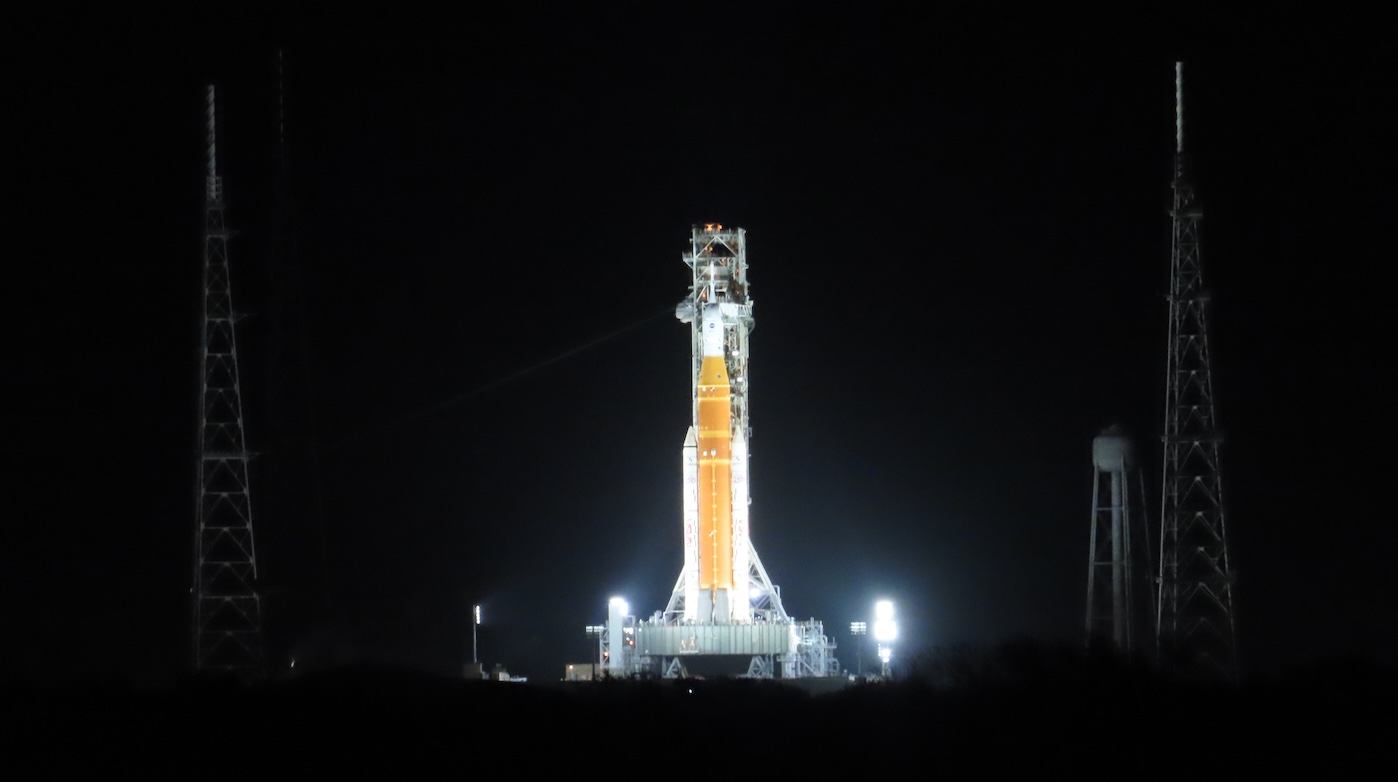
In the coming days, the private sector will likely launch a rocket into outer space. In one sense, that isn’t a new development, but it may still come as news to the American people.
The launch of the Artemis mission, which could happen as soon as Wednesday evening, will take a manned crew around the moon for the first time in over half a century and will draw interest from the press and the public worldwide. This particularly prominent launch will highlight the ways in which the private sector has not only assumed control of launching manned missions into space but also revitalized a space program some may have considered moribund.
Witness to History
The postponement of an earlier Artemis launch window in February due to technical problems meant I had the opportunity to witness a separate rocket launch from the Kennedy Space Center. The Artemis postponement allowed SpaceX to accelerate the launch of Crew-12, a manned mission to the International Space Station, which came after a medical emergency led Crew-11 to return to Earth sooner than planned.
If watching a rocket launch in person isn’t on your personal “bucket list,” it should be. I had the good fortune not just to be in Florida during the Crew-12 mission’s (accelerated) launch window, but to snag a ticket to a nighttime launch early in the morning of Feb. 13.
The impressions from that night remain etched in my memory: the Falcon 9 rocket and Crew Dragon spacecraft bathed in spotlights and silhouetted against the black of the night sky. The brilliant flash of light as the engines fired the rocket skyward, the “oohs” and “aahs” of the crowd, accompanied by the quiet click-click-click of amateur photographers’ shutters. And then and only then — because light travels faster than sound — the rumble and roar of the engines reached our vantage point, as the rocket surged ever higher into the heavens.
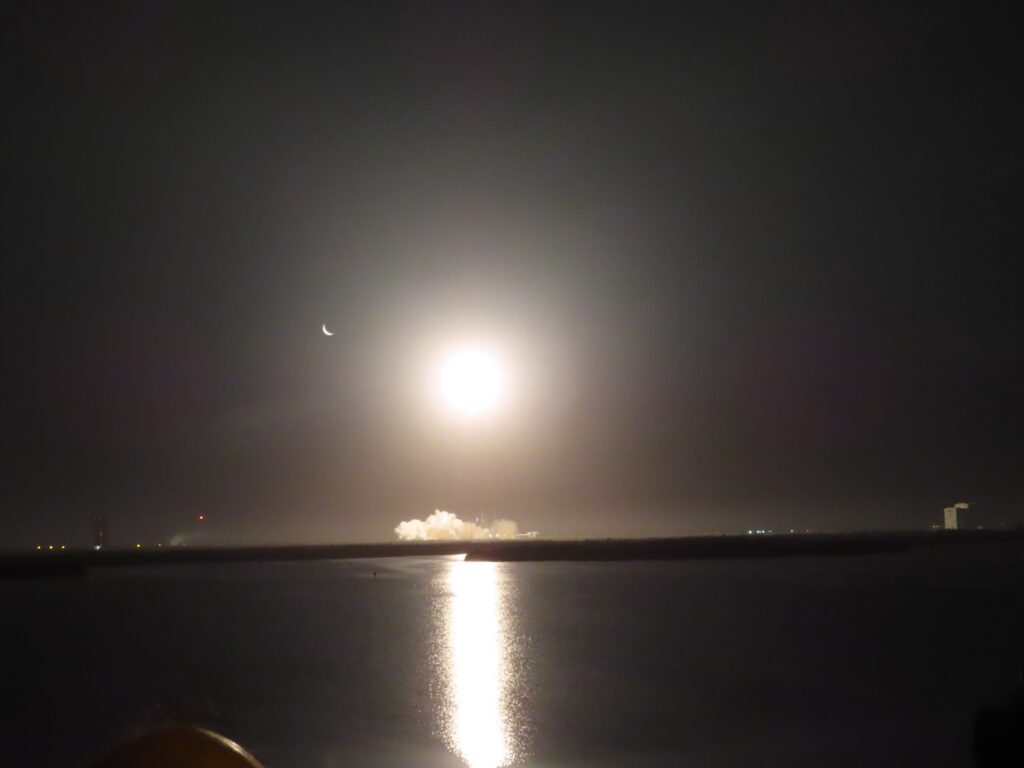
Image CreditChristopher Jacobs
Momentous Launch
As indelible as the Crew-12 launch remains in my memory, the Artemis launch will prove more significant for several reasons. From a practical perspective, the Space Launch System (SLS) rocket, built by the United Launch Alliance, has over five times more power than the Falcon 9 rocket that launched Crew-12 — indeed, more power than just about any instrument created by mankind to this point. While the Saturn V rocket used in the Apollo missions created 7.5 million pounds of thrust, the SLS creates 8.8 million pounds, which likely will make the roar I heard in February a mere whisper by comparison.
All that thrust comes for a single, historic purpose: to take man back to the moon. In flying past the moon without landing, this Artemis mission will resemble the famous Apollo 8 mission of Christmas 1968. While this crew will not land on the moon, it will represent the first time a crewed mission has left low Earth orbit since the final lunar landing in the Apollo 17 mission of December 1972.
New Frontier
In launching a mission to send men back to the moon, the United Launch Alliance and NASA have an opportunity to capture the public’s focus in a way neither has had for years. While space geeks may have closely followed developments in manned space flight, other people like me may not have paid much attention to the topic since the tragic loss of the Space Shuttle Columbia in 2003 or the end of the shuttle program in 2011.
In driving around the Kennedy Space Center in the days leading up to the Crew-12 launch, I couldn’t help but notice the infrastructure that has grown up around the Cape Canaveral site. And this infrastructure, unlike that of the 1960s, comes largely via the private sector. For instance, Blue Origin has an enormous facility located near the Kennedy Space Center Visitor Center. And while NASA finished constructing its Vehicle Assembly Building in 1966 to house the Saturn V rocket, SpaceX is constructing its own similar facility nearby to house its own moon rockets.
SpaceX, Blue Origin, and their peers have helped revolutionize spaceflight, lowering the cost to send objects into space and doing so safely and with regularity. Assuming the Artemis mission goes off without major complications, it would serve as further proof that American companies can help our country explore outer space. As we prepare to celebrate the nation’s 250th birthday, it would serve as a fitting reminder of the power of American innovation.
This article has been updated since publication.