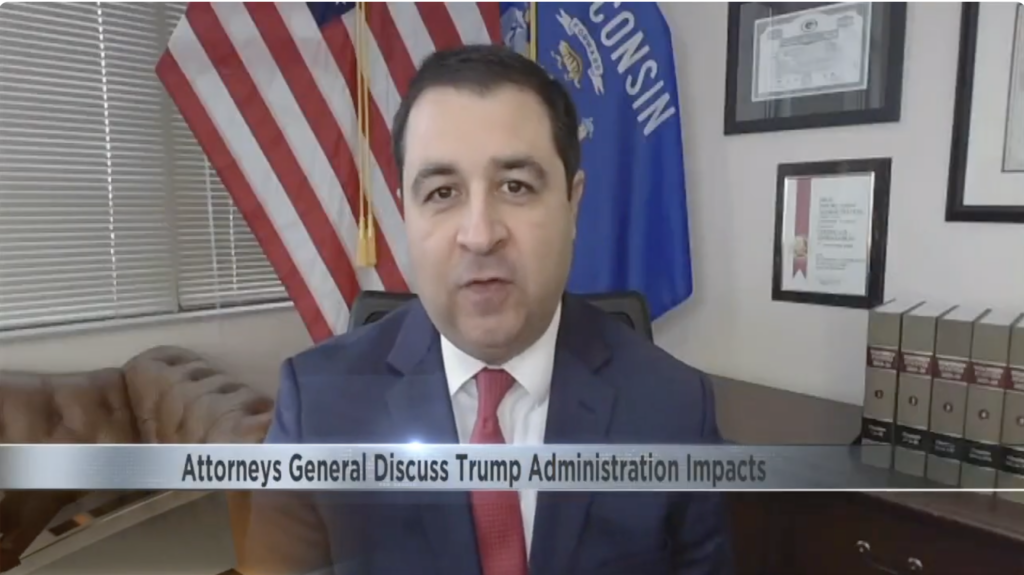

After victimizing his party’s political enemies for more than two years, far-left Wisconsin Attorney General Josh Kaul is asking a Dane County trial court for a protective order to lock away discovery documents from public scrutiny.
And Kaul, the Democrats’ answer to Inspector Javert, is trying to use a 2020 state constitutional amendment intended to protect the privacy rights of sexual assault victims in his trumped-up prosecution of President Donald Trump’s allies in Wisconsin.
“This matter has generated attention from the media and the public. The attention has caused concern for the victims and witnesses who are named in the discovery and may testify in this matter,” the motion, filed Tuesday, claims.
The “matter” is Kaul’s weaponized witch hunt against Jim Troupis and Kenneth Chesebro, the lawyers who represented Trump’s Wisconsin campaign in legal challenges following the rigged 2020 presidential election. Each faces multiple felony forgery charges for advising and carrying out a legal strategy that used alternate electors to protect Wisconsin’s 10 electoral votes for Trump should he prevail in his lawsuits.
Kaul and his friends in the accomplice media like to paint the strategy as a “fake electors” scheme employed in an attempt to overturn the results of the election. How they have come to that conclusion is curious, given the fact that Kaul’s DOJ twice noted, the legal strategy wasn’t a crime. In fact, previous presidential campaigns have employed or considered using alternate electors while election results were being challenged.
The politically weaponized prosecution has been in the national spotlight as most cases involving Trump are, and by design. Kaul announced his first round of charges at a State Capitol press conference in June 2024, just as Trump was securing his third straight GOP presidential nomination. Kaul and the Democrat Party machine that pulls his puppet strings want maximum attention heading into the critical midterm elections.
But Kaul’s case bears a higher glare in the spotlight because it is one of the last swing state electors cases still standing — the only one that hasn’t fully unraveled. If justice is possible for the conservative defendants in the left-ladened Dane County Circuit Court, then Kaul’s case, too, will go the way of Arizona, Georgia, Michigan and others.
What exactly is Kaul looking to protect, “victims” or documentation of a coordinated national lawfare campaign riddled with corruption and prosecutorial abuses?
The Brains Behind Kaul
As The Federalist reported earlier this month, Arizona’s Democrat Attorney General Kris Mayes was forced to dismiss her electors’ case after the state Supreme Court ruled that it was DOA. Mayes is reportedly in search of a new grand jury to indict the local and national Republicans caught up in the witch hunt, including Trump attorney and former New York City Mayor Rudy Giuliani, former Trump chief of staff Mark Meadows, and former Trump lawyer John Eastman.
The state court of appeals had found that Mayes illegally withheld communications between the AG’s office and the States United Democracy Center. Judicial Watch sued the attorney general, who insisted the documents sought were protected by attorney-client privilege. The judge disagreed.
States United is the brainchild of Norm Eisen, a left-leaning lawyer who served as the “Ethics Czar” in the Obama White House. The leftist lawfare group claims that it is an “initiative of the Progressive State Leaders Committee,” a “shell non-profit,” but is actually the Democratic Attorneys General Association, according to court documents. At the least the PSLC is closely tied to DAGA. And DAGA contributed $200,000 to Mayes’ cause while its lawfare arm was helping round up political enemies, according to the filing.
DAGA’s political fund spent nearly $2.2 million to help Josh Kaul beat incumbent GOP Attorney General Brad Schimel in 2018, according to the Wisconsin Democracy Campaign. DAGA’s People’s Lawyer Project spent another $1.9 million to re-elect Kaul in 2022, according to WDC. That was in the thick of the massive campaign by leftist lawfare groups to put Trump behind bars and off the 2024 presidential ballot.
‘How to Stop Donald Trump’
According to the Arizona court filing, States United solicited Kaul for participation in its multistate litigation scheme. Following the initial solicitation from States United’s CEO Joanna Lydgate to Kaul, the Wisconsin Department of Justice “received, and likely participated in many States United zoom calls and presentations targeting political opponents.”
“They provided several talking points to AG Kaul (Exhibit KK) and even worked as a booker for media appearances on behalf of AG Kaul and the Voter Protection Program,” the court filing states. The Wisconsin Department of Justice participated in the regular ‘States United Noon Briefings’ along with many other politically aligned states.”
Kaul’s team also participated in the presentation put together by DAGA’s executive team and presented by Eisen to “States United’s cooperating AGs and staff,” the filing states.
“The presentation’s power point discussed how to stop Donald Trump and Trump supporters. The presentation was less than two months before Arizona AG Kris Mayes opened this grand jury investigation.”
‘Content-Based Gag Order’
While Kaul and crew want to keep discovery materials out of the public eye, they have defenestrated Troupis and his co-defendants in the public square. Meanwhile, the prosecution denies the accused the opportunity to respond when they have evidence of corruption in the case, hiding behind a law meant to protect sexual assault victims.
A source with knowledge of the case tells The Federalist that the co-defendants will file an opposition brief and seek a hearing.
Kaul likes secret prosecutions. Before announcing the initial charges in spring 2024, the attorney general quickly moved to seal the investigation’s subpoenas and silence the defendants to keep the full story in the dark.
“The order forbidding the disclosure of information related to the subpoena is a content-based gag order because it effectively precludes speech on an entire topic: the subpoena and records it seeks. Such a ‘naked prohibition against disclosure is fairly characterized as a regulation of pure speech,’” a motion filed at the time by Troupis’ attorney Joe Bugni argues, citing a 2001 U.S. Supreme ruling.
Matt Kittle is a senior elections correspondent for The Federalist. An award-winning investigative reporter and 30-year veteran of print, broadcast, and online journalism, Kittle previously served as the executive director of Empower Wisconsin.