
Senator Adam Schiff, a California Democrat, is introducing legislation to place new limits on the Pentagon’s use of artificial intelligence by requiring human oversight of the emerging technology.
Schiff seeks to require supervision of AI-powered weapons, and also aims to restrict the use of the tech for domestic surveillance.
Most Democrats have been skeptical of the tech, as the Trump administration has, for the most part, embraced AI.
The Pentagon recently got into a legal dispute with AI company Anthropic after it refused to give the military unfettered access to its models for use on the battlefield.
Speaking with the Wall Street Journal, Schiff noted that, ‘We’re no longer anticipating these impacts. They’re here.’
‘AI could very well be the dominant issue in the next presidential election,’ he added.
Schiff and the Democrats will be hoping to seize on the simmering public discontent with AI as they head into the midterm elections.
If the Democrats take control of Congress they will find themselves in a strong position to scupper Donald Trump’s pro-AI agenda, with the White House framing the push for AI advancement as a new Manhattan Project vital to national security.

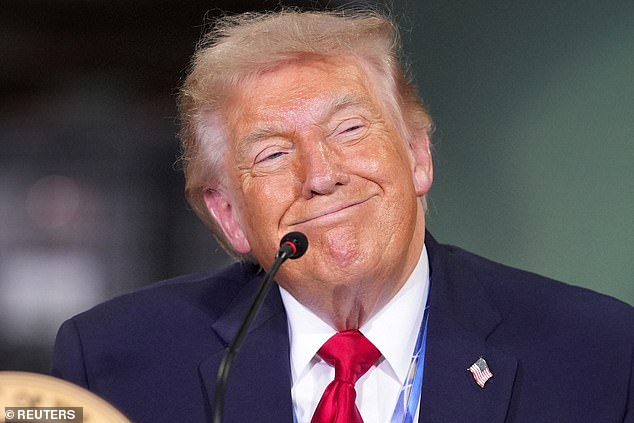
President Donald Trump attends an event at Custer Farms in Chippewa Falls, Wisconsin on June, 5, 2026

Anduril Ghost-X unmanned aircraft system (UAS) drone flies during NATO tests of the new counter-drone technologies on May 15, 2026
A recent CBS/YouGov poll showed skepticism toward the technology. Seventy-eight percent of respondents said that AI companies and developers are trying to encourage the use of AI to give themselves more power, as well as replace human workers with AI.
Younger Americans also seem to be wary of the tech, as former Google CEO Eric Schmidt was booed by graduates at Arizona University when he mentioned the impact of AI on jobs.
Schiff’s bill follows similar efforts from lawmakers including Mark Kelly, Kirsten Gillibrand, and Elissa Slotkin.
Democrats are also advancing proposals ranging from taxes on AI firms and data center regulations to increased transparency about copyrighted training data to try and limit the technology’s reach and power.
Despite an overall positive outlook, the Trump administration is seeking to address some of the public concerns, apparently realizing that the issue is going to become a political football.
Last week, Trump signed an executive order on AI, which marked a shift from a previous hands-off approach.
He encouraged companies to voluntarily submit advanced models for government testing before public release and directed federal agencies to develop cybersecurity benchmarks, share information on AI-related vulnerabilities, and strengthen government defenses against emerging threats.
Trump also recently stunned AI leaders when he suggested that the American people could own ‘pieces’ of AI companies.
‘There’s so much money, it’s so big. There are concepts where pieces could be given to the American public where the American public essentially becomes a partner with the companies,’ Trump said.
‘The American people can benefit from the success of AI — and if they do that, they’re going to like it better.’
David Sacks, the president’s former AI czar, noted in a post on X that ‘Nationalization of AI will accelerate the corporate-government fusion we’re already sliding toward.’
‘America won’t win the AI race if we beat China but end up with a CCP-style social credit system in the US – and that is the danger as the government becomes more deeply involved in AI development and assumes direct ownership and control,’ he added.