
A recovery in Britain’s manufacturing sector has failed to boost jobs as firms cut staff for the 15th month in a row.
Crippling costs mean UK factories are having to reduce roles even as business starts to pick up, monthly purchasing managers’ index (PMI) data showed.
Firms are being battered by sky-high electricity prices as well as Labour’s national insurance hikes, steep minimum wage rises, and the imposition of a new set of workers’ rights.
‘Make no mistake this will be one of the most expensive years ever to run a business in the UK,’ said Fhaheen Khan, senior economist at Make UK.
Khan said that attempts to address costs were resulting in job losses.

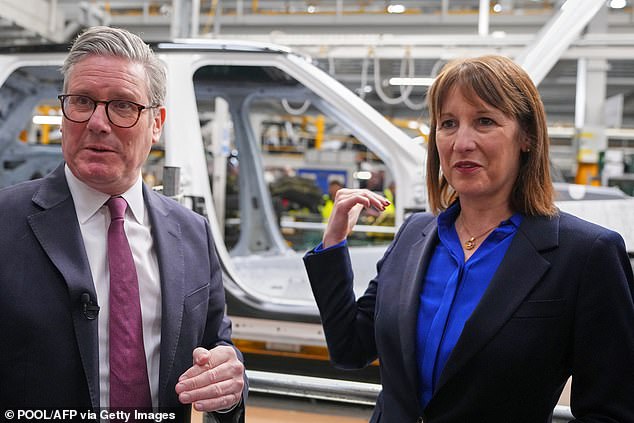
Keir Starmer and Rachel Reeves at a Jaguar Land Rover factory in Birmingham
The PMI survey, compiled by financial firm S&P Global, gave a brighter reading for the manufacturing sector overall – rising to 51.8 in January, a 17-month high – on a scale where the 50-mark separate growth from contraction.
It was the third month in a row of a reading above 50 signalling growth.
Production rose thanks to rising export demand and new orders were given a lift by sales to markets including Europe, the US and China.
Confidence also improved though there were fears that Labour and Donald Trump could yet throw a spanner in the works.
‘Several firms… noted concerns about the geopolitical outlook, UK government policy and tariff uncertainties,’ the report said.
Falling jobs numbers ‘were linked to redundancies, non-replacement of leavers, cost savings and efforts to protect margins’, it found.
Rob Dobson, Director at S&P Global Market Intelligence, said: ‘Cost pressures are creeping higher… as the pass through of the increased minimum wage and employer NI contributions continue to work through the supply chain alongside the rising costs for commodities such as metals.’
Matt Swannell, chief economic advisor to the EY ITEM Club, said the upbeat overall reading for the survey ‘should be taken with a heavy pinch of salt’.
He added: ‘It’s likely that 2026 will be another subdued year for UK manufacturers as fiscal policy continues to tighten, households’ real income growth is set to slow, and international trade policy uncertainty remains elevated.
‘Even with business reported to be on the up, rising costs are still causing manufacturers to reduce headcount.’
Mike Thornton, head of industrials at RSM UK, said: ‘Despite a positive start, crippling energy cost will persist in 2026.’
Thornton said manufacturers were also braced for the introduction in 2027 of a new carbon border tax, a new charge that will be added to imports of goods such as aluminium, cement, fertiliser, hydrogen, iron and steel that are linked to high emissions.
‘In addition, any retaliatory tariff action from the EU could present a real risk to UK manufacturing and derail future growth,’ Thornton added.
DIY INVESTING PLATFORMS

AJ Bell
AJ Bell
Easy investing and ready-made portfolios

Hargreaves Lansdown
Hargreaves Lansdown
Free fund dealing and investment ideas

interactive investor
interactive investor
Flat-fee investing from £4.99 per month

Freetrade
Freetrade
Investing Isa now free on basic plan

Trading 212
Trading 212
Free share dealing and no account fee
Affiliate links: If you take out a product This is Money may earn a commission. These deals are chosen by our editorial team, as we think they are worth highlighting. This does not affect our editorial independence.
Compare the best investing account for you