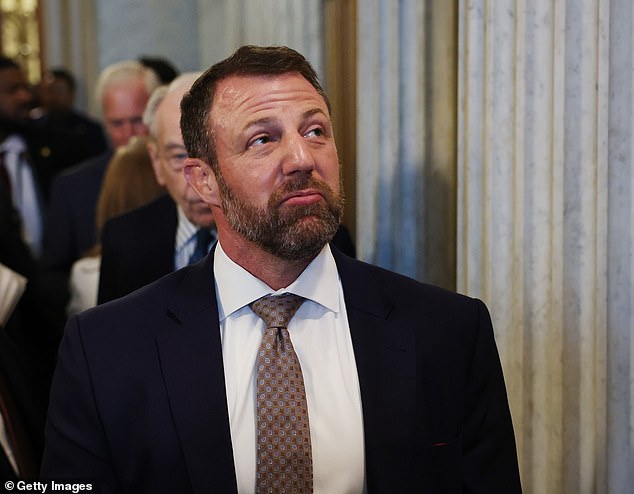

Donald Trump’s new pick for Homeland Security Secretary is one of the most prolific stock traders in Congress.
Over the past three years since becoming a Senator, Markwayne Mullin ranked 20th among all members of Congress when it comes to the volume of money he has in the stock market, according to Capitol Trades tracking of lawmakers’ stock activity.
In the last 90 days, Mullin ranks fifth among all lawmakers for trading activity.
And it’s likely due to an explosion in his portfolio activity a few days after Christmas and just weeks before it was announced he would replace embattled former DHS Secretary Kristi Noem.
His stock purchases are nearly certain to come under fire at his confirmation hearing on Wednesday with the Senate Homeland Security and Governmental Affairs Committee.
While there’s no definitive proof of insider trading, financial news site Finbold called his investments and their timing ‘suspicious.’ Specifically his up to $50,000 purchase of stock in Carpenter Technology, which produces alloys used in military aircraft and missiles, on February 4 – just one month before President Trump launched a war with Iran.
The Oklahoma Republican included in his January disclosure to Congress purchasing as much as $2.76 million on December 29, 2025 by investing in 31 different companies. This includes as much as $50,000 in Chevron, which is the only major US oil company producing in Venezuela.
This leads to another questionable timeline considering just five days after the purchase, Trump gave the green light for an operation to invade Venezuela, capture its leader Nicolas Maduro, extradite him to New York for prosecution and have the US take partial control of the country.

Senator Markwayne Mullin of Oklahoma is one of the most prolific stock traders in Congress with $24.25 million in trades over the last three years

This includes between $15,000 and $50,000 purchased in Chevron on December 28, 2025 – just days before President Donald Trump’s invasion of Venezeula
Mullin’s trading ramped up after he joined the Senate in 2023. His personal wealth in general has inflated substantially since he became a lawmaker in 2013 for an Oklahoma House district.
According to the New York Times review of his financial disclosure forms, Mullin’s assets and worth were assessed at between $29 million and $97 million in 2024. This was up from between $2.8 million and $9 million in 2012.
Congressional reporting rules only require lawmakers to provide ranges of wealth and assets, which is why there is such a broad potential of where Mullin’s wealth lands according to his own reporting.
Mullin purchased between $15,001 and $50,000 in Chevron shares at the end of last year, leading to questions over whether he was aware of impending action in Venezuela due to his admittedly frequent chats with Trump.
Trump after taking control in Venezuela demanded new leadership give better terms to US oil companies – and Chevron’s stock price skyrocketed in response despite an overall slip in the market.
While there is no indication Mullin, a member of the Senate Armed Services Committee, had inside knowledge of the administration’s plans to invade Venezuela ahead of the stock purchases, his financial activity will face fresh scrutiny this week as the Senate considers his nomination to head the highly controversial Trump Department of Homeland Security.
Perhaps one of the only remaining bipartisan measures these days is support for banning members of Congress from stock market activity due to their inherent knowledge that could easily lead to insider trading threats.
A Forbes analysis reported by multiple ethics groups found that lawmakers, spouses and their dependents reported more than 13,000 trades worth more than $600 million in 2025.
Reached for a comment, a spokesperson for Mullin’s Senate office told the Daily Mail that the senator ‘uses an independent, third-party operator firm that manages all stock investments on his behalf.’
‘This independent firm currently reports with Senate Ethics in compliance with federal law,’ they added. ‘If confirmed as the next U.S. Secretary of Homeland Security, Senator Mullin will act to ensure full compliance with all ethics and conflict of interest rules.’
Members of Congress are not prohibited from trading stock – even in industries they oversee as part of their committee duties.
Multiple bipartisan groups of lawmakers have tried to change that.

Trump announced in March his nomination of Mullin to replace embattled DHS Secretary Kristi Noem

Trump posted on March 5, 2026, that Mullin would replace Noem, who struggled to escape scandal after scandal during her one-year tenure
At least five bills have been introduced in the last year that would in some way restrict trading for members of Congress.
In January Democratic Senator Kirsten Gillibrand of New York and Republican Senator Ashley Moody of New York introduced the Restore Trust in Congress Act, which would altogether ban lawmakers and their immediate family members from trading or owning individual stocks.
This represents a proposal that has consensus from both parties following negotiations on how to handle the controversial issue. It has broad support.
Despite the public support and perceived congressional agreement, this bill has not gotten a floor vote because it remains stuck in committee. Historically congressional stock trading restrictions have face structural and self-interested hurdles in the chambers.
On the House side Republican Representative Bryan Steil of Wisconsin, Chairman of the House Administration Committee, introduced the Stop Insider Trading Act to ban members of Congress, their spouses and their dependent children from purchasing publicly traded stocks.
During his first State of the Union address of his second term, Trump earned a rare standing ovation from the Democrat side of the aisle when he championed passing Steil’s proposal to ‘ensure that members of Congress cannot corruptly profit from using insider information.’
‘They stood up for that. I can’t believe it,’ Trump said when this earned applause from Democrats but then stopped the bipartisan moment to single out former Democratic House Speaker Nancy Pelosi.
‘Did Nancy Pelosi stand up?’ he questioned before quipping: ‘Doubt it.’

California Democrat Representative Nancy Pelosi scowled at Donald Trump’s State of the Union on February 24, 2026
The California Democrat is one of the member of Congress who has faced the most scrutiny for her wealth accumulation and stock activity while serving as a lawmaker.
Primarily the stock activity involving her venture capitalist husband Paul Pelosi has come under fire from both parties and the public due claiming the couple potentially profited from insider information due to her high-level of access to legislative actions.
In 2021, Pelosi said: ‘We are a free-market economy. They should be able to participate in that.’
Finally in 2022 she announced support for bipartisan bans on individual stock trading to help boost public confidence in Congress. But critics say the delay in support allowed her family to continue accumulating wealth, which hit over $260 million by 2025.