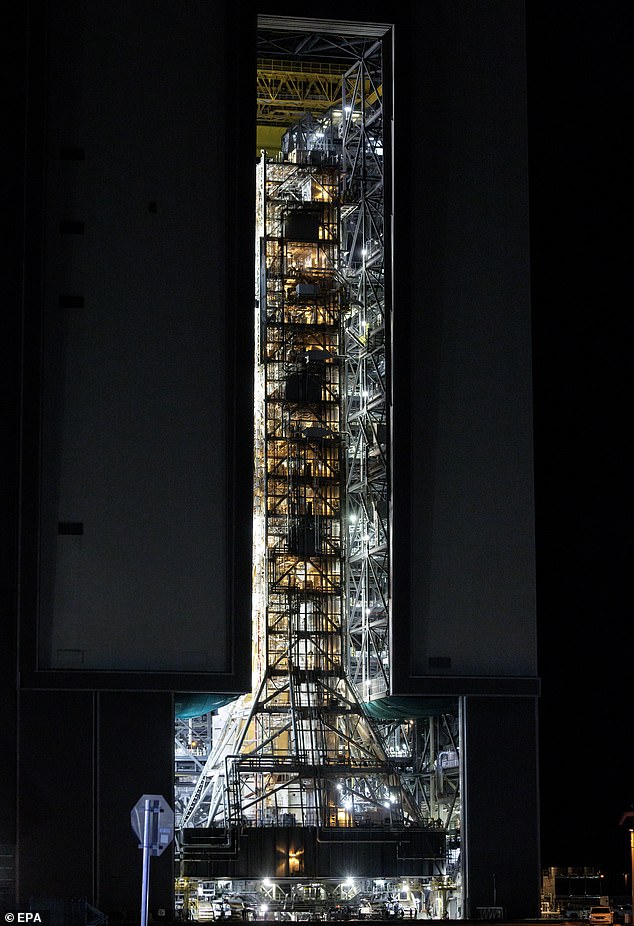

A historic moon mission edged closer to blast off today as NASA rolled out a rocket designed for its first manned lunar expedition in more than 50 years.
The Artemis II rocket began its move toward the launchpad at the Kennedy Space Center in Cape Canaveral, Florida.
The 10-day manned mission, which is set to launch as early as February 6, will be the first to travel around the moon and back to Earth since Apollo 17 in 1972.
NASA’s subsequent Artemis III mission will return humans to the lunar surface sometime in 2027.
The space agency said Artemis, ‘will send astronauts to explore the Moon for scientific discovery, economic benefits, and to build the foundation for the first crewed missions to Mars’.
The crawler-transporter 2 vehicle carried the Space Launch System (SLS) rocket and Orion spacecraft along a four-mile route from an assembly building to the launch pad – a journey that will take up to 12 hours.
Once at the launch pad, engineers will spend the next few days preparing SLS and Orion for a rehearsal test that includes loading all the propellants into the rocket.
NASA Administrator Jared Isaacman said the mission would fulfill ‘a promise to the American people that we will return to the moon’.

Pictured: Early in the morning on Saturday, January 17, NASA begins to move the Artemis II rocket out of the Vehicle Assembly Building at NASA’s Kennedy Space Center. Next month, it will be used for the first manned-mission to the moon since 1972

Pictured: The rocket will propel a four-person team, comprised of three NASA astronauts and an astronaut from the Canadian Space Agency, out of Earth’s atmosphere as soon as February 6

From L-R: Canadian Space Agency astronaut Jeremy Hansen stands alongside NASA astronauts Christina Koch, Victor Glover and Reid Wiseman. Wiseman will also serve as the mission’s commander. The group of four address reporters with the rocket and spacecraft directly behind them
Isaacman said the moon would be a ‘perfect proving ground’ for autonomous capabilities within spacecraft.
‘We talk about building a moon base. Now, day one of the moon base is not going to look like this glass-enclosed dome city that we might imagine some day,’ the billionaire entrepreneur said.
‘That’s certainly what the ideal end state would be. But it’s probably a lot of rovers that are moving around, a lot of autonomous rovers that are experimenting with mining, or some mineral extraction capabilities to start.
‘Naturally, in terms of what we want to achieve in space, you’re going to incorporate more autonomy in our robotic missions.
‘We’re looking at a mission to Venus right now that could have some onboard AI capabilities in it.
‘So this is the way we’re going to go. But I tell you, if humans are on a spacecraft, they’ll always have a vote, they always have a say in it.’
NASA astronauts Reid Wiseman, Victor Glover, and Christina Koch, along with Canadian Space Agency astronaut Jeremy Hansen, will man the Artemis II team. Wiseman will serve as the mission’s commander.
Hansen said the mission was ‘good for humanity’, adding that he had previously taken the moon ‘for granted’.

Pictured: The Artemis II rocket sits in the Vehicle Assembly Building prior to its move

Pictured: The Orion spacecraft sits atop the Artemis II rocket. The spacecraft will carry the astronauts to the moon and back

Pictured: NASA Administrator Jared Isaacman stands with the four astronauts during a press briefing
The Canadian former fighter pilot added: ‘But now I’ve been staring at it a lot more. And I think others are going to join us in staring at the moon a lot more as there are humans flying around the far side.’
Koch emphasized how important adaptability is for an astronaut, especially since none of them have been to the moon and its been decades since a mission like this has been undertaken.
‘This idea that, yes, you train and prepare for everything, but the most important thing is that you’re ready to take on what you haven’t prepared for,’ Koch said.
‘The moon is like a witness plate for everything that’s actually happened to Earth but has since been erased by our weathering processes and our tectonic processes and our other geologic processes.
‘We can actually learn more about solar system formation, more about how planets form maybe around other stars, more about the likelihood of life out there – starting with studying the moon.’
At the end of the mission, Orion will splash down in the Pacific Ocean, and the spacecraft and crew will be recovered with the help of the US Navy.