
NASA has completed an investigation into the 2024 Starliner fiasco that left two astronauts stranded in space for nine months.
The American space agency shared its findings on Thursday, labeling the incident a ‘Type A’ mishap, the most severe classification of mission failure. That puts Boeing’s 2024 test flight in the same category as the Challenger and Columbia disasters, which claimed a total of 14 lives.
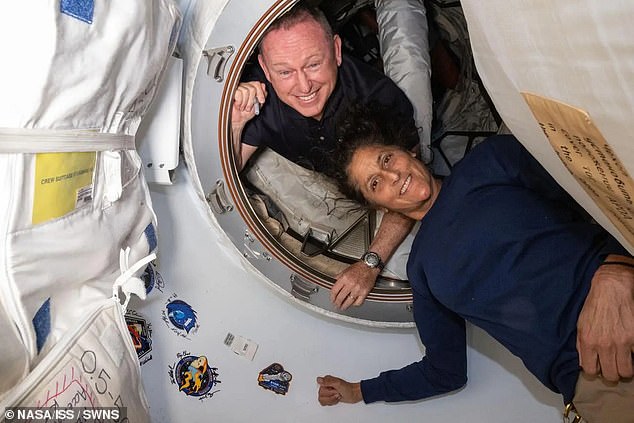
The Starliner launched Sunita Williams and Butch Wilmore to the International Space Station in July 2024 for what was intended to be an eight-day stay. However, the capsule malfunctioned, making it unsafe for human travel and forcing NASA to return it to Earth, leaving the astronauts stranded on the ISS.
NASA Administrator Jared Isaacman said: ‘Mistakes occurred from the program’s inception and continued throughout execution, including contract management, oversight posture, technical rigor and leadership decision making.
‘Boeing built the spacecraft, and from the onset, NASA approved variances and agreed to fly it. As development progressed, design compromises and inadequate hardware qualification extended beyond NASA’s complete understanding.’
The investigation found both technical and organizational issues that affected the mission’s safety and oversight.
Decisions and pressures before and during the flight contributed to a culture that sometimes prioritized schedule over caution.
After the mission, concerns about reputation delayed the formal declaration of a mishap, and the program initially conducted its own review.

The Starliner launched Sunita Williams and Butch Wilmore to the International Space Station in July 2024 for what was intended to be an eight-day stay
Starliner, developed under NASA’s Commercial Crew Program since 2010 to ensure continuous American access to low Earth orbit, faced a series of technical setbacks before its first crewed mission.
Early test flights, including Orbital Flight Test (OFT) 1 in 2019 and OFT-2 in 2021 and 2022, suffered guidance errors, thruster failures, and oxidizer valve malfunctions, with investigations often addressing only immediate causes rather than underlying issues.
The Crewed Flight Test in June 2024 encountered multiple propulsion anomalies, thruster failures, and a temporary loss of full control during docking operations.
The mission took place under the Biden Administration’s NASA.
Despite these challenges, the astronauts remained safe aboard the ISS, Starliner returned autonomously to Earth in September 2024 without crew, and Wilmore and Williams were later brought home safely by SpaceX Crew-9 in March 2025.
Variances in engineering are common across major aerospace programs, but NASA’s report found that Starliner’s qualification deficiencies made it less reliable for crew survival.
The agency acknowledged that it managed the contract, accepted the spacecraft, launched the crew and made critical decisions from docking through post-mission operations, placing a significant portion of responsibility on itself.
The investigation identified both organizational and technical factors contributing to the mishap, though the precise causes of the service and crew module thruster anomalies remain under review.

The American space agency shared its findings on Thursday, labeling the incident a ‘Type A’ mishap, the most severe classification of mission failure, and the same as the Challenger disaster (PICTURED)
NASA’s limited oversight left the agency without full insight into spacecraft systems, while Boeing’s propulsion design operated beyond safety qualifications. Additionally, NASA’s desire to maintain two competing crew transportation systems influenced risk and operational decisions throughout the mission.
Pre-launch, more than 30 scheduled attempts created schedule pressure and decision fatigue, and prior thruster risks were inadequately addressed.
On-orbit disagreements over crew return options led to unprofessional conduct, while advocacy for the Starliner program often overshadowed safety priorities.
Post-mission, despite a severe loss of control and costs far exceeding Type A thresholds, a mishap was not initially declared due to concern for program reputation, and the Commercial Crew Program first investigated itself.
The independent investigation concluded that these decisions were inconsistent with NASA’s safety culture.
The agency has now formally designated the flight a Type A mishap to ensure lessons are captured for future missions.
Officials emphasized that program advocacy had exceeded reasonable bounds, placing the mission, crew, and America’s space program at risk, and pledged leadership accountability to prevent such a culture of mistrust from recurring.