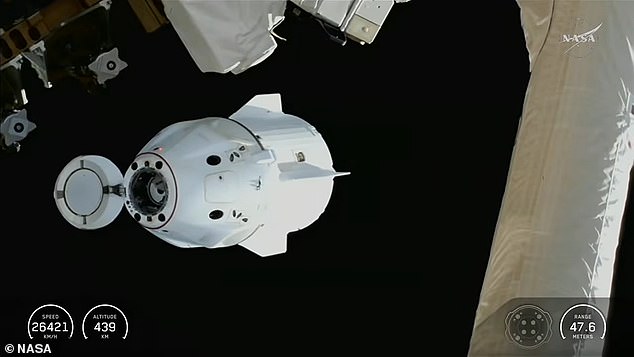

Four astronauts have successfully departed the International Space Station (ISS) in a historic medical evacuation that took less than a week to plan.
The SpaceX Dragon capsule undocked from the ISS at 5.20pm ET, beginning a roughly 10-hour space flight to their deorbiting point above the US early Thursday morning.
Less than 20 minutes after undocking, the capsule completed two engine burns to move the spacecraft away from ISS and outside of an area known as the ‘Keep Out Sphere,’ an imaginary safety perimeter around the station to protect it from collisions during docking and departures.
The capsule carrying NASA astronauts Zena Cardman and Mike Fincke, Japanese astronaut Kimiya Yui, and Russian cosmonaut Oleg Platonov is excepted to splash down off the coast of California around 3.41am on January 15.
The deorbit, scheduled for around 2.50am, involves firing Dragon’s engines briefly to reduce the capsule’s speed, slowing the craft down enough for gravity to take over and pull it back toward Earth.
The capsule will then reenter Earth’s atmosphere, deploying drogue parachutes followed by its main parachutes before splashing down at sea.
Officials for SpaceX and NASA said the entire deorbiting process will be handled automatically by the capsules computers.
Crew-11 were not set to return to Earth for another month, but one crew member suffered a serious medical issue on January 7, forcing the cancellation of a planned spacewalk.

The SpaceX Dragon capsule carrying Crew-11 undocked from the International Space Station at 5.20pm ET on Wednesday

Crew-11 entered the SpaceX Dragon capsule Wednesday afternoon, closing the spacecraft’s hatch at 2.29pm ET
While the astronaut who suffered the medical episode was not revealed, NASA’s chief medical officer Dr James Polk said they were in stable condition and was not in any immediate danger.
New NASA administrator Jared Isaacman decided to bring the crew home early out of an abundance of caution, noting that astronaut’s medical episode was considered ‘serious’ and would require additional medical care on Earth.
This is the first time a crew on board the ISS has had their mission ended early due to medical reasons.
However, Dr Polk noted that the astronaut’s medical condition had nothing to do with an upcoming spacewalk on January 8 that was cancelled or any other operations on board the station.
‘It’s mostly having a medical issue in the difficult areas of microgravity,’ Polk explained without going into specifics at a January 8 press conference.
Crew-11 arrived at the ISS on August 1, 2025, meaning their return date had been scheduled for late February.
The four astronauts were supposed to leave after Crew-12 arrived on a new SpaceX Dragon capsule no earlier than February 15.
Until their arrival, a group including NASA astronaut Chris Williams, who arrived at the ISS aboard a Russian Soyuz spacecraft in November 2025, will be maintaining the station.

Crew-11 before leaving the ISS. Roscosmos cosmonaut Oleg Platonov (Back left), NASA astronaut Mike Fincke (Front left), JAXA astronaut Kimiya Yui (Front right), and NASA’s Zena Cardman (Back right)

The SpaceX Dragon capsule (Pictured) which carried Crew-11 was docked at the ISS since August 2025
Isaacman said that any decision to potentially move up the launch of Crew-12 would not impact the upcoming Artemis II mission planned for February 2026.
He called the two launches ‘totally separate campaigns,’ meaning there should be no issue in launching Artemis on time. Artemis II will be the first manned spaceflight to orbit the moon since 1972.
Just 10 months ago, SpaceX and NASA carried out a historic rescue mission to retrieve astronauts Sunita Williams and Butch Wilmore, who had been stranded on the ISS for 286 days after their Boeing spacecraft Starliner malfunctioned.
A Thursday morning press conference has already been scheduled once Crew-11 returns safety to Earth.

Crew-11 completed two successful engine burns after leaving the station and exited the ‘Keep Out Zone’ around ISS roughly 20 minutes after departure on Wednesday
The evacuation followed NASA’s Spaceflight Human-System Standard, which mandates contingency return procedures whenever onboard medical resources are insufficient.
Although statistical models have long predicted that such an event could occur roughly once every three years, the plan has never before been used.