
Two days before the production October 7: In Their Own Words took the stage at the Kennedy Center, news broke that the last of the Israeli hostages held in Gaza had been returned. For the first time since 2014, there were no longer captives in Hamas custody. The headlines lent the Jan. 28 performance a sense of timely significance. What unfolded that night was not merely a theatrical event, but a collective act of remembrance and reflection.
The mood in the lobby before the performance felt less like a typical audience gathering and more like a solemn celebration. People hugged. They exchanged inside jokes: “It’s a small Jewish world out here in D.C.,” and spoke about family in Jerusalem, recent trips to Israel, and how those visits had changed them.
In attendance were Jewish and Israeli individuals with personal ties to the region, mixed with Christians who had traveled to Israel and followed the war closely and casual observers who were intrigued by the premise of a verbatim production. There was laughter, warmth, and a quiet sense of relief layered over grief.
Several audience members mentioned the hostage news as they took their seats. One Israeli woman said the timing gave her a sense of closure she would not have felt just days earlier.
This was no ordinary night at the newly named Trump Kennedy Center. This staging of October 7 came amid a wave of protests and withdrawals by artists unhappy with the venue’s new leadership. High-profile performers canceled appearances due to opposing the views of the center’s new leadership.
Since its off-Broadway premiere in New York, this production struggled to find permanent institutional backing. Major theaters declined to host October 7, and Broadway never opened its doors at all. Venues cited scheduling conflicts or outright rejected it, wary of the political and cultural backlash that now accompanies any work centered on Israeli victims.
Even in New York— a city whose theater culture was built in large part by Jewish artists and audiences— the play required continuous police presence throughout its run. Difficulty in finding a home has become part of the story itself. Yet this play still made its way onto one of America’s most prestigious stages.
Truth Without Political Instruction
Written by Irish journalists and husband-and-wife duo Phelim McAleer and Ann McElhinney, October 7 is constructed entirely from survivor testimony gathered in Israel weeks after the Hamas attacks in 2023. McAleer and McElhinney are known for creative work with stories corporate media won’t touch, such as a true-crime drama about an abortionist who kept body parts of his victims, Gosnell: The Trial of America’s Biggest Serial Killer.
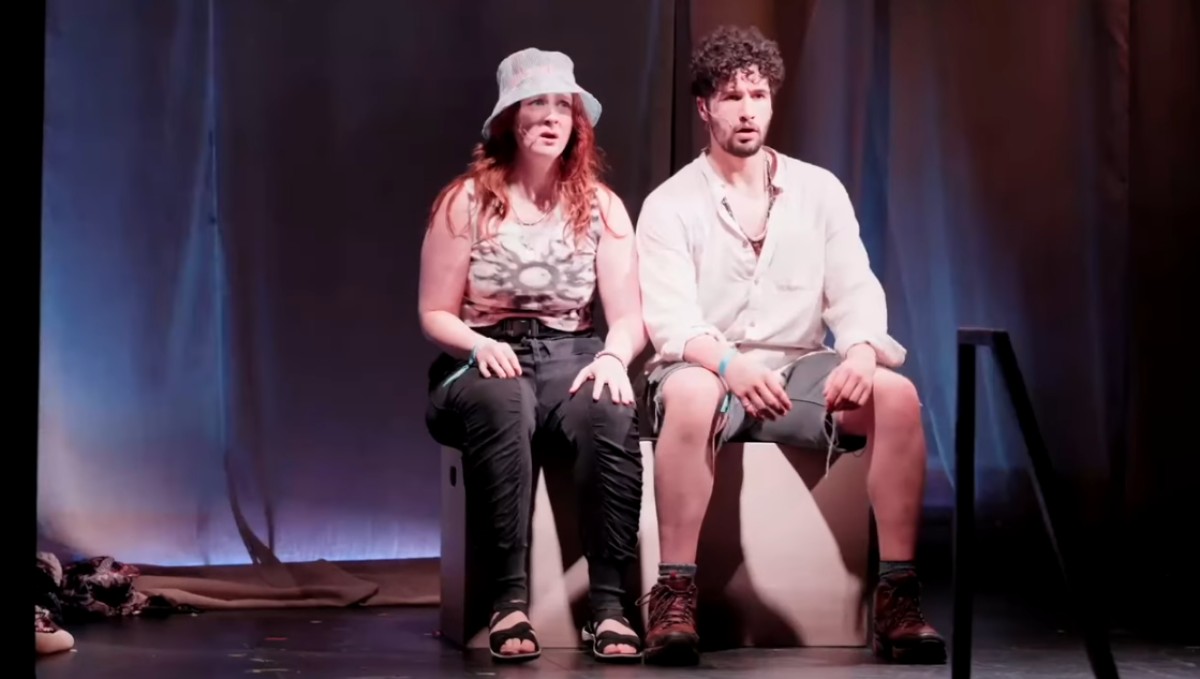
At the Trump Kennedy Center, October 7 was a dramatized reading, not a conventional play: no elaborate staging, no loud sound effects, no political innuendo. The words simply belong to those who lived through the day. The decision to present the play as a dramatized reading made it feel less like a production and more like a collective testimony.
At a time left-leaning theaters increasingly tell audiences what to believe, October 7 employs restraint. It does not tell the audience what to think about policy or politics. It asks only that they listen. McAleer has described the project as an attempt to prevent October 7, 2023, from being rewritten or forgotten. “Journalism is the first rough draft of history,” he noted.
The couple feared that day was already slipping into abstraction and argument rather than memory, starting on October 8. McAleer said they set aside personal politics and religion in order to let the testimony speak for itself: “We just wanted to show what October 7 did to these people.” He emphasized that truth in storytelling depends on showing human vulnerability rather than heroic polish.
Their faith encouraged this restraint. As Irish Catholics, they initially wondered whether they were the right people to tell an Israeli story. They came to believe they were because they approached the story as journalists and as believers in the dignity of testimony. One audience member went so far as to describe the playwrights as angels and divine messengers from God.
“Telling the truth is a political act nowadays,” McAleer said. This play’s “politics” lie in its refusal to manipulate or rewrite history.
The Emergence of Faith
What emerged most clearly during the play was not ideology or agenda, but faith. Again and again, characters describe moments of prayer they never expected to utter. “I never pray, but…” becomes a recurring refrain.
One survivor wonders aloud whether God protected her. Another says simply, “God was with me that day.” A religious man recounts breaking Shabbat to save lives, calling it “the most holy thing in our religion.”
In one of the most striking testimonies, a Muslim doctor rejects any attempt to tie Hamas’s violence to her religion. “Nothing connects me to those people,” she says. “Evil does not come from God.” She reframes the conflict not as Palestinians versus Israelis, but as something more elemental: people who love violence versus people who love kindness and peace.
Despite various degrees of religiosity, the individuals share a new sense of faith and identity born of catastrophe. A young woman who describes herself as a scientist—now serving as a medic—says she has begun keeping Shabbat. “I think I found faith,” she says. “God was with me that day.”
Another voice reflects: “This is a different country now.” Accordingly, the play ends not with despair but with a message of hope: “We are the tribe of light.” “This is the promised land of the people of Israel.” At the end, a final message of faith and perseverance rings throughout the auditorium: “We will dance again.”
Culture Under Pressure
That such a production requires heightened security—and has faced an uncertain welcome in our nation’s most iconic theaters—reveals as much about American culture as it does about the Middle East. A play composed of Israeli voices recounting a massacre has become controversial simply for existing. It is not accused of falsehood so much as of being inconvenient.
This is the context in which October 7 arrived at the Trump Kennedy Center: amid boycotts, resignations, and accusations of political capture. The nation’s center for performing arts has become a symbol for ongoing culture wars, with artists declaring they can no longer participate in a space they believe has shifted ideologically.
Still, this play was staged. Carefully. Under watch.
The audience seemed aware of the strangeness of that fact. The applause was not merely for the performers, but for the permission to remember.
A Night of Closure
The news of the hostages’ return transformed the meaning of the evening. What might have been only an act of mourning and remembering became something closer to a moment of renewal. Several audience members spoke of feeling, for the first time, that a chapter had closed.
But the play did not suggest the story has ended. On the contrary, it insisted October 7 remain part of public life. Not as rhetoric. Not as political talking points. But as memory.
In a cultural moment when even grief is often politicized, October 7 offered something rare: moral clarity without instruction, faith without propaganda, and testimony without shame. It did not demand allegiance to one side, but it certainly demanded attention.
In so doing, it reminded the audience—at the Trump Kennedy Center, under guard, just days after the last hostage came home—that truth still has a place on the stage, even when our culture is unsure what to do with it.
Juliana Sweeny is a mom, wife, and teacher in Loudoun County, Virginia, and PhD student at Liberty University.