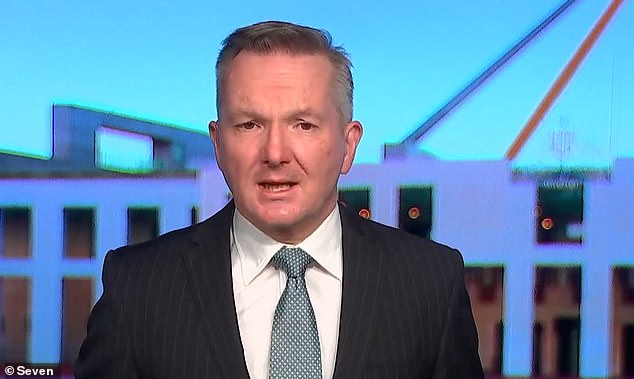

Energy Minister Chris Bowen has admitted that it may take days for prices to go down at the bowser after the fuel excise was halved.
Prime Minister Anthony Albanese announced on Monday his government would cut the tax paid on fuel as part of a four-point National Security Fuel Plan to battle price jumps triggered by the ongoing war in the Middle East.
Bowen urged motorists to be patient and not abuse service station staff if the fuel excise isn’t passed on in the coming days in the lead up to Easter
‘The fuel in the tank at the service station might have been there for days,’ he told Sunrise co-host Nat Barr on Tuesday.
‘They’ve already paid the tax on that fuel.
‘So if you turn up tomorrow and the price hasn’t gone down, it’s because they’re waiting for new fuel with the lower tax to arrive.
‘It’s really important we don’t yell at the person behind the counter — it will take a little while.’
Barr asked how long a ‘little while’ would be.
‘Days in the city areas, could be longer in regional areas,’ Bowen replied.
The fuel excise cuts come into effect from 12am Wednesday.
But Bowen struggled to give Barr a definite answer as to when motorists will see a 26 cent a litre drop at the bowser.
‘It’ll vary from station to station,’ he said.
‘City stations turn over fuel more quickly, regional ones more slowly.’
‘It could be real quick for some, but for others, it may take longer.’
The minister also addressed fears from everyday Aussies that they won’t be able to afford their mortgages if inflation and interest rates rise due to the fuel excise cuts.
‘I hear you, but this will help cut headline inflation,’ Bowen explained.
‘If you reduce petrol by 26 cents a litre, that eases cost pressures during this international crisis.
‘And remember — the food you buy at the supermarket is transported by diesel. If diesel is cheaper, that helps bring down food prices too.
‘Petrol and diesel are essential across the whole supply chain — not just for drivers, but for everything we buy.
‘There’s a war on. It’s having global economic impacts. We can’t stop the war — but we can shield Australians from the worst of it.’