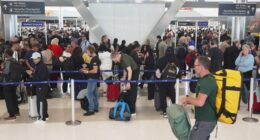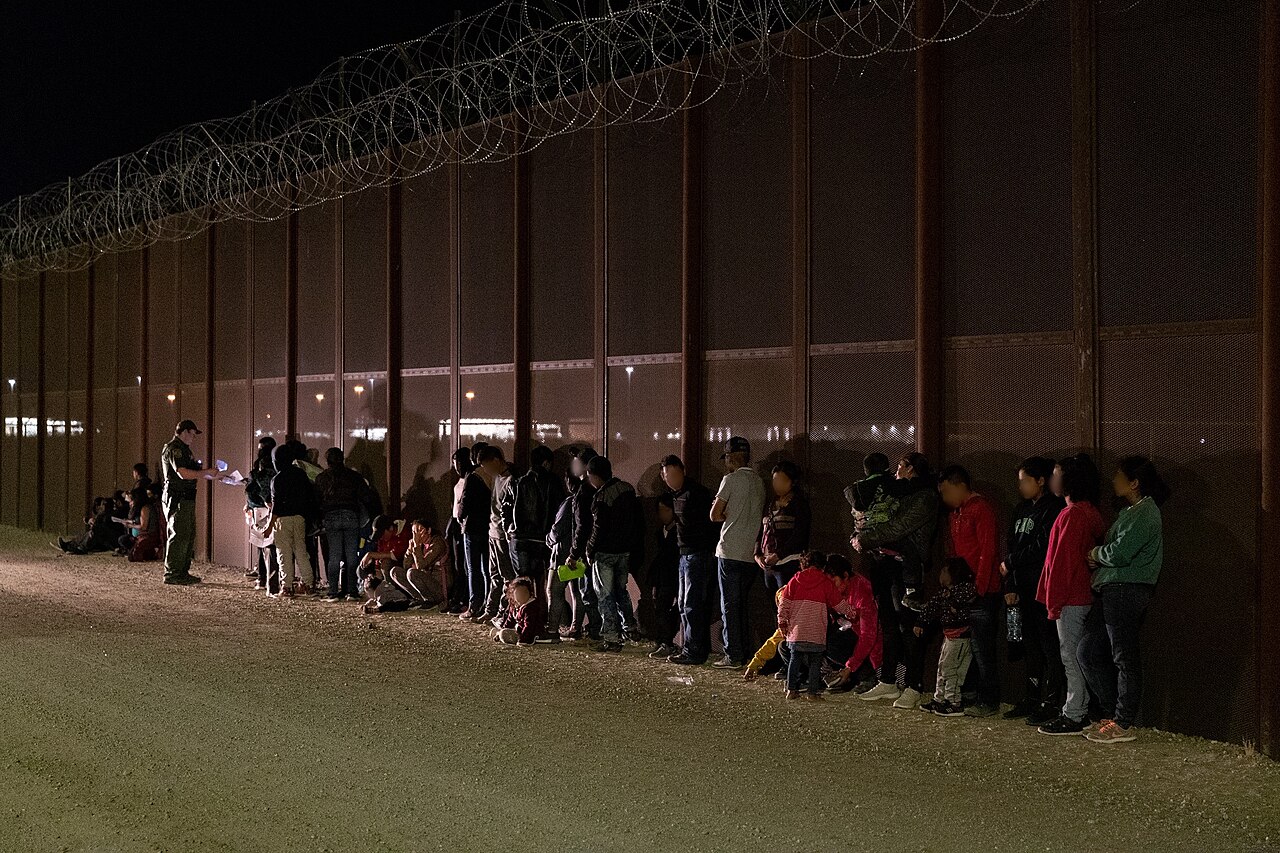
The U.S. Supreme Court is considering the legality of a border policy that’s played a key role in immigration officials’ efforts to stave off migrant surges at the U.S.-Mexico border.
The justices heard oral arguments on Tuesday in Noem v. Alt Otro Lado, which deals with a challenge to border officials’ now-inactive “metering” policy. As described by the Trump administration, the practice — which was initially implemented in 2016 and later formalized in 2018 — involves “port officials … stand[ing] along the border and temporarily prevent[ing] aliens without valid travel documents from crossing into the United States, generally telling them that they would need to return to the port of entry later, when there were sufficient resources to process them.”
The Trump administration appealed the case to SCOTUS after the 9th Circuit Court held that the policy violates provisions of the Immigration and Nationality Act that allow for an individual who “arrives in the United States” to apply for asylum and undergo inspection by an immigration official. The lower court argued that “the phrase ‘arrives in the United States’ encompasses those who encounter officials at the border, whichever side of the border they are standing on.”
Assistant to the U.S. Solicitor General Vivek Suri rejected that conclusion during Tuesday’s arguments. He contended that such a theory “is wrong for the simple reason that it defies the statutory text.”
“You can’t ‘arrive in the United States’ while still in Mexico. That should be the end of this case,” Suri said, while also citing SCOTUS precedent he argued supports the government’s position.
The administration’s attorney faced aggressive pushback from the court’s Democrat appointees — more specifically, Associate Justices Sonia Sotomayor and Ketanji Brown Jackson.
Sotomayor took issue with Suri’s response to a question from Associate Justice Clarence Thomas, in which he argued that metering does not “implicate” America’s treaty obligations as it relates to refugees and asylum issues. The Obama appointee’s repeated unwillingness to allow Suri to answer her long-winded questions prompted Chief Justice John Roberts to interject and ask that he finish his response.
In her questioning, Jackson expressed concern about the “practical implications” of the administration’s position “insofar as it suggests that a Congress that was authorizing asylum would be requiring people to break the law in order to obtain it” (i.e. that someone would have to enter the U.S. illegally before they could apply for asylum under the statute). She also seemingly suggested that the case should be deemed moot since metering isn’t currently being used.
Suri later got the chance to fully address Jackson’s first point when pressed on the issue by Associate Justice Brett Kavanaugh. The assistant to the solicitor general noted how metering only temporarily turns away an asylum seeker when a port of entry is overcrowded on a given day, and that “Congress could reasonably determine that the United States has greater responsibilities to aliens in the United States than to aliens in Mexico.”
(Kavanaugh would later pose a counter to Jackson’s framing in a question to the opposing side.)
Meanwhile, the court’s Republican appointees had their fair share of challenging questions for Alt Otro Lado’s attorney, Kelsi Corkran.
Citing a prior point made by Roberts about the fact that the statute uses the language “arrives in” instead of “arriving,” Associate Justice Amy Coney Barrett noted how “‘arriving’ sounds more ‘in the process of,’” and “‘arrives in’ sounds more like you’ve reached your destination.” She then pressed Corkran on how, under her theory, one is supposed to know “when the person is close enough that we could say … they have ‘arrives in’ or ‘arrived in’ the destination?”
“What if there’s a queue and they’re far back, or what if they arrive not at a port of entry? How close do you have to be to the border?” Barrett asked. “If it’s not crossing the physical border, what is the magic thing or the dispositive thing that we’re looking for where we say, ‘Ah, now that person we can say ‘arrives in’ the United States’?”
Conflicting rhetoric about the statute’s specific text is also an issue Associate Justice Samuel picked up on. In his questioning, the Bush 43 appointee chastised Corkran, Sotomayor, and Jackson for misrepresenting what the law actually says.
“It will be interesting to read the actual transcript of the oral argument because I believe that both you, and Justice Sotomayor and Justice Jackson, on several occasions, have used the phrase ‘arriving at.’ … But that’s not the term that is in the statute. Do you think that there is no difference between ‘arriving at’ a location and ‘arriving in’ the location?” Alito asked Corkran.
Kavanaugh suggested that the debate about “trying to figure out at the threshold on the [border] line” is “artificial” “because wherever the line is, the government’s presumably going to stop you on the other side of that line and prevent you from getting to wherever the line is.” He added that it seems the “bigger question” at issue is whether the government can “physically stop people before they get to whatever that line is no matter how we define it.”
Roberts and Associate Justice Neil Gorsuch also appeared skeptical of Corkran’s arguments.
A decision in Noem v. Alt Otro Lado is not expected until later in the court’s 2025-2026 term, which is slated to end in late June.
Shawn Fleetwood is a staff writer for The Federalist and a graduate of the University of Mary Washington. He is a co-recipient of the 2025 Dao Prize for Excellence in Investigative Journalism. His work has been featured in numerous outlets, including RealClearPolitics and RealClearHealth. Follow him on Twitter @ShawnFleetwood