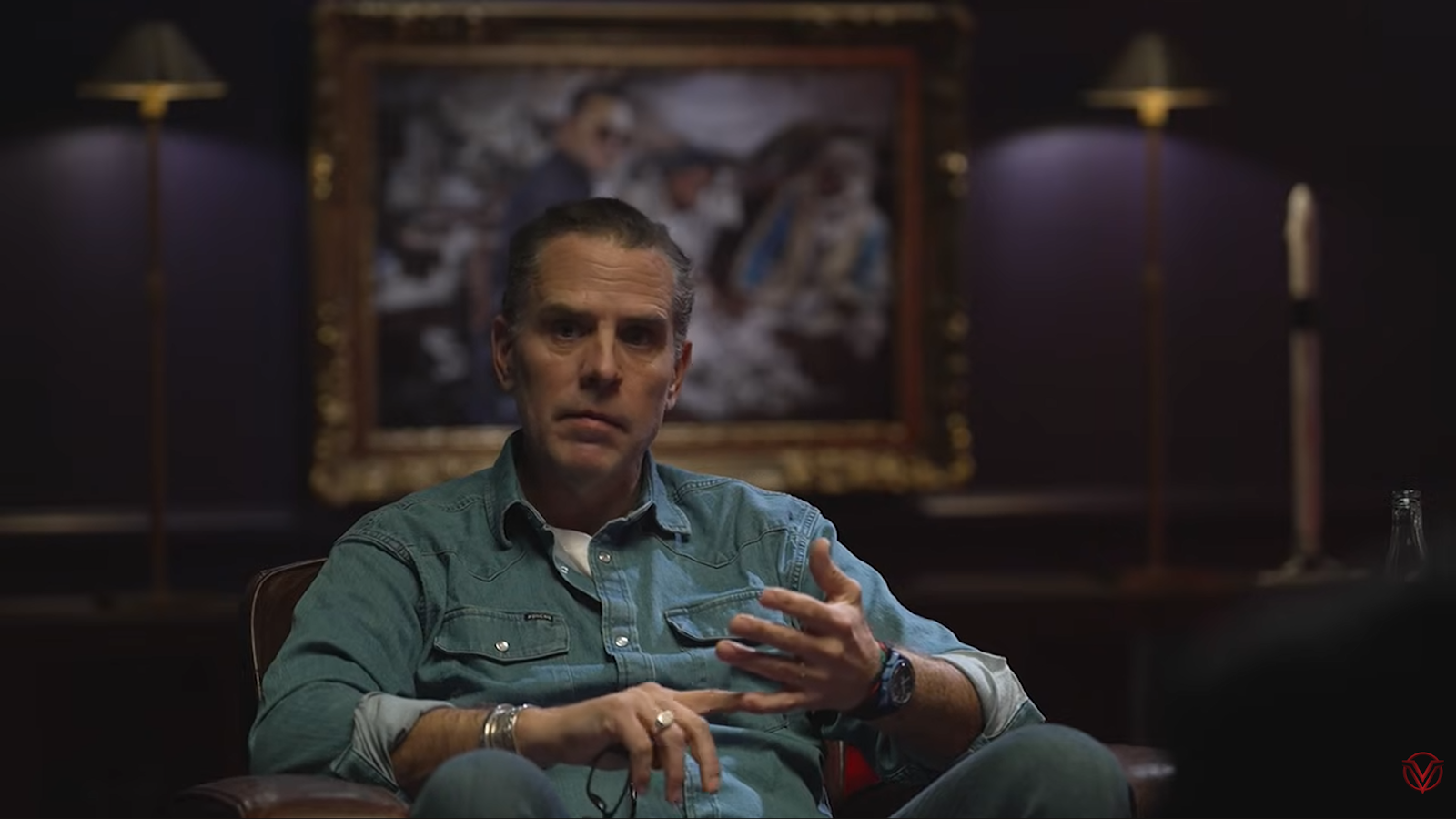
The U.S. Supreme Court heard oral arguments in a pivotal gun rights case on Monday. And oddly enough, it indirectly relates to former First Son Hunter Biden.
In U.S. v. Hemani, the justices considered the case of Texas resident Ali Danial Hemani, who was charged under a provision (18 U.S. Code § 922(g)(3)) of the 1968 Gun Control Act that prohibits a person who is “an unlawful user of or addicted to any controlled substance” from possessing a firearm. The charge came after federal authorities searched Hemani’s home on allegations of ties to a foreign terror group and discovered a pistol, 60 grams of marijuana, and 4.7 grams of cocaine. Hemani reportedly admitted to being a regular marijuana user.
The high court’s weighing of the contested provision’s legality is significant given that federal prosecutors also used it to indict Hunter Biden several years ago. While the gun charge and other tax-related charges were largely seen as a cover for obfuscating Joe Biden’s role in the Biden family business, Hunter — who argued the law was unconstitutional but was ultimately convicted — received a pardon from his father during the latter’s final days in office.
[RELATED: Please Let Hunter Biden Help Overturn Our Unjust And Unconstitutional Gun Laws]
Arguing in the law’s favor on behalf of the Trump administration, Principal Deputy Solicitor General Sarah Harris contended that the Second Amendment “does not prohibit the government from temporarily disarming habitual marijuana users while they persist in using frequently.” “That tailored restriction,” she claimed, “easily fits within the historical tradition of disarming categories of people who present a special danger of misuse.”
“That is no license for Congress to deem anyone dangerous. The government must show a historical analog that is relevantly similar and why and how it restricts Second Amendment rights,” Harris said. “Here, that’s habitual drunkard laws. Under historical vagrancy and civil commitment laws, habitual drunkards were imprisoned or confined without specific dangerousness findings based on judgments that habitual drunkards, as a class, threaten public safety.”
After taking questions from Associate Justices Clarence Thomas and Sonia Sotomayor about the founding era vagrancy laws and the contested statute’s applicability to homelessness, Harris was challenged by Associate Justice Neil Gorsuch about whether the habitual drunkard statutes she cited are “sufficiently analogous.” The Trump appointee noted how the “habitual drunkard” standard was very different from the founding era than it is today, and how several of America’s Founding Fathers drank large quantities of alcohol daily but were not considered habitual drunkards in their time.
“John Adams took a tankard of hard cider with his breakfast every day. James Madison reportedly drank a pint of whiskey every day. Thomas Jefferson said he wasn’t much a user of alcohol, he only had three or four glasses of wine a night. … Are they all habitual drunkards who would be properly disarmed for life under your theory?” Gorsuch asked, to which Harris said, “No.”
Gorsuch went on to steer the discussion back to Hemani’s case and his use of marijuana — which is federally illegal but is legal in some states — several times a week. He posed a hypothetical in which Hemani is a Colorado resident who was medically prescribed one cannabis gummy a day to help him sleep at night, and asked whether the federal government could potentially disarm him for life.
“I think the answer’s ‘yes’ under the government’s theory,” Gorsuch said, to which Harris admitted it could.
Picking up where Gorsuch left off, Associate Justice Amy Coney Barrett pressed the administration on its expansive interpretation of the law. The Trump appointee posed a hypothetical about a spouse who takes her husband’s prescribed Ambien — a controlled substance — and questioned whether that person would be considered dangerous and pursuable under the contested statute.
“[T]he example that I just gave you about the Ambien is important to me because it’s not the drug itself in this circumstance that’s causing the dangerousness. It couldn’t be because, if my husband has a prescription and I don’t, what is it about Ambien itself that would make one of us more likely to be dangerous? It’s not. It’s the lawfulness,” Barrett said. “And so too here with the marijuana, I just don’t see anything in the scheme that actually reflects Congress’s judgment that this makes someone more dangerous.”
Associate Justice Ketanji Brown Jackson also expressed skepticism about the government’s claims — specifically its definition of “habitual user.”
Meanwhile, Hemani’s attorney Erin Murphy argued that the “‘unlawful user’ prong of 922(g)(3)” cannot be constitutionally applied to her client or anyone else “because the statute fails to provide fair notice of what makes someone an unlawful user of a controlled substance who can be stripped of their Second Amendment rights.” But even if the statute “could be applied to Mr. Hemani consistent with due process,” she reasoned, “it could not be applied to him consistent with the Second Amendment.”
The government “cannot support disarming someone based solely on the fact that [he] consumes a few times a week something that Congress has designated a controlled substance,” Murphy said.
The greatest pushback to Murphy’s arguments came from Chief Justice John Roberts and Associate Justice Samuel Alito.
The chief justice probed whether Murphy’s argument would apply not solely to marijuana, but “to any drug, whether it’s PCP, methamphetamine, whatever.” He also appeared to express concern that such a stance would override “the judgment of Congress and the executive branch with respect to the listing of particular drugs.”
“It just seems to me that [your position] takes a fairly cavalier approach to the necessary consideration of expertise and the judgments we leave to Congress and the executive branch,” Roberts said.
Alito — a former federal prosecutor — was much more aggressive in his questioning. The Bush 43 appointee told Murphy that he was “puzzled by most of your argument,” and he probed the limits of her stance as it relates to Congress’s ability to regulate gun ownership for “dangerous” drug users.
“Suppose someone regularly takes a drug, and during the period when that person is taking the drug, that person is super dangerous. … The Second Amendment would not permit Congress to say that’s too risky?” Alito asked.
A decision in the case is not expected until later in the Supreme Court’s 2025-2026 term.
Shawn Fleetwood is a staff writer for The Federalist and a graduate of the University of Mary Washington. He is a co-recipient of the 2025 Dao Prize for Excellence in Investigative Journalism. His work has been featured in numerous outlets, including RealClearPolitics and RealClearHealth. Follow him on Twitter @ShawnFleetwood


![Longevity specialist Dan Buettner championed air-popped popcorn as 'the best longevity snack [that] might already be in your pantry'](https://citigist.com/wp-content/uploads/2025/07/The-best-snack-to-eat-if-you-want-to-live-380x200.jpg)