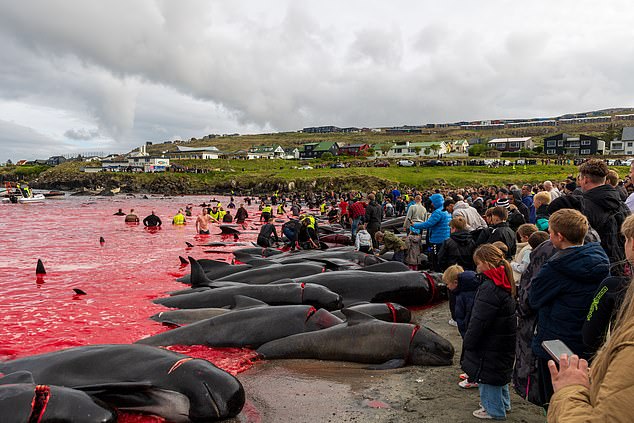

Hundreds of pilot whales have been slaughtered in the Faroe Islands as part of an annual tradition.
The coast of the North Atlantic archipelago was turned a disturbing crimson red as the blood of the animals stained the sea, with crowds including young children watching on.
The ‘grindadrap’, or ‘grind’ for short, is a Viking tradition that sees pilot whales and dolphins encircled and driven into shallow waters with boats.
The terrified animals are beached, and fishermen then brutally slaughter them with knives on the shore, with locals then eating their meat and blubber as part of the 1,000-year-old Faroese tradition.
But every summer, shocking images of the bloody hunt show the macabre ritual, which is strongly condemned by outraged animal rights defenders who consider the practice barbaric.
However, the Faroese state, which is an autonomous territory of Denmark, argues that the grindadrap is an integral part of the region’s cultural identity and the bodies provide free food for the community.
In some of the gruesome pictures of this year’s ritual, dozens of carcasses were lined up along the shorefront, with their blood seeping into the waves.
Fishermen could be seen wading up to their chests in the vibrant waters while fins poked out of the water.

The coast of the Faroe Islands was turned a crimson red as the blood of slaughtered pilot whales stained the sea, with crowds including young children watching on

The ‘grindadrap’ is a Viking tradition that sees pilot whales and dolphins encircled and driven into shallow waters with boats where they are then slaughtered by fishermen
Young children joined their parents to watch as the frenzy took place, with some even touching the bodies.
Although there are no official quotas in regards to the amount of animals slaughtered, previous figures have estimated more than 1,000 sea animals killed annually.
Last year, it is believed that 814 long-finned pilot whales and white-sided dolphins were killed.
In the wild, female long-finned pilot whales can live up to 60 years, whilst males can live up to 45 years.
Like all cetaceans – whales, dolphins and porpoises – long-finned pilot whales play a vital role in ocean ecosystems, helping to keep the oceans alive and thriving.
Breeding and mating usually takes place between April and September and a single calf is born every three to six years.
Older and non-reproductive females help care for the calves in the pod.