
Nothing puts a dampener on a trip to the seaside quite like a seagull stealing your chips.
From maintaining eye contact to wearing stripy clothes, experts have already come up with all manner of tips to keep the pesky birds away.
But a new study suggests the secret to getting rid of seagulls once and for all is much simpler – just shout at them.
Scientists from the University of Exeter tested a total of 61 gulls across nine seaside towns in Cornwall by placing a closed Tupperware box of chips on the ground.
Once a gull approached, they played either a recording of a man shouting the words, ‘No, stay away, that’s my food’, the same voice speaking those words, or the ‘neutral’ birdsong of a robin.
The researchers found that the birds appeared spooked when they heard the speaking voice.
However, they were most likely to fly away – and quickly – when the shouting voice was played.
‘When trying to scare off a gull that’s trying to steal your food, talking might stop them in their tracks but shouting is more effective at making them fly away,’ Dr Neeltje Boogert, a research fellow in behavioural ecology, said.

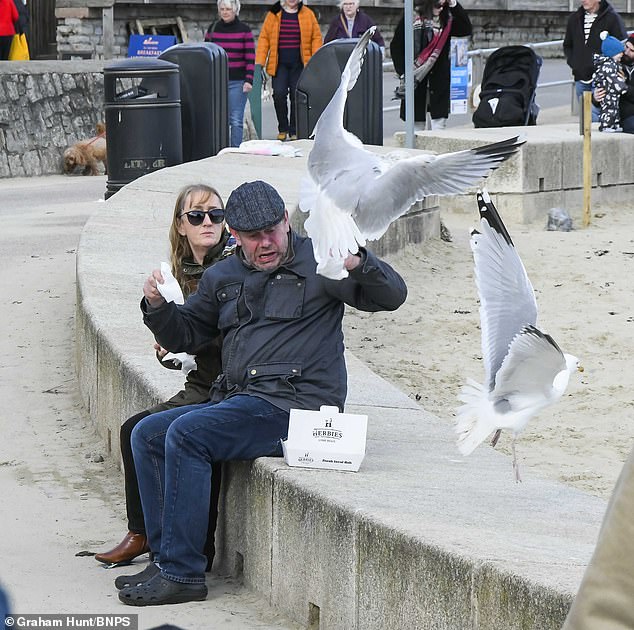
From maintaining eye contact to wearing stripy clothes , experts have already come up with all manner of tips to keep the pesky birds away. But a new study suggests the secret to getting rid of seagulls once and for all is much simpler – just shout at them. Pictured: Seagulls attacking a couple trying to enjoy their fish and chips on the esplanade at Lyme Regis

The researchers found that the birds appeared spooked when they heard the speaking voice. However, they were most likely to fly away – and quickly – when the shouting voice was played
Overall, half of the gulls exposed to the shouting voice flew away within a minute, the researchers found.
Only 15 per cent of the gulls exposed to the speaking male voice flew away, while the majority slowly walked away from the food, still sensing danger.
In contrast, 70 per cent of gulls exposed to the robin song stayed near the food for the duration of the experiment.
‘We found that urban gulls were more vigilant and pecked less at the food container when we played them a male voice, whether it was speaking or shouting,’ Dr Boogert said.
‘But the difference was that the gulls were more likely to fly away at the shouting and more likely to walk away at the speaking.’
The recordings, in which five male volunteers recorded themselves uttering the same phrase in a calm speaking voice and, separately, in a shouting voice, were adjusted to be at the same volume.
This suggests gulls can detect differences in the acoustic properties of human voices, the researchers said.
‘Normally when someone is shouting, it’s scary because it’s a loud noise, but in this case all the noises were the same volume, and it was just the way the words were being said that was different,’ Dr Boogert said.

The scourge of the seaside: A seagull steals a woman’s donut as she walks along Brighton seafront

Seagulls who heard shouting spent less time near the container filled with chips, while those that were played the sound of robins stayed the longest
‘So it seems that gulls pay attention to the way we say things, which we don’t think has been seen before in any wild species, only in those domesticated species that have been bred around humans for generations, such as dogs, pigs and horses.’
The study, published in the journal Biology Letters, was designed to show that physical violence is not necessary to scare off gulls.
‘Most gulls aren’t bold enough to steal food from a person, I think they’ve become quite vilified,’ Dr Boogert explained.
‘What we don’t want is people injuring them.
‘They are a species of conservation concern, and this experiment shows there are peaceful ways to deter them that don’t involve physical contact.’
Her previous work has revealed that seagulls find highly–contrasting patterns aversive, so wearing clothes with zebra stripes or even leopard print could help put them off.
Meanwhile the birds find the human gaze ‘aversive’ and are less likely to approach your food when you’re staring them down.
Further advice includes eating underneath a parasol, umbrella, roof, narrowly–spaced bunting or even with your back against a wall.
While many beachgoers find seagulls annoying, scientists from the University of Sussex actually say that the birds should be seen as ‘charismatic’ and not ‘criminal’.
‘When we see behaviours we think of as mischievous or criminal – almost, we’re seeing a really clever bird implementing very intelligent behaviour,’ Professor Paul Graham, Professor of Neuroethology at the University of Sussex told the BBC.
‘I think we need to learn how to live with them.’