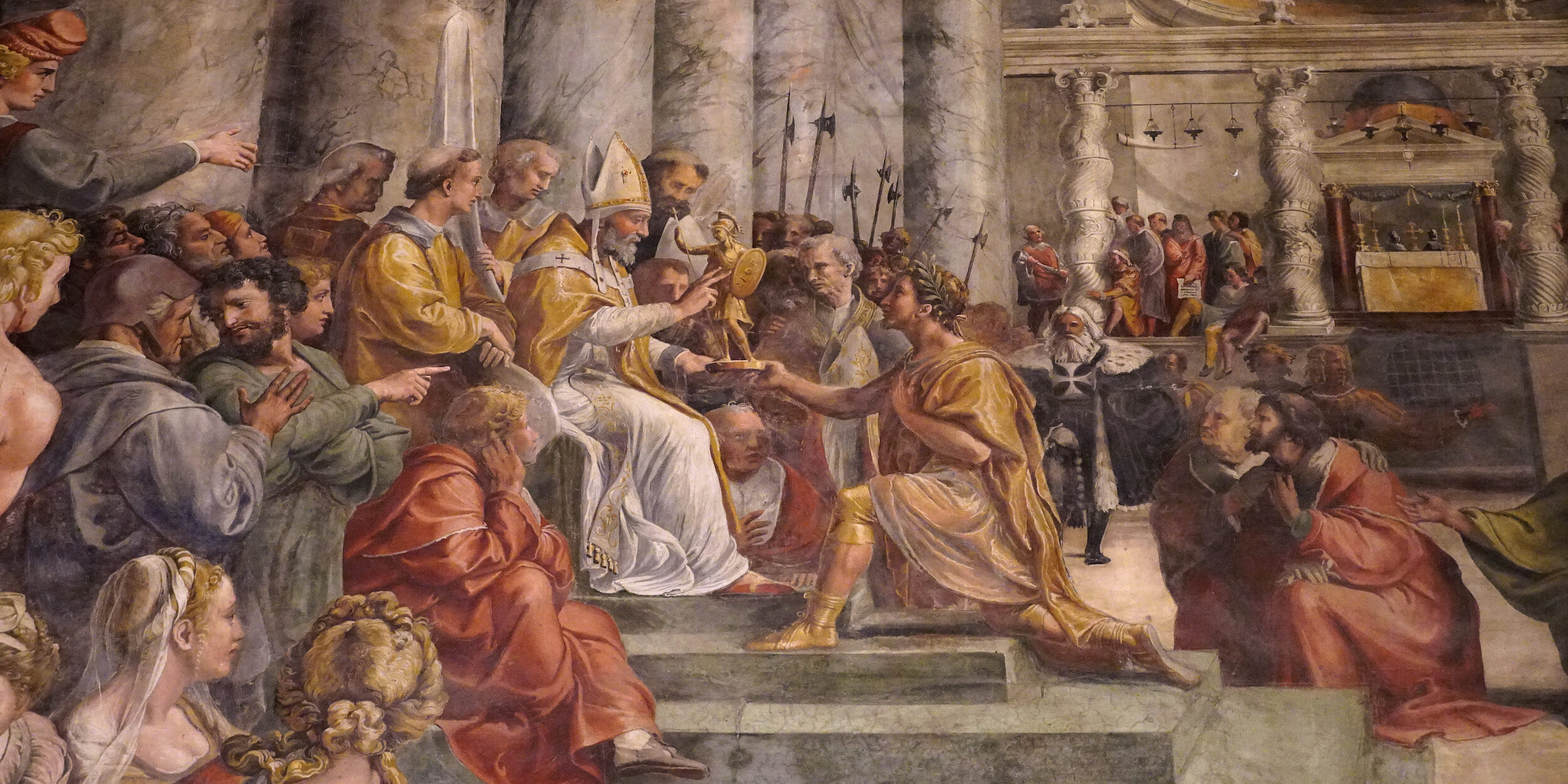

While you may mark December 31 on your calendar as New Year’s Eve or Hogmanay, in Old World nations such as Germany and Poland, the day is still known as Silvester, after the Feast of Saint Sylvester, which falls on the Seventh Day of Christmas.
(You may have noticed we did not mark the Sixth Day of Christmas—that’s because it’s kept clear for the Feast of the Holy Family, which falls on December 30 if there is no Sunday between Christmas Day and New Year to host it.)
St. Sylvester served as Pope from 314 to 335 A.D., during an era when the Roman Catholics, the Eastern Orthodox, and the Oriental Orthodox—if you’ve heard of the Coptic Pope in Egypt, that’s them—were united in a single Church, with the Protestant movement still over a thousand years into the future.
Significantly, St. Sylvester’s papacy began just one year after Emperor Constantine issued the Edict of Milan, which permanently ended the state persecution of Christians and permitted them to practice their faith openly. Perhaps still more significantly, St. Sylvester was the pope who approved the original version of the Nicene Creed, a text that remains the core profession of faith for Catholics, Orthodox, and the majority of Protestants to this day:
We believe in one God, the Father almighty, maker of all things visible and invisible; And in one Lord, Jesus Christ, the Son of God, begotten from the Father, only-begotten, that is, from the substance of the Father, God from God, light from light, true God from true God, begotten not made, of one substance with the Father, through Whom all things came into being, things in heaven and things on earth, Who because of us men and because of our salvation came down, and became incarnate and became man, and suffered, and rose again on the third day, and ascended to the heavens, and will come to judge the living and dead, And in the Holy Spirit.
But as for those who say, There was when He was not, and, Before being born He was not, and that He came into existence out of nothing, or who assert that the Son of God is of a different hypostasis or substance, or created, or is subject to alteration or change – these the Catholic and apostolic Church anathematizes.
Another famous Christmastime figure also played a role at the Council of Nicaea, where the Creed originated, was Saint Nicholas—better known today as Santa Claus—who, according to tradition, gifted the heretic Arius a lump of coal in the form of a physical slap when he denied the full divinity of Christ.
Many customs linked to Silvester have evolved significantly over time, but they often resemble modern New Year’s Eve celebrations, including fireworks to welcome the new year. Similar to Childermas, the day also lends itself to playful tricks; in Germany, for example, people share jelly donuts, though one or two may be sneakily filled with mustard instead of jam.
A Polish tradition especially appealing to housewives suggests there should be no household cleaning on Silvester, lest you “sweep away” your good fortune for the year ahead—a welcome break in the middle of Twelve Days that can demand quite a lot of work around the house.
Happy New Year!
Image by Slices of Light.
Join Pulse+ to comment below, and receive exclusive e-mail analyses.