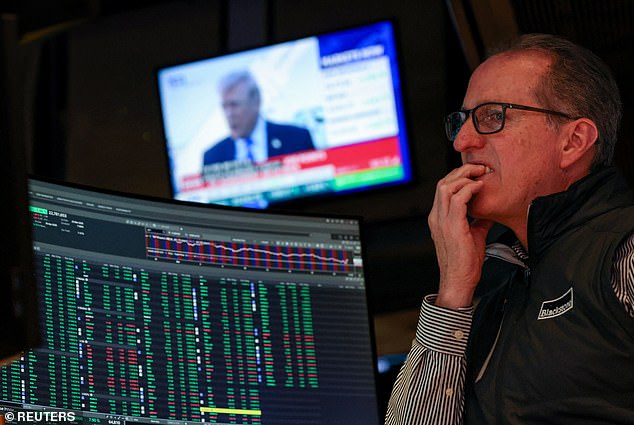

Stock and oil futures exploded in a sudden and unexplained burst of trading just minutes before President Donald Trump revealed a market-moving update on Iran on Monday morning.
At approximately 6:50am in New York, S&P 500 e-mini futures on the CME registered a sharp and highly unusual spike in volume, breaking from an otherwise quiet premarket session, reports CNBC.
At nearly the exact same moment, West Texas Intermediate oil crude futures also saw a sudden surge in activity, interrupting the typically subdued early-morning trading conditions.
Then, at 7:05am, roughly 15 minutes later, Trump posted on Truth Social that the United States had engaged in talks with Iran and that he was halting planned strikes on Iranian power plants and energy infrastructure.
S&P 500 futures surged more than 2.5 percent before the opening bell, while oil prices plunged, with West Texas Intermediate futures falling nearly 6 percent in the immediate aftermath.
The coordinated moves across equities and crude meant that anyone who had bought stock futures and sold or shorted oil contracts just minutes earlier would have locked in substantial gains.
It is that precise timing and the lack of any obvious public announcement before Trump’s post that has rattled traders and drawn scrutiny.
The sequence is now raising questions about whether someone may have acted on advance knowledge of the president’s announcement.

S&P 500 e-mini futures saw a sharp spike in volume at approximately 6:50am on Monday. West Texas Intermediate crude oil futures showed a similar surge in trading activity (file photo)

An LED sphere screen shows information inside the new location of the prediction market online platform Polymarket called ‘The Situation Room’, during its opening day last week

The trades were spotted by the X account Unusual Whales which specializes in tracking ‘unusual’ trading activity
The trades were spotted by the X account Unusual Whales which specializes in tracking ‘unusual’ trading activity.
‘Just five minutes before Trump’s announcement to halt the attacks on Iran, massive trades reportedly hit the market. In one move, $1.5 billion in S&P 500 (ES) futures was bought while $192 million in oil (CL) futures was sold,’ the account stated.
‘These orders were 4–6x larger than anything else at the time. The trader seemingly made huge gains. Unusual.’
Early-morning futures markets are typically thinly traded, meaning large orders can stand out more dramatically than during regular hours – but it was the size and coordination of the trades, across two major asses that appeared striking.
The US Securities and Exchange Commission and CME Group have not commented on the activity.
Some analysts cautioned that algorithmic or macro-driven trading strategies can generate sudden flows without a clear headline trigger.
Still, the pattern of a burst of aggressive positioning immediately followed by a major geopolitical announcement, has intensified speculation that certain traders may have been informed ahead of the news being made public.
That suspicion is now being amplified by parallel activity in the fast-growing world of prediction markets, where bets on geopolitical events are increasingly drawing scrutiny.
Join the debate
Do YOU think markets moving before Trump’s Iran post raises serious questions?

At 7:05am Donald Trump posted on Truth Social about US-Iran talks and halting planned strikes. S&P 500 futures rose more than 2.5% following the announcement. Oil dropped 6%

Shayne Coplan, pictured, is the CEO and founder of Polymarket, the platform on which the lucrative bets were placed

Traders who bought equity futures and shorted oil beforehand would have profited significantly
On the crypto-based platform Polymarket, a cluster of newly created accounts placed unusually large wagers over the weekend on the likelihood of a US-Iran ceasefire.
Eight accounts, all reportedly created around March 21, collectively staked nearly $70,000 on a ceasefire occurring before March 31.
If successful, those bets could return close to $820,000.
The timing of those wagers raised eyebrows among analysts, particularly because they coincided with shifting signals from Trump who in recent days has alternated between escalating rhetoric and suggesting he might ‘wind down’ military operations.
Ben Yorke, a former researcher with CoinTelegraph who now works on an AI trading platform, said the activity showed characteristics that can be associated with insider knowledge.
The wallets ‘definitely [look like] someone with some degree of inside info,’ Yorke said to The Guardian pointing to the pattern of bets and the apparent splitting of positions across multiple accounts.
Such ‘wallet-splitting,’ he explained, can sometimes indicate an attempt to conceal the size or identity of a single investor.
‘Typically, when you see wallet-splitting and deliberate attempts to obfuscate identity, it’s one of two scenarios: either a very large investor trying to shield their position from market impact, or insider trading,’ Yorke said.

Kalshi CEO Tarek Mansour has said previously his online prediction market is more accurate than opinion polls
Join the debate
Do sudden market swings before major political updates suggest insider trading – or just smart trading?
Polymarket accounts are anonymous, making it extremely difficult to trace who is behind specific trades.
Adding to the intrigue, a separate account that previously bet on US strikes against Iran and won had also been created shortly before that event and has reportedly placed no other wagers.
Meanwhile, the platform’s own implied probability of a ceasefire surged from just 6 percent on March 21 to 24 percent by Monday, with more than $21 million now riding on the outcome.
Prediction markets like Polymarket and Kalshi have rapidly become a new frontier in geopolitical speculation, allowing users to wager on everything from military actions to diplomatic agreements.
But the features of speed, anonymity, and global access that make them attractive, also make them difficult to police.
Recent reporting has highlighted concerns that such platforms could be used to profit from non-public information tied to sensitive events, including military operations and diplomatic negotiations.
Even so, insiders caution that having advance knowledge may not guarantee success in this particular market.
The Polymarket contract requires formal confirmation from both the US and Iranian governments that a ceasefire has been reached – a high bar that introduces uncertainty even for well-informed traders.