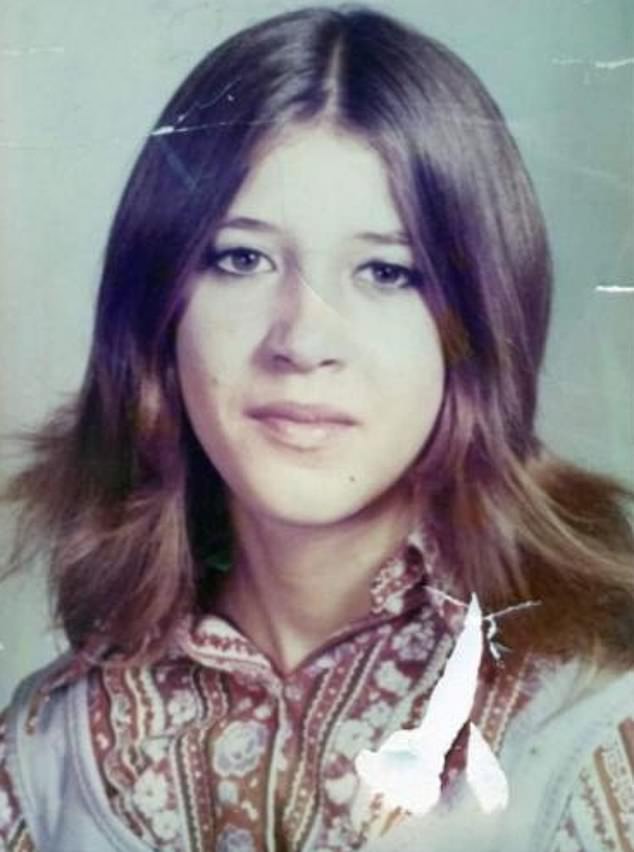

Notorious serial killer Ted Bundy has been identified as the murderer of a teenage girl who vanished on Halloween night more than half a century ago.
Laura Ann Aime, 17, disappeared on October 31, 1974, while staying with friends.
Around a month later on November 27, 1974, her naked body was found in an embankment near American Fork Canyon Road in Utah.
For decades, her murder was linked to Bundy, with the serial killer giving a deathbed confession to killing Aime and at least 29 other victims before he was sent to the electric chair in January 1989.
But, her case remained unsolved for the next 37 years, with investigators needing more evidence to close the investigation once and for all.
That evidence finally arrived in the way of a breakthrough in DNA evidence last month.
In a press conference on Tuesday, Utah County Sheriff Mike Smith announced that advanced DNA testing of bodily fluids found on the victim had proven Bundy to be the killer once and for all.
‘Although Bundy did claim that he committed the murder of Laura, the confession he gave was deemed to be not enough evidence to close the case and rule out any other party having had committed this crime, as had been speculated at the time,’ Smith said.

Laura Ann Aime, 17, disappeared on October 31, 1974, while staying with friends. She has now been confirmed as a victim of Ted Bundy

Serial killer Ted Bundy in the courtroom at his murder trial where he represented himself
‘Fortunately, we have had new forensics techniques become available through our partnership with the Utah Department of Public Safety crime lab that made the closure of this case possible.’
The advanced DNA technology was able to separate mixed DNA profiles found on the victim to identify a single male profile. That profile was then found to be a match to a profile on file in Florida. That profile was Bundy.
‘This case is now officially closed,’ Smith said.
Aime’s sister Michelle Impala, who was just 12 when her sibling was murdered, said it was ‘amazing’ that people were still interested in solving her case after all this time.
She said her sister would be ‘really happy to know’ that her case was no longer cold.
The investigators hinted that this was only the beginning of a new push to solve cold cases linked to one of the most prolific serial killers in American history.
Sgt Mike Reynolds said that, through this case, Bundy’s full DNA profile is now on file and can be used by law enforcement agencies across the country for comparison.
One other case linked to Bundy is already close to being solved, he added.
Over a four-year reign of terror from 1974 to 1978, Bundy murdered at least 30 women across seven states.
And those are only the murders he confessed to.

Photo of evidence gathered by police in one of the cases against Ted Bundy. The serial killer confessed to killing 30 victims

Florida State University’s Chi Phi fraternity celebrates the execution of Ted Bundy with a large banner that says ‘Watch Ted Fry, See Ted Die!’
The true extent of his crimes – and how many years he preyed on women – will likely never be known.
Aime’s murder came just days before he attacked Carol DaRonch – a botched kidnapping that first landed him on law enforcement’s radar.
When DaRonch managed to escape and identify Bundy as her attacker, he was arrested and convicted of aggravated kidnapping.
While serving his sentence, he was transferred to Colorado to face charges for the 1975 murder of nurse Caryn Campbell but managed to escape by jumping out of the window of a courthouse law library and going on the run.
He hid out in the mountains for several days before he was recaptured.
Back behind bars in another jail in Colorado, Bundy then managed to escape a second time on December 30, 1977.
Within two weeks of that latest jailbreak, the man who was then placed on the FBI’s Ten Most Wanted list had made it all the way to the East Coast.
It was there, in the early hours of January 15, 1978, that he broke into the Chi Omega sorority house at Florida State University in Tallahassee and went room to room, attacking young women as they slept in their beds.
He murdered two students Margaret Bowman and Lisa Levy and left Karen Pryor and Kathy Kleiner seriously wounded before fleeing to an apartment a few blocks away where he attacked another student Cheryl Thomas.

Ted Bundy in Leon County jail in Tallahassee, Florida, in July 1978 after being charged with the murders of two Chi Omega students

A woman looks out of the second story balcony of the Chi Omega sorority house on January 15 1978 – hours after Bundy broke in and went on a violent rampage
Around a month later, Bundy was captured for the final time. By then, he had claimed the life of another victim, 12-year-old Kimberly Leach.
During a high-profile trial that captured the nation’s attention, the serial killer – who had studied law at the University of Puget Sound and the University of Utah – represented himself, forcing his surviving victims to endure cross-examination by the man who had almost killed them.
On July 24, 1979, he was found guilty of the murders of Levy and Bowman, as well as the attempted murders of Pryor, Kleiner and Thomas and burglary.
Days later on July 31 – Pryor’s birthday – he was sentenced to death.
After sitting on death row for a decade, on January 24, 1989, Bundy was strapped to the electric chair in Florida’s state penitentiary and executed.
His final words were: ‘I’d like you to give my love to my family and friends.’