
Pentagon officials are privately whispering fears that a drawn-out conflict with Iran will drain US air defense munitions and open up American forces to drone attacks.
President Donald Trump has said he expects his offensive on Iran to last ‘four or five’ weeks, but the military is prepared to go ‘far longer.’
Military insiders say that dragging out the war could pose a major issue for the United States as ammunition is rapidly drained.
A source told the Daily Mail that the largest ‘concern’ among top brass in the days since the war started was that it will ‘spillover into a larger regional conflict.’
That’s because the US is rapidly draining its missile supply and defense systems.
‘I think we’re all concerned about the possible casualty number,’ the military official stated. So far, six US service members have been confirmed dead as part of Trump’s Operation Epic Fury.
Amid reports of ‘paranoid’ leadership in the Department of War, the official said that ‘increased force protection measures’ went into effect.
That includes the disabling of mobile location tracking on all soldiers’ devices, among other measures.
A former high-ranking military official told the Daily Mail that the main issue of a dragged-out conflict is the rapidly declining number of bespoke, expensive interceptor missiles used by the US, and Iran’s vast quantity of cheap Shaheed drones.

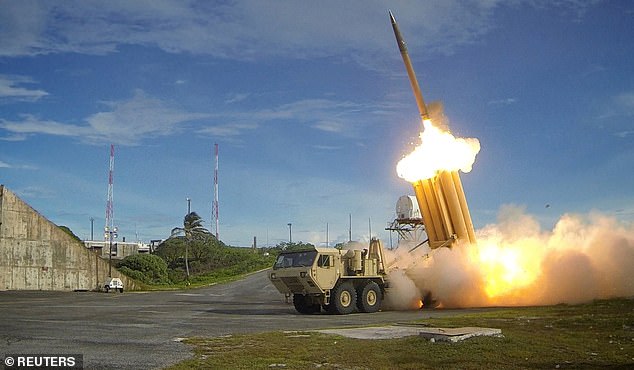
Among the most vital pieces of weaponry in the US arsenal is the Thaad antimissile system, which are stationed across the globe to monitor and track potential incoming missiles. US officials are warning that a prolonged conflict could threaten interceptor stockpiles
The US military uses the Patriot missile system to defend against cruise missiles, ballistic missiles, and drones.
‘I assume Iranians will sponge up all of our Patriot missiles and when expended launch 1,000 Shaheed-136s,’ one former high-ranking military official told the Daily Mail.
The military also uses the Terminal High Altitude Area Defense (THAAD) system, which has a longer range than the Patriot system, to intercept incoming strikes.
But since it is cheaper and quicker for Iran to mass-produce Shaheed-136 drones used to attack US bases, it is a concern.
The fear of running out of interceptors has prompted a race against time to destroy Iran’s missile capabilities before the US uses all of its supply to fend off retaliatory strikes.
The former senior military official added that the Iranians will ‘continue to deplete our magazines.’
And they said a new wave of Shahed attacks will occur ‘when our high-tech defenses are exhausted.’

A Department of War map entitled, Operation EPIC FURY Timeline – First 100 Hours
It’s a terrifying reality for officials on the ground working to ensure the safety of US troops. Shaheed drones reportedly cost around $35,000 per unit, while each Patriot interceptor costs around $4 million and each THAAD interceptor around $13 million.
Tomahawk missiles cost upwards of $2 million apiece; gravity bombs deliver a comparable punch for roughly $25,000 per unit, though they require total air superiority to be deployed within range.
Hegseth said Wednesday that the military has started launching ‘laser-guided precision gravity bombs.’
‘Now with complete control of the skies, we will be using 500-pound, 1,000-pound and 2,000-pound GPS and laser-guided precision gravity bombs of which we have a nearly unlimited stockpile.’
Despite Hegseth’s assurances about US capabilities, the asymmetric cost and speed of production is a concern among military officials.
‘I guarantee you the logisticians are sh***ing themselves about diminishing air defense missile stocks,’ said the official.
Trump and his advisers don’t appear to be worried as ammunition rapidly declines.
The US has ‘a virtually unlimited supply of these weapons,’ he said in a post to Truth Social on Monday.
He wrote that the US has plenty of ‘medium and upper medium’ grade weapons in supply; however, he admitted in the same post that the US is ‘not where we want to be’ when it comes to ‘high grade weaponry.’
Hegseth said on Wednesday that the US had opened the campaign with ‘exquisite standoff munitions,’ sophisticated long-range weapons designed to strike from beyond the reach of enemy air defenses.
He said those munitions were no longer needed, pushing back at reports of stretched supplies with the assurance that ‘our stockpile of those remains extremely strong.’

Two Patriot missile batteries deployed in Israel. The batteries are used by US allies across the globe, including in Israel and Ukraine

Secretary of War Pete Hegseth held a briefing on Monday morning to explain the US strategy for the next phase of the conflict. He noted how the US wants to destroy Iran’s missile program and Navy and ensure they cannot create a nuclear weapon
Still, the military official told the Daily Mail that the Pentagon covertly and rapidly deployed assets to the region to prepare for a prolonged campaign.
‘The Defense Logistics Agency took steps over the past few weeks to ensure a sustained air campaign could be carried out longer than previously estimated by Iranian Intelligence,’ the military source told the Daily Mail.
And there are reports that the largest military contractors – including Lockheed Martin and Raytheon – will meet at the White House on Friday to discuss weapons productions as munitions decline.
The US and Israel have conducted strikes hitting over 2,000 targets on Iranian assets since Saturday, resulting in the death of Iran’s longtime leader, Ayatollah Ali Khamenei and scores of other top Iranian officials.
In response, Iran has launched massive rocket salvos at US military bases across the Middle East, Israel, the United Arab Emirates, Kuwait, Bahrain, Qatar, Jordan, and other targets.
The retaliation has forced the US and its allies to expand their anti-missile systems.
The number of THAAD and Patriot interceptor munitions in the US’s stockpile is a closely guarded secret.
Lockheed Martin, the manufacturer of both systems, announced earlier this year that it would drastically increase THAAD and Patriot interceptor production.
The firm said in January that it would increase production of Patriot missile interceptors from around 600 annually to 2,000. The company also said it would increase production of THAAD interceptors from 96 annually to 400.
Though the US arsenal contains other interceptor systems, the Patriot and THAAD systems are seen as the most bespoke and effective.

Massive explosions and air raid sirens have erupted over Tel Aviv as Iran launches surgical missile strike in retaliation to a joint Israeli-US strike on Iranian territory early Saturday morning

The US-made THAAD system has been deployed across the Middle East in preparation for any potential attack. It has a maximum range between 93 and 124 miles and takes nearly 100 soldiers to operate.
A Patriot missile battery has a range of around 100 miles and similarly requires around 90 soldiers to operate.
Over the past decade, from 2015 to 2024, Lockheed Martin produced 270 Patriot interceptors on average, according to an analysis from the Center for Strategic and International Studies (CSIS).
Kelly Grieco, a senior fellow at the Stimson Center think tank who used to teach at the Air Command and Staff College, told the Wall Street Journal that with more strikes and interceptions likely, the size of the US stockpile may become a factor.
‘One of the challenges is you can deplete these really quickly,’ Greico said. ‘We’re using them faster than we can replace them.’
Another insider told the Washington Post: ‘I don’t think people have fully absorbed yet, like, what that has done with stockpiles.’
The person added that it typically takes two or three US interceptors to guarantee that Iran’s missiles are stopped.

Rocket trails from an interception by Israel’s Iron Dome missile defense system are pictured over Jerusalem on March 1, 2026. The Iron Dome has been critical to Israel’s anti-missile and anti-drone defense

Trump exiting the driver seat of a THAAD mobile launcher in July 2019
‘The mood here is intense and paranoid,’ an insider told the Washington Post, adding there is concern the conflict ‘could spiral out of control.’
Another source told the Daily Mail that the mood within the Pentagon is unchanged from before the conflict.
They argued there is no significant concern about additional casualties, with one major exception.
‘Now if there’s a move for boots on the ground in the area, that could change. But so far, the small number of casualties is less than what we would expect for such a significant operation.’
The Pentagon did not respond to the Daily Mail’s request for comment on US air defense stockpiles.