Two sadistic crimes that were the stuff of nightmares.
Two reigns of terror over California.
Two of the most notorious cases in history left unsolved for more than half a century.
But now, after all this time, one suspected killer is unmasked.
In a world exclusive, the Daily Mail can reveal that a new investigation has concluded that the Zodiac killer and the murderer of the Black Dahlia were the same man.
The FBI and California police departments are reviewing the explosive theory – and a trove of damning evidence has been unearthed by independent investigators and is undergoing forensic analysis.
If the evidence passes scrutiny, it would mean that two of the world’s biggest murder mysteries will finally be solved.
Between 1968 and 1969, the Zodiac killer terrorized northern California, murdering at least five victims while claiming to have slaughtered dozens more. The phantom taunted the media and police with letters and ciphers, daring the public to unravel his identity.
Two decades earlier in 1947, another slaying cast a shadow of fear over the state.
Aspiring Hollywood actress Elizabeth Short, who became known as the Black Dahlia, was found dead near a lovers’ lane in Los Angeles. Her body had been mutilated – severed clean in half at the waist, with a grotesque smile carved into her cheeks.
Now, after more than a half-century of mystery, countless law enforcement and amateur investigations, unsuccessful attempts to harness DNA testing, and the world’s brightest codebreaking minds left defeated, investigative consultant Alex Baber believes he has finally solved both cases.

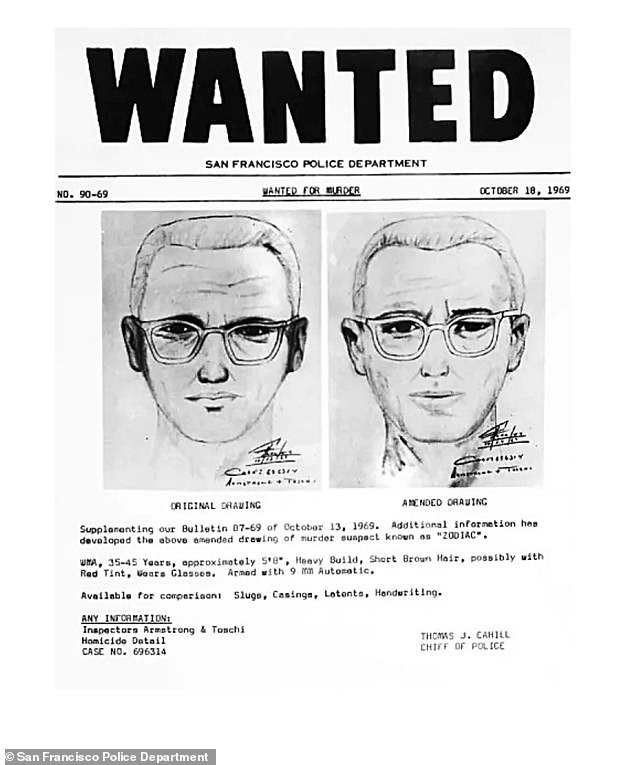
A composite sketch and description circulated by San Francisco Police as they tried – in vain – to catch the Zodiac killer, who terrorized northern California between 1968 and 1969

The phantom taunted the media and police with letters and ciphers, daring the public to unravel his identity

Two decades earlier in 1947, aspiring Hollywood actress Elizabeth Short, who became known as the Black Dahlia, was found dead and her body mutilated in Los Angeles
The Zodiac killer hinted that the Z13 cipher he sent in April 1970 contained his true name. Baber, the co-founder of Cold Case Consultants of America, claims he has finally cracked it using AI, newly released Census records and classic cryptography.
His solution revealed the name of a man who was also a prime suspect in Short’s murder.
He has also decrypted the Zodiac’s Z32 cipher, finding a solution that links to the murder of the Black Dahlia.
And through his years-long investigation – including exhaustive reviews of law enforcement files, court documents and public records – Baber has uncovered a trove of circumstantial evidence that he believes proves that the same man carried out both barbaric crimes.
A man who had the medical experience to mutilate Short’s body with chilling precision and had been in a relationship with her in the months before she died.
A man with ties to military code-breaking, who returned from the Second World War with a bayonet matching the weapon used in one of the Zodiac’s attacks.
A man who left behind a deathbed confession that could connect the two cases.
Here, for the first time, the Daily Mail can reveal that man’s identity.
His name is… Marvin Margolis.
Who is Marvin Margolis?
Marvin Skipton Margolis, who later used the alias Marvin Merrill, was born in Chicago, Illinois, in 1925, to Russian and Polish parents.
In 1943, he joined the Navy and served with the 1st Marine Division as a corpsman. Serving in the medical corps, Margolis learned both the surgical and marksmanship skills seen in the Zodiac and Black Dahlia crimes.
During the Second World War, he was stationed overseas for 27 months and took part in the Okinawa campaign – the last major battle between US and Japanese forces.

Marvin Skipton Margolis was a prime suspect in the murder of Elizabeth Short. He is seen in an enhanced image obtained by Alex Baber

Margolis appeared in local paper The Garfieldian after he returned home from World War II. The article showed him posing with a Japanese military rifle
His Veteran Affairs records, obtained by a grand jury inquest, reveal a man with a disturbing temperament.
While in Okinawa, Margolis was buried alive in a cave and was forced to dig his way out. Afterward, he was described as ‘resentful’ and ‘apathetic’ with an affinity for ‘aggression’.
When asked by a military neuropsychiatrist what he would do if another war broke out, Margolis made the chilling comment: ‘The next time there is a war, two of us are not going – the one who comes after me and myself.’
His resentment also stemmed from a ‘persistent demand and desire’ to serve in the surgical unit – a post repeatedly denied to him – and he left the Navy on 50 per cent mental disability grounds.
Along with battle wounds, Margolis brought home a distinctive Japanese rifle and bayonet with a wooden sheath, according to a 1945 newspaper article and his youngest son. That bayonet would later tie him to the Zodiac killings.
After leaving the military, he moved to Los Angeles and enrolled as a medical student at the University of Southern California (USC) in 1946, where his first task was to dissect a human corpse.
Due to his medical experience and brief – allegedly volatile – relationship with Short, Margolis quickly fell on law enforcement’s radar after her murder. Court records from the 1949-1950 LA grand jury investigation into Short’s murder identified ‘Marvin Margolis’ as one of 22 suspects.
But as Short’s murder made headlines, he fled LA, moving between Chicago, Atlanta, Arizona and Kansas, and changing his name to Marvin Merrill, according to social security records.
Newly named Merrill returned to California a couple of years before the first confirmed Zodiac attack, records show.
The Zodiac, Baber believes, took his moniker from the scene where he may have slaughtered Short two decades earlier.
Baber claims that his weapon of choice for one confirmed Zodiac attack was also personal: the Japanese military bayonet he brought back from the war.
In his final years, after a terminal cancer diagnosis, Merrill drew a macabre sketch, featuring a woman named Elizabeth and what appears to be a single hidden word ‘ZoDiac.’
Baber believes that this chilling drawing now amounts to a confession.
The Daily Mail has spent several months reviewing Baber’s investigation, combing through hundreds of documents and records shared by his team.
‘It’s irrefutable. It’s just mathematically impossible for it not to be him,’ Baber told the Daily Mail.
‘With all the connections, either he’s the unluckiest man in the history of the world – in the wrong place at the wrong time, every time – or he’s the perpetrator.’
An investigation backed by police and leading experts
While independent investigators and amateur sleuths claim to have solved the cases in the past, Baber says his investigation is different because it has caught the attention of active law enforcement.
Baber said he met twice with the California police departments responsible for the Zodiac case and that they are now reviewing his findings.
Following an initial meeting with the San Francisco Police Department, the Daily Mail has confirmed he was invited to present his evidence to the interagency group with jurisdiction over the Zodiac crimes – consisting of the SFPD, Napa County Sheriff’s Office, Solano County Sheriff’s Office and the FBI (Vallejo Police were the only agency not in attendance).
The Daily Mail has learned that members of Baber’s team also met with LAPD Police Chief Jim McDonnell back in October, who then directed his robbery-homicide division to look into the findings related to the Black Dahlia. The Daily Mail has contacted the LAPD for information about where this currently stands.
Baber’s findings have also been backed by several experts.

Alex Baber believes he has solved the Z13 cipher using classic cryptography methodologies, newly-released Census data and AI
Ed Giorgio, the former Chief US Codemaker and Chief US Codebreaker at the National Security Agency (NSA), told the Daily Mail that he agrees Baber has solved the Z13 cipher based on both the solution itself and the breadth of circumstantial evidence he has independently reviewed.
One of the world’s leading handwriting analysts and forensic document examiners, who works as a consultant for Baber’s organization, has said in a sworn statement that a letter sent by the ‘Black Dahlia Avenger’ in January 1947 matches three handwriting samples taken from the suspect’s possessions. Baber’s team is submitting a comprehensive set of the suspect’s writing samples to an independent third-party expert, unaffiliated with the team, for an additional comparative analysis to provide further confirmation.
Several highly-regarded former law enforcement officers have also gone on the record to say they believe both cases have now been solved once and for all.
Among them are retired LAPD homicide detectives Mitzi Roberts and Rick Jackson.
‘I have no doubt this is the person,’ Jackson told the author Michael Connelly in Killer in the Code, a new podcast and website chronicling Baber’s investigation.
‘I have no doubt at all. And that’s a lot to stake your reputation on but I feel it’s totally overwhelming, circumstantial evidence and now it has become mixed in with some physical evidence that supports Alex’s suspect as being the Dahlia and Zodiac killers.’
Roberts, who previously led the LAPD’s cold case team and reviewed numerous theories in the Black Dahlia case, said: ‘It’s overwhelming evidence that connects this man to these murders.
‘It’s hard to think that this person is not the person who was responsible for killing the Black Dahlia,’ she added.
‘I really believe he’s found the guy. He solved the Black Dahlia.’
Now, in the latest development, Merrill’s youngest son has shared hundreds of items of physical evidence with the team – items which are now being forensically analyzed – though he told the Daily Mail he doubts the theory his father is the killer.
The murder of the Black Dahlia
It was the morning of January 15, 1947, when a woman walking with her child through LA’s Leimert Park neighborhood came across a horrifying sight: a naked body sliced cleanly in two at the waist.
Rather than crude butchery, the cutting was precise, with care taken not to damage the vital organs. This was, investigators believed, no work of an amateur.
Her torso had been arranged on grass near the sidewalk, arms posed above her head and face turned to one side. Her lower body was posed off-center beneath, her legs splayed outward.

It was the morning of January 15, 1947, when a woman walking with her child through LA’s Leimert Park neighborhood came across a horrifying sight: a naked body sliced cleanly in two at the waist. Law enforcement are seen on the crime scene

Police officers on the scene where Short’s body was found, in the grass next to the sidewalk. Investigators concluded that the victim had met her horrific end elsewhere and her body washed before being dumped in the street for all to see
The sadistic killer had carved a chunk of flesh from her left thigh, removed a large square of skin from her right breast, and cut away a flap of skin beside her left nipple, according to the autopsy report and photographs. There were several more cuts and slashes to her chest and a four-inch gash from her naval to lower abdomen, where a criss-cross pattern had been chiseled into her skin.
A grotesque grin had been carved into her youthful face, extending two to three inches upward from each corner of her mouth.
Despite the extreme disfigurement, there was no blood at the scene.
Investigators concluded that the victim had met her horrific end elsewhere and her body washed before being dumped in the open for public discovery.
She was soon identified as 22-year-old Elizabeth Short, who had moved from Massachusetts to Hollywood in search of stardom.
The press dubbed her the Black Dahlia – a nickname given by friends because of her affinity for sheer black clothing and her raven hair.
Long before the Zodiac’s cat-and-mouse game years later, the murderer of the Black Dahlia began corresponding with the local media.
It started with a phone call to Jimmy Richardson, editor of the Los Angeles Examiner, on January 23, 1947.
The caller said he wanted to ‘congratulate’ Richardson on the newspaper’s coverage of the murder but noted that ‘you seem to have run out of material’. He promised to mail some of Short’s belongings.

Elizabeth Short, 22, is pictured outside John Marshall High School in Los Angeles. She had moved from Massachusetts to Hollywood in search of stardom
The following day, a package was intercepted by postal authorities.
Words cut from newspapers and magazines and pasted on the envelope read: ‘Here is Black Dahlia’s Belongings, Letter To Follow.’ Inside were photographs, Short’s birth certificate, an address book and other personal papers neatly clipped together.
Days later, the Examiner received another letter, this one handwritten in capital letters with black ink on a one-cent US government postcard.
The sender claimed that he had ‘had my fun at police’ and promised to surrender on January 29. It was signed: ‘Black Dahlia Avenger.’
January 29 came and went. No one appeared.
More letters followed, including a crude drawing of a dagger dripping with blood.
As the correspondence continued, investigators began scrutinizing Short’s acquaintances – and Margolis quickly came under suspicion.
A jealous ex-Marine lover
Due to the precision with which Short’s body had been dissected, detectives believed that the killer had surgical training and focused on students at nearby medical schools, an FBI memo shows.
Before joining the military, Margolis had taken a pre-medical course in Illinois. After the war, he enrolled at USC’s medical school.
As the grand jury records later said: ‘It should be noted further that this suspect, Marvin Margolis, is the only pre-medical student who ever lived as a boyfriend with Beth Short.’

Long before the Zodiac’s cat-and-mouse game years later, the killer of the Black Dahlia began corresponding with the media. He sent a package containing these belongings days after her murder

Days later, another letter arrived in which the sender claimed that he had ‘had my fun at police’ and promised to surrender on January 29. It was signed: ‘Black Dahlia Avenger’
Based on investigative records, Baber believes Short and Margolis met in Chicago in the summer of 1946 and began dating.
That October – three months before her murder – Short moved into an apartment in LA with Margolis, her friend Margorie Graham and Margolis’s friend Bill Robinson, the grand jury records show.
Margolis’s close friendship with Robinson would potentially pave the way for the Zodiac’s codemaking game two decades later. During the war, Robinson had served in the Army’s Signal Intelligence Service – the military’s specialist codebreaking division – which used the classical cryptographic techniques later seen in the Zodiac ciphers.
Short’s relationship with the resentful veteran Margolis soon unraveled.
After living together for just 12 days, she fled the apartment. Witness accounts suggest that the sudden rupture stemmed from her attending a CBS broadcast with another man.
The terrified 22-year-old travelled to San Diego, seemingly to escape Margolis.
On the night of January 7, 1947, two mystery men and a woman appeared at the friend’s home where she was staying.
The next day, Short returned to LA, where Margolis was now living with Robinson and Short’s former roommate Lynn Martin.
In the weeks and months leading up to her death, Short confided in friends and acquaintances that she feared for her life at the hands of a jealous ex-boyfriend.
Those fears seemed to peak on January 14, 1947.

A high school yearbook photo of Marvin Margolis, who was in a doomed relationship with Short before her death
That day, Officer Myrl McBride later recalled a troubling encounter with a woman she identified as Short at a downtown Los Angeles bus station.
The woman approached McBride hysterically sobbing, saying that she had bumped into her ‘insanely jealous’ ex-Marine boyfriend, who had threatened to kill her if she went out with another man.
Among Short’s known boyfriends and the 22 suspects named in the grand jury records, Margolis was the only one with ties to the Marine Corps, Baber has learned.
McBride escorted the woman to retrieve her purse from a nearby bar where she had seen the former boyfriend. They then parted ways, with the woman believed to be Short planning to meet someone arriving by bus from San Diego that evening.
Final hours and the inspiration for the Zodiac
What exactly unfolded in the few hours between this last purported sighting of Short and the discovery of her mutilated body the following morning is known only to her killer.
But that night, witnesses waiting at a bus stop in North Long Beach reported hearing screams coming from a passing black sedan, according to contemporaneous media reports.
Inside, they saw a man and woman in the front seat, and a second woman being pinned down by a fourth person in the back.
That same night, a man driving a black sedan approached at least three motels around San Pedro asking for a room with a bathtub.
Employees at the Harbor Moon Motel, Normandie Motel and Hillcrest Motel all recalled a nervous, jittery man – who matched Margolis’s physical description – insisting that he needed a tub for his wife, police said.
Curiously, the man parked his car far from the motel entrances. No one saw his wife.
When no suitable room was available, the man moved on.
Because there was no blood where Short’s body was found, investigators theorized that she had been dissected and washed in a bathtub. Detectives scoured the area for a so-called ‘torture room’ – but it was never found.
Roughly ten miles north of the three motels was a place called the Zodiac Motel.

The motel formerly known as the Zodiac Motel where Baber believes Elizabeth Short was mutilated by her killer

An advert for the opening of the Zodiac Motel in June 1946. Baber believes this was the inspiration for the Zodiac killer’s name two decades later
The Zodiac Motel opened in June 1946 in Lynwood, an advertisement from the time shows. A 1951 auction listing for the same 22-lot property describes ‘modern facilities’ including ‘Bath’.
While the inspiration for the Zodiac killer’s moniker has long been attributed to a watch brand, Baber’s investigation suggests it may instead have referred to where Short took her last breath.
Supporting that theory was the discovery of a canvas iceman’s bag marked with a letter ‘Z’ and containing red stains found a four-minute drive from where her body was left. In the 1940s, ice delivery workers commonly marked bags with the initials of the motels they served, raising the possibility that the bag came from the Zodiac Motel.
The Zodiac Motel would have also aligned with one possible route between the bus stop, the other motels and the dump site.
Were witnesses at the bus stop unknowingly watching as Short was driven in terror toward her death – in a bathtub in a room at the Zodiac Motel?
Was the Black Dahlia the Zodiac’s first victim?
And were the Zodiac murders the continuation of a violent man’s obsession with his own girlfriend who he had murdered and mutilated two decades earlier?
Following Short’s murder, Margolis, Robinson and Martin all lied to investigators about their connections to the victim, according to grand jury records. Social Security documents show that Margolis also began using the name Merrill.
During the grand jury investigation, police tried to track him down in Chicago for further questioning.

A photo in a newspaper shows police officers looking at a canvas iceman’s bag marked with a letter ‘Z’ found close to where Short’s body was found. Baber believes this supports his theory about the Zodiac Motel
LA Deputy District Attorney Arthur Veitch warned that Margolis must not be alerted that he was still under scrutiny: ‘If we do that, we might inadvertently, [enable] the culprit to escape punishment forever.’
Ultimately, investigators were unable to find him.
The case went cold. No one was ever charged with the murder of Elizabeth Short.
The Zodiac killer’s campaign of terror
Twenty years went by and Los Angeles – and the rest of California – moved on.
Merrill married his first wife and the couple had two children. For reasons that remain unclear, he abandoned his ambition of becoming a surgeon. Instead, while living in Chicago, he worked as a used car salesman.
When his first marriage ended, he remarried, had two more children and became stepfather to a daughter from his wife’s previous relationship.
If Merrill feared that law enforcement was catching up with him, he didn’t show it.
On the contrary, he appeared to crave media attention.
After moving to Kansas in 1960, he reinvented himself as an artist and was the subject of a newspaper article in which he claimed to have studied under Salvador Dali and embellished his military record.
When he returned to California with his family in 1962 and entered real estate, he boasted in local papers of plans to build an 11-story hotel in Oceanside.

After moving to Kansas in 1960, Marvin Merrill reinvented himself as an artist and was the subject of a newspaper article in which he claimed to have studied under Salvador Dali and embellished his military record
In September 1964, Merrill also sent a cryptic letter to the editor of The San Diego Union under his new alias.
It read: ‘If we look at the past, as the liberal members of our society suggest, perhaps we should look at this situation: Violent demonstrations were, in the past, considered crimes, it seems that, now violent crimes are considered “demonstrations.”’
Soon afterward, California faced a new bogeyman: the Zodiac killer.
In December 1968, quiet lovers’ lanes and remote beauty spots in the Bay Area became a serial killer’s hunting ground under the cover of darkness – places where moments of romance and stolen kisses quickly turned to moments of horror and stolen lives.
By the end of 1969, five victims were dead and two injured across four apparently random attacks in the Bay Area.
The killer – who called himself ‘the Zodiac’ and adopted a distinctive crosshair symbol – sent 21 confirmed letters and four ciphers to local newspapers, goading police and threatening more unhinged violence.
The correspondence – which continued into the mid-1970s – was riddled with phonetic misspellings, including ‘frunt’ for ‘front’, ‘victoms’ for ‘victims’ and ‘paradice’ for ‘paradise’.
The Zodiac’s first confirmed attack occurred on the night of December 20, 1968, when a young couple’s first date became their last.
David Arthur Faraday, 17, and Betty Lou Jensen, 16, were found murdered along a lovers’ lane on Lake Herman Road just outside Vallejo. Faraday was killed execution-style with a single shot to the back of the head with a .22-caliber semi-automatic sidearm, while Jensen was hit five times as she ran for her life.
Seven months later, on July 4, 1969, the killer struck again two miles away, shooting Darlene Ferrin, 22, and Michael Mageau, 19, as they sat in Ferrin’s car in Blue Rock Springs Park, Vallejo.

David Arthur Faraday, 17, and Betty Lou Jensen, 16, were found murdered along a lovers’ lane on Lake Herman Road just outside Vallejo on December 20, 1968

Faraday was killed execution-style with a single shot to the back of the head with a .22-caliber semi-automatic sidearm, while Jensen was hit five times as she ran for her life

The Zodiac killer targeted Darlene Ferrin, 22, and Michael Mageau, 19, in Blue Rock Springs Park, Vallejo, on July 4, 1969
Ferrin died after being shot nine times. Mageau was hit four times and survived, later telling police that the attacker simply walked up to the car and opened fire without uttering a word.
Later that month, the Zodiac began his game with the media – sending letters to three local newspapers in which he claimed responsibility for both attacks and included his first cipher.
On August 2, 1969, the Z408 cipher was published, shocking the public and setting off a race to crack the killer’s code.
Within days, a couple had succeeded.
‘I like killing people because it is so much fun … man is the most dangerous animal of all to kill,’ it read in part.
The warped text closely echoes The Most Dangerous Game, a short story – later adapted into a film – about a killer hunting humans for sport. An adaptation was screening at The Marcal Theater in LA the week of the Black Dahlia murder and Short herself is believed to have seen it days before she died, according to grand jury records. The theater was owned by her acquaintance Mark Hansen.
Days after the cipher appeared, the Zodiac myth was born.
In a letter to the Examiner on August 4, the killer declared his chilling moniker for the first time, writing: ‘This is the Zodiac speaking.’

In August 1969, the Zodiac began his game with the media – sending letters to three local newspapers in which he claimed responsibility for both attacks and included his first cipher, the Z408

On August 2, 1969, the Z408 cipher was published. Within days, a couple had succeeded in cracking it. ‘I like killing people because it is so much fun … man is the most dangerous animal of all to kill,’ it read in part

The warped text closely echoes The Most Dangerous Game, a short story – later adapted into a film – about a killer hunting humans for sport. An adaptation was screening at The Marcal Theater in LA the week of the Black Dahlia murder, this advert shows
The next confirmed kill came on September 27, when a man wearing a black cloth hood emblazoned with the Zodiac’s crosshair symbol attacked Bryan Hartnell, 20, and Cecilia Shepard, 22, in Lake Berryessa.
After holding the couple at gunpoint in the remote beauty spot, the assailant stabbed them repeatedly with a bayonet-type weapon. Shepard later died from her injuries. Hartnell survived.
The bayonet, described in police filings as a nine to 11-inch military-style blade, marked a departure from the Zodiac’s usual murder weapon of choice.
It was also a weapon familiar to Merrill.
According to Baber’s analysis of a 1945 photograph and accounts from Merrill’s son, he had returned home from the war with a Japanese Nagoya rifle mounted with a Type 30 bayonet.
Such bayonets feature long blades, wooden handles and distinctive markings denoting the manufacturer and serial type – symbols that resemble those that the Zodiac adopted in his ciphers. That weapon is now believed to be in the possession of Merrill’s family, possibly holding crucial DNA evidence.
Days after the Lake Berryessa attack – on October 11 – 29-year-old cab driver Paul Stine was shot dead in his taxi in the upscale Presidio Heights neighborhood of San Francisco.
Initially, his death was treated as an unrelated robbery until the Zodiac sent a piece of his blood-stained shirt to the San Francisco Chronicle.
Stine was the Zodiac’s last confirmed victim.

The next confirmed kill came on September 27, 1969, in the remote beauty spot of Lake Berryessa


Bryan Hartnell, 20, survived but Cecilia Shepard, 22, died from her injuries after being stabbed multiple times

The killer was wearing a black cloth hood emblazoned with the Zodiac’s crosshair symbol
Although police officially do not attribute any other murders to the Zodiac, his final letter boasted of 37 victims and several other crimes are thought to bear the serial killer’s hallmarks.
One such case strongly indicates a link to Merrill.
On the night of April 10, 1962, 29-year-old cab driver Ray Davis was murdered after picking up a fare to Oceanside.
The next day, his body was found in an alley in the affluent beachfront area, his car abandoned 15 blocks away. Davis had been shot in the back and head with a .22-caliber semi-automatic firearm loaded with long rifle rounds – the same type of weapon and ammunition used in the Zodiac’s first confirmed attack at Lake Herman Road.
The parallels with the murder of Stine – both cab drivers shot execution-style after taking fares to wealthy neighborhoods – fueled speculation that Davis was an early Zodiac victim.
After Davis’s killing, police also received a call from a man claiming responsibility and threatening to target a bus driver – eerily mirroring the Zodiac’s later threat against a school bus.
Throughout the Zodiac’s spree, Merrill’s son told the Daily Mail the family was living in Vista, Southern California – and he said they were in Kansas in 1962 when Davis was murdered.
But public records list Merrill in Oceanside just one month before Davis’s murder, at an ‘Elm Street’ address. Baber pointed out that there is an ‘Elm Street’ less than two blocks from where the cab was abandoned.

Days after the Lake Berryessa attack – on October 11 – 29-year-old cab driver Paul Stine was shot dead in his taxi in the upscale Presidio Heights neighborhood of San Francisco

Initially, his death was treated as an unrelated robbery until the Zodiac sent a piece of his blood-stained shirt to the San Francisco Chronicle. Stine was the Zodiac’s last confirmed victim
Baber asserted that Merrill was linked to addresses in San Jose, northern California, and that he worked there for computer company Intel in 1969, placing him in the Bay Area at the time of the Zodiac murders.
The Daily Mail’s investigation found the addresses and Intel job were from a later period.
And Merrill’s son, who was around seven years old at the time of the Zodiac murders, told the Daily Mail that his father was ‘broke’ and never traveled far from their southern California home.
The son said this is one of the biggest unanswered questions in Baber’s theory.
But Merrill is also believed to have had access to other properties across the Bay Area – as well as multiple vehicles – through his construction, real estate and car repair businesses, allowing him potential proximity to the Zodiac killings.
The Zodiac’s cryptic communications and menacing letters did not end with Stine’s murder.
Then, in March 1971, the letters abruptly stopped.
A three-year silence
The Zodiac fell silent for three years.
At the time, police were closing in on Merrill – but for entirely different reasons.
In April 1971, he became embroiled in a fraud investigation involving his Oceanside car repair business.
That December, he was charged with grand theft, petty theft and false advertising. He pleaded guilty to the latter two crimes and was sentenced to 30 days in jail with three years’ probation, according to media reports.
Merrill’s probation ended early, around January 1974, Baber said he learned from Merrill’s son.
It was then that the Zodiac resurfaced, sending what would be his final confirmed letter on January 31, 1974.
As with the Black Dahlia case, police never caught the Zodiac killer.
Only one suspect has ever been publicly named by law enforcement – Arthur Leigh Allen, a former teacher and Navy veteran later convicted of child sexual abuse.

The Z340 cipher was finally solved by a team of international codebreakers in 2020 – more than half a century after the Zodiac sent it

In a letter sent in December 1969, the killer drew a crude sketch of a knife, labelling it: ‘The Bleeding Knife of Zodiac’


Baber has also decrypted the Zodiac’s Z32 cipher, finding a solution that links to the murder of the Black Dahlia
In 2002, Allen was excluded as the source of a partial DNA sample recovered from a stamp on one of the envelopes sent by the Zodiac. The sample was, however, too small to build a full genetic profile and the findings remain inconclusive. Allen died in 1992.
Merrill, meanwhile, moved to Atlanta after the Zodiac killings and set up an insurance firm.
In 1978, his wife filed for divorce following a violent incident inside the family home. Merrill’s youngest son told Baber’s team his father had threatened to kill his stepsister, prompting his mother to desperately try to defend her with a knife. Police were called and Merrill was arrested. The son confirmed this incident to the Daily Mail.
Cracking the Zodiac’s unsolved ciphers
During his campaign of terror, the Zodiac sent four ciphers: the Z408 in July 1969; the Z340 in November 1969; the Z13 in April 1970; and the final, Z32, in June 1970.
While the Z408 was solved almost immediately, it took another 51 years for the Z340 to be cracked by a team of international codebreakers in December 2020.
Its message included the chilling boast: ‘I hope you are having lots of fun in trying to catch me. I am not afraid of the gas chamber because it will send me to paradice [sic] all the sooner because now I have enough slaves to work for me.’
The Z13 and Z32, by contrast, have never been conclusively solved.
The Z13 is widely believed to conceal the Zodiac’s real name, with its 13-character code preceded by the teaser: ‘My name is -’
Using Al technology, Social Security Administration (SSA) birth records, newly released Census records from 1950 and mirroring the methodologies used to crack the Z340 cipher, Baber claims he has now decrypted Z13.
The recent solving of the Z340 cipher had provided him with greater insight into the Zodiac’s encryption methods, giving a clue as to which classic decryption methodologies should be used for Z13.
He also realized that the killer had to be listed in the 1950 Census. At the time of the attacks, the Zodiac was believed to be between 35 and 45 years old – based on the San Francisco Police Department’s profile and eyewitness accounts from the last confirmed attack.

The Z13 is widely believed to conceal the Zodiac’s real name, with its 13-character code preceded by the teaser: ‘My name is -’ Baber believes he has finally decrypted it to reveal the name Marvin Merrill
And, so, Baber obtained the newly released Census records as well as SSA birth records for male names and surnames, and cross-referenced them.
He then used AI technology to narrow down the possible solutions, arriving at a single potential suspect: Marvin Merrill.
Baber also claims to have discovered a solution to the last remaining cipher, Z32, and is now awaiting independent verification that it does, as he believes, provide a direct link between Zodiac and the Black Dahlia murder.
Evidence from beyond the grave
Marvin Merrill, Marvin Margolis, the Zodiac killer, the Black Dahlia Avenger. Whichever name he allegedly went by at different times of his life, he died in California in 1993 – seemingly taking his secrets with him.
But a cache of physical evidence could now bring those secrets into the open.
Merrill’s youngest son has handed over boxes containing more than 200 items that once belonged to his father – though he remains skeptical that he is in fact the son of a serial killer.
Among the most damning pieces of evidence is one of the final sketches Merrill produced.
A year before his death – a death he knew loomed as he battled terminal cancer – he drew an image in black ink depicting a nude woman’s body from the waist up, set against a darkly shaded background.
Distinctive markings on her body and a possible dissection of her nipple closely resemble the injuries inflicted on Short. If the sketch does depict Short, Merrill revealed details only the killer could have known. It wasn’t until 1994 – after Merrill died – that author John Gilmore revealed previously unreleased information about the full extent of her brutal wounds.
Beneath the figure appears the name ‘ELIZABETH’, written in distinctive capital letters that look eerily similar to the handwriting in the Zodiac’s letters.

Among the most damning pieces of evidence is one of the final sketches Merrill produced, depicting a naked woman named ‘ELIZABETH’


Using image-enhancement software, Baber searched for further clues. The software revealed what appears to be the word ‘ZoDiac’ hidden beneath the ink
The sketch is signed, ‘Marty Merrill ‘92’, matching his signature on checks and other documents provided by his son.
Using image-enhancement software, Baber searched for further clues. The software revealed what appears to be the word ‘ZoDiac’ hidden beneath the ink. The Daily Mail also replicated the finding.
To Baber, the sketch is Merrill’s deathbed confession – a single piece of physical evidence in which the killer links both the Zodiac and Black Dahlia crimes.
Merrill’s son has handed the drawing over to Baber’s team and they claim to have shared it with a forensic image analyst for independent review.
When the Daily Mail asked the son about the sketch, he suggested it could depict another woman, saying that his father had a girlfriend named Elizabeth around the time it was drawn.
The son said he did not know the girlfriend’s last name and revealed that he and his father ‘weren’t close’ back then, having fallen out of contact in the 1980s.
Other sketches of naked women in odd poses, including one in which a woman appears to be strung up and has a pronounced line across her midsection, have also been found, Baber revealed.
Another drawing depicting a voice-modulation device appears to mirror some of the Zodiac’s technical, schematic diagrams of bombs as well as his use of phonetic misspellings. In all, 92 words in the Zodiac’s 21 confirmed letters and three of the 17 words in Merrill’s voice modulator sketch are phonetically misspelled.

Another of Marvin Merrill’s drawings depicts a voice-modulation device which Baber believes mirrors some of the Zodiac’s technical, schematic diagrams of bombs

A Japanese Nagoya Type 30 bayonet like the type Marvin Margolis brought home from World War II according to his son

These bayonets feature symbols that mirror some of the Zodiac’s symbols in his complex ciphers
There are also business cards, checks under various aliases, Merrill’s military discharge letter, and poetry he wrote – some of it centered on obsession and love.
Numerous handwriting examples have been collected and are now being sent to an independent expert for comparison to both the Zodiac and Black Dahlia killer’s letters.
Baber told the Daily Mail that once the forensic analysis is conducted on the sketch and handwriting analysis completed on the documents, police will have no choice but to take up the investigation – and close both cases once and for all.
‘They’re not beating down doors to solve these two cases. But once it’s in their face, they can’t deny it,’ he said.
‘We need all the jurisdictions involved in the Zodiac and the Black Dahlia to first acknowledge Marvin Merrill as a suspect based on the information that we’ve uncovered, and then to identify him as the perpetrator based on the physical evidence.’
Baber also believes more evidence remains to be discovered.
Merrill’s son told him that his father left him his journals and the Japanese military bayonet when he died.
‘I don’t believe dad did it’
Merrill’s son told the Daily Mail that he remembered playing with his dad’s bayonet when he was in elementary school but claimed he thought it was from Korea, not Japan.
If the bayonet was the weapon used by the Zodiac, Baber believes that its wooden handle could contain DNA from the killer or the victims – and place Merrill at the scene of the crime.
Baber told the Daily Mail that Merrill’s youngest son admitted he now believes his father was the Zodiac killer and the murderer of the Black Dahlia, based on the evidence presented to him.


Marvin Merrill / Margolis handwriting samples, shared with Alex Baber for forensic analysis

Baber’s team is seeking independent analysis of several handwriting samples from Merrill’s son
However, when contacted by the Daily Mail, the son – who wished to remain anonymous – denied this and called the theory and findings ‘a speculative cesspool’ and ‘fiction’: ‘I don’t believe that dad did it.’
The son insisted: ‘[The Black Dahlia murder] was 20 years before I was born. I would love for the families to have peace in the Zodiac killings. But there’s just no way it was my dad,’ he said in a phone conversation Tuesday.
‘There’s no way – just no way my dad killed kids.’
The son – who would have been around six and seven years old at the time of the Zodiac attacks – said he never saw anything in his father that would support him being the Zodiac killer or the murderer of the Black Dahlia.
The son claimed he did not even know about his father’s relationship with Short or that he was a suspect in her murder prior to being contacted by Baber around two years ago.
When asked for his reaction to that revelation, the son insisted he has not seen any evidence to convince him he could be the perpetrator.
‘He’s the only dad I have. I didn’t have any other dads that were or weren’t accused of anything. No epistemological reality to draw from, no memory. There’s nothing there. I was a little kid, and we never spoke of any of this stuff,’ he said.
Merrill’s son also offered an explanation for his father’s decision to change his last name from Margolis to Merrill, saying that his dad told him it was because of the antisemitism he faced in his business with a Jewish last name.
‘With antisemitism in the 1950s he was selling insurance in Atlanta, and no one would buy from the Jew,’ the son said. ‘He said that outright.’

Marvin Merrill in an undated family photo. Merrill’s youngest son told the Daily Mail he does not believe his father is the perpetrator of the Black Dahlia and Zodiac crimes

Enhanced image of Marvin Margolis/Merrill compared to the composite sketch of the Zodiac killer shared by SFPD
The son also claimed his father did not speak to him about his time in LA in the late-1940s or his military service, and that he does not know of any links his father had to cryptography like that used by the Zodiac.
He also denied that his father had the financial means to rent multiple properties around California during the time the Zodiac was active, insisting that the family was ‘broke’ – though he appeared to be unaware of his father’s military benefits from his mental health discharge.
However he brushed off the possibility of his father’s involvement in the two cases.
‘I’m not forming any conclusions. I’m going to let the evidence speak for itself,’ he said.
‘Until I see the police say, oh my gosh, this is right, and then I’ll have a reality to work with.’
The son added that, even if law enforcement confirm Baber’s findings to be correct, he will still be skeptical of his father’s guilt of the crimes.
Yet, despite his denials, the son confirmed to the Daily Mail he had shared some items with Baber’s team.
Before it’s too late…
For Baber, solving both cases and bringing closure to victims after so many years is deeply personal.
His own family was rocked by tragedy, and he has long been troubled by the thousands of unsolved murders that leave families without answers.
That led him to found his independent consulting group dedicated to revisiting complex cold cases.
‘My moral compass tells me the bad guy can’t get away,’ Baber said. ‘There has to be a way to track him down and identify him. Even in a perfect crime, there are the means with today’s technological advances. I want to ultimately make it where they have no place to run or hide.

Baber spoke to one of Elizabeth Short’s relatives just before she died. More than 70 years had passed since her murder

Short’s family gathered at her funeral in Oakland in January 1947. Family members of victims are still searching for the truth about both cases
‘It’s about the victims and victims’ families – about what’s best for them and giving them the answers they have never received.’
Yet, given the passage of time in the Black Dahlia and Zodiac cases, few victims are left to see justice unfold.
Baber managed to speak to one of Elizabeth Short’s last surviving family members before she died.
More than 70 years had passed since the murder.
‘She had given up on ever getting answers,’ Baber recalled. ‘She was grieving so deeply she had come to terms with the fact she would never know what happened to her. That’s hard to swallow… to go almost eight decades and not know who did it or why. That’s overwhelming.’
Baber made her a promise. ‘I told her that we’d see this to the end, and I’d do my best to get justice.’
She died before learning who was responsible for her loved one’s monstrous death.
But, for others, it’s not too late.
After surviving the Zodiac’s Lake Berryessa attack, Bryan Hartnell went on to become a lawyer, marry and have two children. Now 76 and still living in California, he is the last known living victim of the Zodiac’s confirmed attacks.
Family members of other victims are also still searching for the truth on behalf of those who cannot.
As Baber put it: ‘We need to give people answers before they pass.’
The investigation is also being developed as a premium documentary series by Emmy Award winning producers Melanie Capacia Johnson and Jonathan Reynaga, in collaboration with Baber, through TH Studios