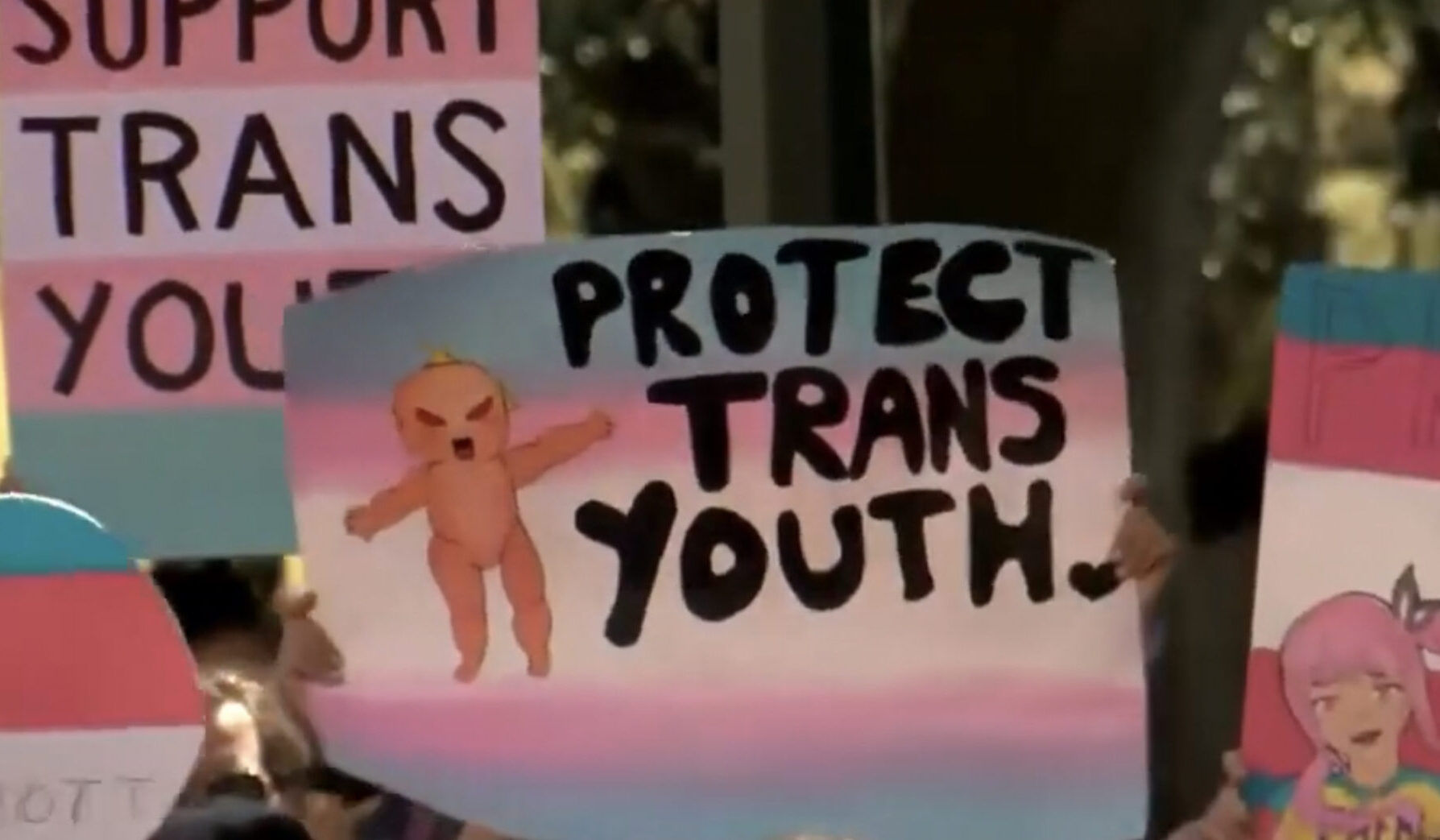

It may not be an 80/20 issue. It may be turning into a 90/10 issue.
The media depiction of the transgender debate is that it stands atop a left/right divide: left for, right against. Democrats for, Republicans against. In Texas, the creepy fake preacher and U.S. Senate candidate James Talarico keeps pounding the theme of far-right hate, framing trans stuff as an us-vs.-them question, decent progressives fighting against ignorant bigots who bully trans kids.
But a remarkable debate in a California legislative committee this week over a pair of pro-transgender bills brought out a crowd of bitterly angry people who loathed the legislation and what it represented, and they weren’t at all who you would expect. You may not read this sentence many times in your life, but far-left San Francisco lesbians agree with you.
You can watch the March 17 meeting of the Assembly Health Committee here, though the whole hearing on a bunch of bills is just one video. To watch the two discussions I’m about to describe, you’ll want to fast-forward to 43:27, then to 1:22:30.
The first of those two debates covered AB 1540, a bill that would require the state to bifurcate its suicide-prevention telephone service so LGBT youth who call the 988 crisis hotline will be transferred to a different call center for specialized gay suicide prevention: “a subnetwork of LGBTQ+ specialized youth suicide prevention service providers.”
At 53:30 in the hearing video, you can hear the testimony of a young man named Johnny Skinner who called an LGBT suicide hotline as a teenager. He was on puberty blockers and estrogen, his physical development halted, and you’ll be shocked to hear that he felt like he was in crisis. “I was having thoughts of suicide because I didn’t like anything about my body,” he told the committee. “The doctors told me I was supposed to be a girl, so I viewed my male body as defective.”
But Skinner’s discussion with the LGBT suicide prevention specialists went off the rails when he told them he hated his body and was depressed because of his gender transition treatment: “They got very quiet, and then they hung up on me, a suicidal child.” Here’s a screenshot of that moment, with captions:
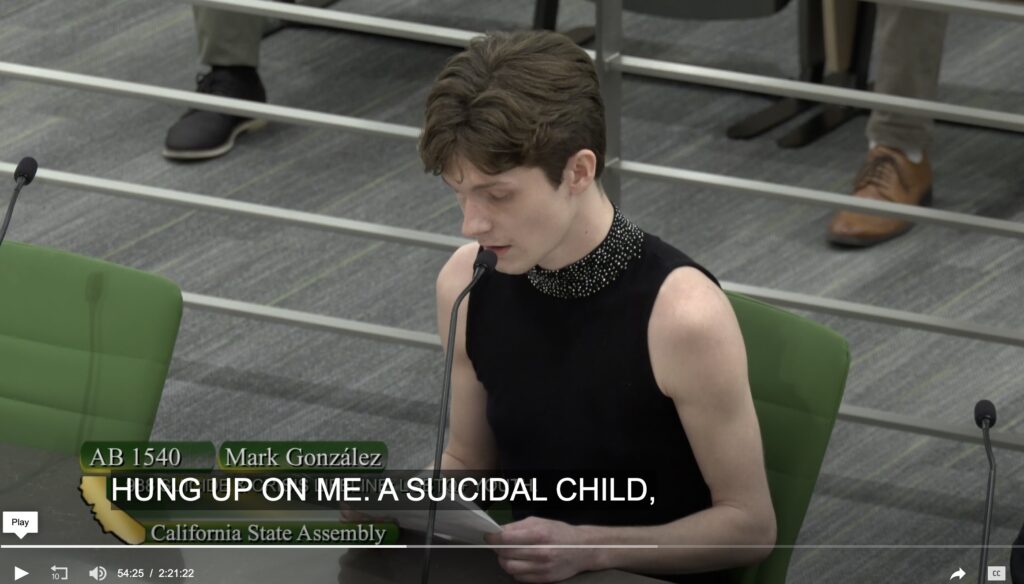
Skinner understands what he experienced. The LGBT crisis center wasn’t trying to get him through his crisis; they were trying to drive him forward through his transition, serving an ideology and rejecting dissenters. LGBT suicide call centers, he argued, would be staffed by “an organization that believes children can be born wrong. An organization that doesn’t want to hear about the harms of so-called gender-affirming care.”
The California legislature introduces over a thousand bills a year, so they slam legislation through committee hearings with a few minutes of debate. Limiting discussion, committees take a parade of “me-toos” after a small number of primary speakers, giving individuals and organizations a brief chance to tell legislators who they are and what position they take on the bill. The me-toos aren’t allowed to make speeches; their abbreviated testimony is limited to name, organization, and for or against. (“Chris Bray, The Federalist, against.”) The opposition me-toos for AB 1540 start at 56:58, and you may want to take a few edifying minutes just to watch a long line of leftist Bay Area and Los Angeles TERFs who loathe transgender ideology.
58:19: Tish Hyman on behalf of Black Lesbians of Los Angeles. “I strongly oppose this bill.”
59:03: Arianne Geringer, from Oakland, “on behalf of LGB,” leaning into the microphone and punching the letters to make sure people heard the absence of the T in the name of the Lesbian, Gay, and Bisexual Alliance USA, opposed.
1:01:10, opposition from Lesbians Advocating for a Resilient Future.
1:01:17, a “longtime San Francisco progressive Democrat and LGB activist, mother of a formerly trans-identified son,” who says, “I stand in strong opposition to this bill.”
And on and on. Is this left versus right? In increasingly obvious ways, a pro-LGB culture is deeply disturbed by the T. People you mostly wouldn’t agree with agree with you on this.
The debate closes at 1:06:11 with the distinctly strange author of the bill, Assemblyman Mark Gonzalez, saying that he’s heard the opposition, “those hateful voicemails, the ones claiming that this bill is about ideology or politics or some kind of agenda.” But really, he says, the bill is just about helping kids. No amount of actual discussion can change his framing: good people versus bigots, kindness against being hateful.
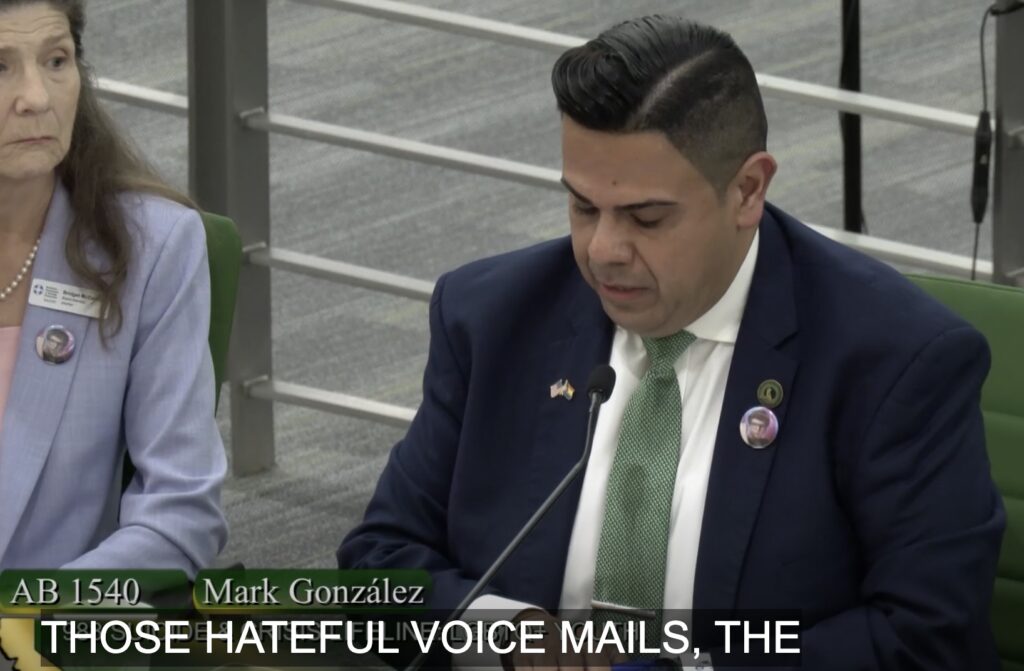
You can see with your own eyes that he’s lying.
The second debate, the one that starts at 1:22:30, is about AB 1876, which would require health insurance companies to cover medical treatment on the basis of a person’s declared gender identity. The parade of testimony here mirrors the last one, and I mostly won’t dive back into the familiar details.
But note the testimony of the person who just gives her name as Layla, at 1:32:12. A detransitioner, Layla describes “childhoods filled with abuse” for her and her peers, and doctors promising that surgery would fix their anxiety and pain. “A few weeks after I turned 13, my breasts were amputated because my mother was told that I would kill myself if she didn’t consent to the procedure. I became extremely suicidal after I was pumped with drugs and affirmed by all the trusted adults in my life that everything about my body was wrong.”
Other countries, Layla adds, “have stopped this barbarism.”
The opposition me-toos begin at 1:34:10, and it’s the same parade of mostly Democrats and leftists. Second speaker: “Bev Talbott, San Francisco Democrat with the Lesbian and Gay Courage Coalition.”
Democrats and the media tell you that opposition to transgender ideology and transgender procedures for children is limited to a few people on the political right, extremists who live outside the American mainstream. They’re lying.
Both bills were successfully voted out of committee, by the way. The California legislature is on a death march to trans Jonestown, and mere reality won’t stop them. But the rest of the country is waking up, quickly, and doing so across partisan lines. This is the mainstream, and the mainstream is rising.