
It has started.
After weeks of formal talks, warnings and military positioning, including the deployment of roughly a third of the US Navy’s deployable fleet, the pre-emptive strike against Iran has begun.
As its codename suggests, Operation Epic Fury has unleashed air strikes against military, political and infrastructure targets.
The scale is game-changing. The military execution, by all accounts, formidable.
But what happens next?
Generals like to ask one question before committing force: what does victory look like?
Bombing is the easy part. What follows is far less predictable.
Perhaps that explains reports that the Chairman of the Joint Chiefs, General Dan Caine, pressed for clarity before the operation began.

Tobias Ellwood, former minister for the Middle East, says President Trump has ‘opened a Pandora’s box’ in Iran
To approve kinetic force without understanding the end state is not bold leadership, it is negligence.
Overwhelming force is not a substitute for a political plan.
This uncertainty explains why some Western allies did not line up unquestioningly behind Washington.
That hesitation should not be misinterpreted as sympathy for Tehran.
The regime’s toxic influence across the Middle East, sponsoring Hamas, Hezbollah and the Houthis, suppressing its own people and destabilising neighbours for decades, is well understood.
Since the 1979 revolution, Iran has tested every American president.
The fall of the Shah, the 444-day hostage crisis, the export of revolutionary ideology, the steady expansion of proxy networks, and the long dispute over nuclear enrichment have defined four decades of confrontation.
For years, Iran operated just below the threshold of decisive response.

US Central Command released this image as part of Operation ‘Epic Fury’ on Saturday, when it attacked Iran in partnership with Israel
When intelligence suggested Tehran was approaching nuclear breakout capability, the US and Israel acted last June, striking Fordow and other sites in a 12-day campaign.
Yet the regime endured. Enrichment resumed. The ambition remained.
This time it’s different. Donald Trump’s message to the Iranian people – ‘When we are finished, take over your government’ – signals that this is not simply another limited series of air strikes.
It hints at regime change.
Iran’s air defences may be degraded, but it retains formidable missile and drone capabilities.
Retaliation has already begun.
Expect its proxies in Lebanon, Iraq and Yemen to widen the theatre.
Disruption of shipping through the Strait of Hormuz and cyber operations are likely.

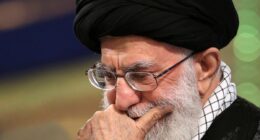
President Trump claimed Iranian Supreme Leader Ayatollah Ali Khamenei had been killed in Saturday’s attack
The Middle East is not a closed system; energy markets and global security will feel the effects.
Then comes the harder question: what happens inside Iran?
It is tempting to assume that recent civilian uprisings suggest the country is ready to cast off this despotic regime.
But two uncomfortable truths intervene.
First, there is no unified opposition waiting in the wings.
Iran is a mosaic of peoples, Persians, Azeris, Kurds, Arabs, Baluch and others, with deep ethnic, linguistic and regional identities.
Shared anger does not equal shared vision.
There is no leadership structure prepared to assume control.

Israeli air defences worked to intercept Iranian missiles headed for the country after Operation ‘Epic Fury’ on Saturday
Second, the Islamic Revolutionary Guard Corps (IRGC) is not simply a military force.
It is an embedded power structure.
Beyond its elite units and missile programmes, it holds economic clout across construction, energy, telecommunications and banking.
In any vacuum, it is the most organised and well-armed actor in Iran.
Trump will hope that in the event of the regime’s collapse, the IRGC will be open to a bargain, immunity from war crimes prosecution in return for a quiet disarmament, perhaps.
Without that, no international ‘stabilisation force’ – similar to that proposed for Gaza – will dare tread on Iranian soil.
Decapitating the government without structured transition planning could just as easily yield a military-dominated despotism.
Is that the outcome we want?
Trump has opened a Pandora’s box. Calls for de-escalation are understandable, but the threshold has been crossed.
In 50 years there has never been a greater opportunity to shape a different chapter for Iran.