
The message from Donald Trump was clear – America’s allies were taking advantage of it and the time had come to cut them loose.
‘The saga continues unabated as we defend the Persian Gulf,’ he wrote. ‘An area of only marginal significance to the United States for its oil supplies…but one upon which others are almost totally dependent.’
He was particularly angry at allies who had not sent mine sweeper vessels to help US efforts in the Middle East.
This was not President Trump venting on Truth Social. Social media was, at the time, science fiction. This was businessman Donald Trump castigating US allies nearly 40 years ago.
It was September 2, 1987 and Trump had spent $94,801 taking out full-page adverts in the New York Times and Washington Post to ask why the US was paying billions of dollars to protect allies who did nothing in return.
His language then was exactly the same as it is now. Trump has been nothing if not consistent in his disdain for NATO and, on Wednesday, he threatened to pull America out of the alliance.
Trump’s latest takedown of NATO came on April 1 and, had the comments been made in isolation, officials in European capitals might have thought it was his idea of an April Fools’ joke. However, it was far from the first time he has expressed similar sentiments.
Allies may not have read his 1987 newspaper advert, but they were listening in 2016 when, during his presidential campaign, he slammed ‘NATO members that aren’t paying their bills.’
At that time, he also suggested the US may not defend the Baltic states against Russia if they did not ‘fulfil their obligations to us.’

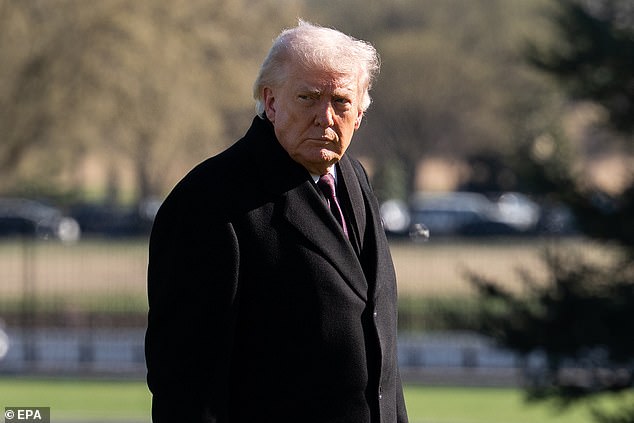
President Donald Trump has been urging allies to step up more for 40 years and now says he is seriously considering pulling out of NATO
Then, days before he took office in January 2017, he declared: ‘I said a long time ago that NATO had problems. Number one, it was obsolete, because it was designed many, many years ago.’
The following year, at a tumultuous NATO summit in Brussels in July 2018, he told European leaders directly to their faces that he was considering leaving.
Later, at a rally in West Virginia, Trump confirmed how he had told allies in private ‘Yes, I will leave if you don’t pay your bills,’ and that ‘You could see those checkbooks came out for billions of dollars.’
After January 2021, when he was out of office, senior officials from his first term, including former National Security Advisor John Bolton, revealed that Trump had threatened to destroy NATO.
Bolton predicted he would ‘almost certainly withdraw’ from the alliance in a second term. Officials said Trump didn’t see the point of it for America.
When he hit the campaign trail in 2024 the threats ramped up as Trump suggested Russia should be able to do ‘whatever the hell they want’ with US allies who did not pay their fair share of defense costs.
After assuming office again in 2025, Trump’s relationship with key European allies initially appeared to improve as they did commit to increased defense spending.
However, relations took a new hit when he threatened to invade Greenland, an overseas territory of NATO ally Denmark.
Remarks the president made that allies had ‘stayed a little back, a little off the front lines’ in Afghanistan were also deeply damaging.
With fault lines spreading within NATO the Iran war subsequently became, for Trump, a litmus test on whether allies would rush to support the US. They did not.
Once again, Trump seemed notably vexed by allies not sending mine sweepers, exactly the same topic that had so annoyed him in 1987.

Trump made the Iran war a litmus test for allies; Here, a fire erupts at an oil depot in Iran’s capital Tehran
By March 20, 2026 Trump seemed closer than ever to upending the world order by acting on a grudge against NATO that had been brewing for decades.
‘Without the U.S.A., NATO IS A PAPER TIGER!,’ he wrote on Truth Social.
‘They didn’t want to join the fight to stop a Nuclear Powered Iran. Now that fight is Militarily WON, with very little danger for them, they complain about the high oil prices they are forced to pay, but don’t want to help open the Strait of Hormuz, a simple military maneuver that is the single reason for the high oil prices.
‘So easy for them to do, with so little risk. COWARDS, and we will REMEMBER!’
A week later, on March 27, he told a crowd in Miami he was done with NATO allies.
‘We would have always been there for them, but now, based on their actions, I guess we don’t have to be, do we?’ he said.
Trump knew well the significance of what he was saying.
‘That sounds like a breaking story,’ he went on, looking at the media. ‘Yes, sir. Is that breaking news? I think we just have breaking news.
‘But that’s the fact. I’ve been saying that – why would we be there for them if they’re not there for us? They weren’t there for us.’

A plume of smoke rises after a strike in Tehran but allies have been less supportive than Trump wanted

British Prime Minister Keir Starmer (L), NATO Secretary-General Mark Rutte (C) and Ukrainian President Volodymyr Zelensky (R) outside 10 Downing Street, London, UK, March 17, 2026.
Then, on April 1, he was even more direct, revealing, ahead of an address to the nation on the Iran war, that he was ‘absolutely’ considering a US withdrawal from the alliance.
‘I’ll be discussing my disgust with NATO,’ he said of the speech.
Asked if he was thinking about pulling out of NATO, he said: ‘Oh, absolutely without question. Wouldn’t you do that if you were me?’
It came hours after Pete Hegseth, his Secretary of War, had declined to reaffirm the US commitment to NATO’s collective defense, a concept that lies at the heart of the alliance.
NATO was founded in 1949, with the signing of the Washington Treaty in the US capital, to counter the risk of an attack by the Soviet Union and has been the cornerstone of the security of the West.
Its membership has grown to 32 nations including European countries, the US and Canada.
Under Article 5 of the treaty each member nation pledges that an armed attack against one ‘shall be considered an attack against them all.’

Trump has long slammed NATO as ‘obsolete’ and said America should not pay so much

A leaders photo during a NATO summit in 2025 showing President Trump with Finland’s President Alexander Stubb, Netherlands’ Prime Minister Dick Schoof, France’s President Emmanuel Macron, NATO Secretary General Mark Rutte, Greece’s Prime Minister Kyriakos Mitsotakis, Britain’s Prime Minister Keir Starmer, Hungary’s Prime Minister Viktor Orban
Experts have long warned that remarks by President Trump suggesting the US might not honor that commitment could embolden Russia to attack NATO members.
NATO has invoked Article 5 only once, the day after America was attacked on 9/11. It led the International Security Assistance Force in Afghanistan until 2014.
At the heart of President Trump’s derision of NATO is the fact that the US spends more on its military than all the other member states combined.
That imbalance also means a US pullout could essentially spell the end of NATO.
François Heisbourg, senior adviser for Europe at the International Institute for Strategic Studies, said Trump’s latest statements were a ‘new step’ and a ‘very disturbing one.’
Ukraine would be the first casualty of a US withdrawal, he said. European countries would have to increase their defense spending, speed up procurement, and take time to replace what the US provides.

People watch as smoke billows from an oil warehouse in the Kani Qirzhala area on the outskirts of Erbil, the capital of Iraq’s autonomous Kurdistan region, following a suspected drone strike, on April 1, 2026. Iraq has been drawn into the broader Middle East war

British soldiers carry out an exercise simulating a mission to reinforce a NATO ally
The more optimistic European officials hope Trump may just be launching another gambit aimed at forcing them to increase their defense spending.
The UK is working on plans that could help assuage the president, hosting a virtual meeting of 35 countries that have signed up to help ensure security for shipping in the Strait of Hormuz after the Iran war ends.
But their opposition to the Iran war has been vocal and may have proved the final straw for Trump.
Relations between Washington and London have ruptured, with Trump frequently fulminating against Prime Minister Keir Starmer, and calling him ‘no Churchill.’
Even the government of Italian Premier Giorgia Meloni, long seen as one of the European Union leaders with the best personal ties with Trump, denied permission for US bombers to land at the Sigonella air base in Sicily. Spain closed its airspace to US planes involved in the war.
However, even if Trump has made up his mind, he cannot simply walk away from NATO, and doing so may lead to a constitutional crisis.
While he was out of office efforts were made to ensure he could not abandon NATO if he was reelected.
In 2023, Congress passed, and President Joe Biden signed into law, legislation barring any US president from suspending, terminating, or withdrawing the US from the Washington Treaty that established NATO.
Any withdrawal would have to be backed by a two-thirds majority in the 100-member Senate.
The legislation was introduced as an amendment to the 2024 National Defense Authorization Act, a massive annual bill setting policy for the Pentagon.
Remarkably, the two sponsors of the amendment in the Senate included then-Senator Marco Rubio of Florida, who is now Trump’s Secretary of State and National Security Adviser.
Amid the latest furor over NATO, Rubio appeared to have changed his mind.
‘I do think, unfortunately, we are going to have to reexamine whether or not this alliance that has served this country well for a while is still serving that purpose,’ Rubio said.

Marco Rubio co-sponsored a law which limited the ability of a president to withdraw from NATO
Legal experts say it is not clear whether Trump could unilaterally pull the US out.
The Constitution gives the president the power to make treaties with the advice and consent of the Senate, provided two-thirds of senators concur.
However, it says nothing about withdrawing from treaties.
Under Article 13 of the Washington Treaty any nation may withdraw from NATO one year after submitting a ‘notice of denunciation.’
That notice should be delivered to the government of the US, which would then inform other member nations, according to the treaty.
So far, no country has ever withdrawn from NATO.
However, Trump does have a legal argument for doing so by himself without Congress approving.
In 2020, during his first term, the Department of Justice’s legal counsel issued an opinion saying that the president, not Congress, has the exclusive authority to withdraw from treaties.

A February 2026 report by the Congressional Research Service said that, if the issue went to court, the executive branch could cite that opinion and argue that the amendment, sponsored by Rubio and signed by Biden, is unconstitutional.
The issue of withdrawing from treaties has never been heard by the Supreme Court, but Trump may feel confident with the court currently having a 6-3 conservative majority.
Alternatively, rather than formally withdrawing from NATO, he could just carry out what experts said amounted to a process of quiet quitting.
That could include not appointing ambassadors to allied nations, removing troops from their countries, or keeping them from taking part in joint exercises.
‘If the president and the military are not committed to NATO and European security, then I don’t think there’s much Congress can actually do to hold that back,’ said Max Bergmann, a former State Department official, and director of the Europe, Russia, and Eurasia Program at the Center for Strategic and International Studies.