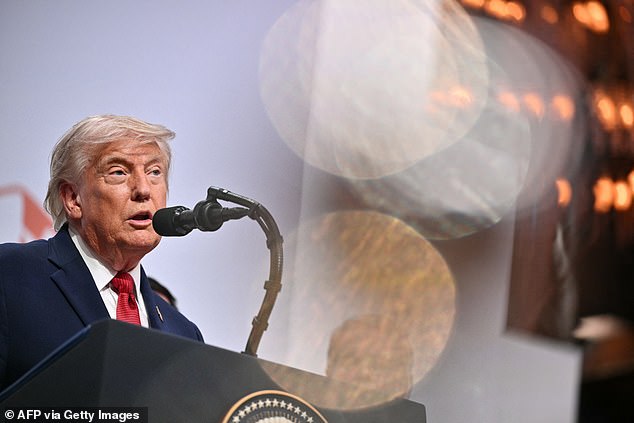

Donald Trump has hit back at critics who said he had not been tough enough with Iran after signing a peace deal aimed at ending the war and reopening the Strait of Hormuz.
The US President took to his Truth Social platform this morning after several US lawmakers and politicians warned that the US-Iran Memorandum of Understanding does not curb Iran’s nuclear ambitions and leaves Tehran with a strategic advantage over the Strait of Hormuz.
‘These fools, who think I haven’t been tough enough on Iran, when the Stock Market Just Hit A RECORD HIGH, and Oil prices are “tumbling” down, are either jealous, bad people, or stupid. MAKE AMERICA GREAT AGAIN!!! President DJT,’ the American leader wrote.
The agreement, which took ‘immediate effect’ last night, also includes a plan for Iran’s ‘reconstruction’ and the US terminating ‘all types of sanctions’ on Tehran.
However, the issue of Iran’s nuclear programme – the main reason why Trump began his military campaign in February – remains under negotiation for a further 60-day period.
Trump has said the peace agreement will prevent an ‘economic catastrophe’ but threatened to ‘bomb the hell’ out of Iran if no final deal emerged.
Part of the agreement involves Iran making arrangements to ensure that traffic starts flowing through the Strait of Hormuz ‘immediately’.
It also involves the creation of a plan for the rehabilitation and economic development of Iran, while ensuring financing of at least $300billion.
The negotiations have been shrouded in secrecy and confusion for days. US officials refused to disclose the terms even after saying Trump and Vice President JD Vance digitally signed it over the weekend.

Donald Trump has hit back at critics who said he had not been tough enough with Iran after signing a peace deal aimed at ending the war

Trump signed a physical copy on Wednesday while dining with French President Emmanuel Macron at Versailles

Iran’s President Masoud Pezeshkian holds a document showing a memorandum of understanding he signed to end the Middle East war
Trump signed a physical copy on Wednesday while dining with French President Emmanuel Macron at Versailles, the palace where many historic agreements have been signed over the centuries, ending wars or territorial disputes.
‘It’s signed,’ Trump said as he left the dinner at Versailles, which followed his trip to the Group of Seven summit in France.
In a video posted online by a White House aide, Trump was seen seated at a table next to Macron, signing a paper copy of the agreement.
Trump then handed the document and pen to Secretary of State Marco Rubio as people in the room applauded.
‘This was not easy,’ Trump said right before he signed it, according to a video posted to social media by Macron.
Oil prices fell by over 3 per cent after the deal was signed.
In the US, top figures were divided in their opinion over the agreement.
Republican senator Lindsay Graham, one of Trump’s top allies, softened his view of the memorandum after a ‘very lengthy and productive’ conversation with the US special envoy Steve Witkoff.
Graham wrote on social media: ‘After this discussion, it is my opinion that signing the MOU will be beneficial to the United States, in as much as the strait of Hormuz will begin to open, and the hostilities with Iran will stop.’
Senator Ted Cruz, however, claimed Trump is getting ‘very poor advice’ when it comes to the deal, while Senator Bill Cassidy said ‘Reagan is rolling over in his grave’.
He added: ‘Iran’s nuclear ambitions were not curbed, and they have learned that threatening the Strait of Hormuz works and will undoubtedly leverage it in the future.’
And Susan Rice, a former official in the Obama and Biden administrations, called it ‘the biggest national security blunder in decades’.
In Israel, the reaction to a deal has been largely negative, with senior officials questioning how seriously Iran would approach negotiations over its nuclear programme, now that the US has removed economic and military pressure.
Furthermore, Netanyahu’s government was not shown the memorandum of understanding drafted to end the war, an Israeli government official told NBC News.
Yair Lapid, the leader of Israel’s opposition, said: ‘Netanyahu promised us a historic victory – and we got a crisis with the Americans, Hormuz open to the Iranians, money for the Revolutionary Guards, ballistic missiles aimed at Israel, and Israel waiting in the corridor like a scolded child.’

The US President took to his Truth Social platform this morning after several US lawmakers warned that the US-Iran Memorandum of Understanding does not curb Iran’s nuclear ambitions
However, some in Israel had a more positive outlook, with Danny Citrinowicz, a former head of the Iran branch of Israeli military intelligence, saying the deal showed reality had ‘finally returned to US policy on Iran’.
‘Before events spiralled completely out of control, the US administration stepped back from maximalist objectives and returned to a more measured and realistic approach,’ Citrinowicz said on Wednesday.
In Tehran, a stone-faced President Masoud Pezeshkian signed the deal on behalf of Iran, according to the state-run IRNA news agency, which posted images of him holding up the deal with his signature and Trump’s.
Earlier this week, Iran’s parliamentary speaker and key negotiator Mohammad Bagher Ghalibaf warned his country’s finger is on the trigger.
‘If the enemy does not understand the language of logic, we will enter again with the language of power,’ he told state broadcaster Fars.
The text of the agreement still has not been formally released. US officials dictated draft language to journalists after days of secrecy, speaking on condition of anonymity. Iranian state TV later released text that largely tracked what the US put out.
Much of the agreement would restore the status quo before the war, including ending hostilities, restarting talks between the US and Iran over Tehran’s nuclear programme, and reopening the Strait of Hormuz, the crucial passage for the world’s oil and natural gas, whose closure created a historic energy crisis.
The agreement opens the strait without tolls for two months, but does not preclude fees in the future, according to the drafts from both countries.
In return, the US will move to waive, but not eliminate, some wide-ranging sanctions against Iran.
The Strait’s closure drove up energy prices around the world and made many basics, including food, more expensive.
Iran let through some vessels that paid tolls, something never done before in the strait, which has long been considered an international waterway.
The US later provided military support to get other tankers out, but traffic was nowhere near the levels before the war.
The deal also says the US will lift a blockade imposed on Iranian ports and that the strait will return to its prewar traffic levels in 30 days, while acknowledging Iranian mines may need to be destroyed.
The deal also affirms a commitment to Lebanon’s territorial integrity in the face of Israel’s invasion against the Hezbollah militant group.
That is one of the most delicate parts of the agreement because Israel has maintained it will continue to defend itself and to occupy vast swaths of Lebanon.
Iran has said Israel must withdraw under the deal, a condition Israel has already rejected.
‘Without me, there would be no Israel,’ Trump told the G7 summit on Tuesday, calling Netanyahu ‘crazy’, openly criticising Israeli attacks on Lebanon.
‘Too many people have been killed,’ Trump said, ’You don’t have to knock down an apartment house every time you’re looking for somebody, because there are a lot of people in those apartment houses, and they’re not all Hezbollah.’
The US and Israel went to war on February 28 in part to prevent Iran from ever getting a nuclear weapon.
Trump has cited various goals for the war, including at times vowing it would end Iran’s nuclear and missile programmes and its support for Hezbollah and other proxy groups in the region. He also suggested it could lead to toppling the Iranian government.
The interim deal falls short of all those goals, but Trump hailed it on Wednesday as ‘very strong.’
He also opened the door to abandoning it: ‘It’s a memorandum of understanding, and if I don’t like it, we’ll go back to shooting at them, dropping bombs.’
The US agreement to immediately allow Iran to sell its oil freely and the offer to eventually lift all sanctions represent major concessions that go beyond the terms of Iran’s 2015 nuclear deal with world powers.

The agreement opens the Strait of Hormuz without tolls for two months, but does not preclude fees in the future

Trump with Macron at Chateau de Versailles before signing the deal
Trump withdrew America from that Obama-era pact in his first term, declaring it the ‘worst deal ever.’
Iran maintains its nuclear programme is peaceful, though it is the only country to enrich uranium to 60 per cent purity without a weapons programme, according to the International Atomic Energy Agency.
The interim deal calls for the IAEA to monitor the ‘downblending’ of that uranium in Iran, without elaborating.
The accord likely will draw intense opposition in Washington, and it appears to be a major setback for Israeli Prime Minister Benjamin Netanyahu, who has come under criticism at home from the media, his opponents and even some allies as details emerge.
Under the Obama-era nuclear agreement with Iran that Trump pulled out of, Iran also agreed to restrictions on its nuclear programme and promised never to build an atomic weapon in exchange for the lifting of economic sanctions.
Some concessions to Iran – including the full lifting of sanctions and the release of frozen assets – would happen gradually and be linked to progress in the nuclear talks, according to Pakistani officials.
But in the meantime, the US will issue waivers to sanctions that allow Iran to sell oil freely.