US President Donald Trump threatened to abandon Nato on Friday night after his European allies declined to intervene to help reopen the Strait of Hormuz.
Trump said the US does not ‘have to be there for Nato’, in his latest comments hitting out at his allies for not joining in his and Israel’s war on the Islamic Republic.
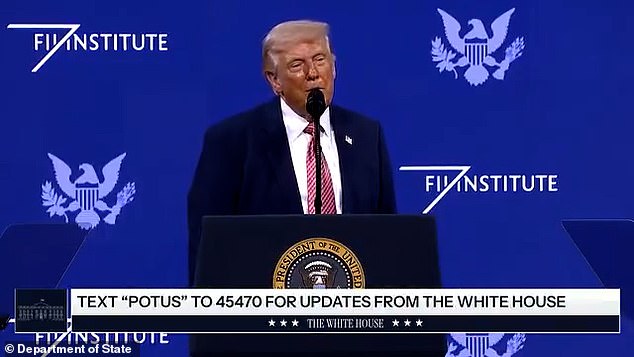
Speaking to an investment forum in Miami on Friday night, the President said he was upset that European Nato countries had declined to provide material support to the US as the conflict enters its second month.
‘We would have always been there for them, but now, based on their actions, I guess we don’t have to be, do we?’ he told the audience.
‘That sounds like a breaking story? Yes, sir. Is that breaking news? I think we just have breaking news, but that’s the fact. I’ve been saying that. Why would we be there for them if they’re not there for us? They weren’t there for us.’
European allies were not consulted by the US on its decision to attack Iran late last month, and many leaders in the alliance opposed the action.
It comes as the White House continues to give mixed messages about their intentions in the conflict, with Trump flitting between claims that the war is all but won and threatening major escalation, possibly even troops on the ground.
Today the war widened once again after the Houthi rebels, an armed terror militia in Yemen, launched a missile attack on Israel.

Speaking to an investment forum in Miami on Friday night, the President said he was upset that European Nato countries had declined to provide material support to the US as the conflict enters its second month

Wreckage of a car garage in Tehran is pictured today, following US-Israeli strikes across Iran

It is the first time the Houthis, which are backed by Iran, have entered the conflict and has sparked fears of another major escalation through increased threats to shipping.
Experts have warned that if the group begins attacking ships in the Red Sea, as it did in 2024 amid the war in Gaza, or the Suez Canal, the global economy could be severely damaged.
The Strait of Hormuz closure by Iran has already sent oil prices spiralling, with other vital global resources such as fertiliser also affected.
Trump has had a famously on-again-off-again relationship with Nato, and he has at various points made comments that provoked questions about his willingness to adhere to Nato’s Article 5, which states an attack against one member state is an attack on all.
Washington-Brussels relations soured in 2026 after Trump ramped up his threats to invade Greenland, which is an overseas territory of Denmark.
He then made relations worse by baselessly claiming that Nato troops, including British personnel, stayed away from the front lines in Afghanistan.
And since the beginning of the Iran conflict last month, he has branded countries in the alliance ‘cowards’.
Last week, he shared a post on Truth Social which read: ‘Without the U.S.A., NATO IS A PAPER TIGER!
‘They didn’t want to join the fight to stop a Nuclear Powered Iran.

Missile traces are seen over the West Bank on Saturday night, believed to belong to a missile launched by Yemen’s Houthi rebels

A large plume of smoke rises over Tehran after explosions were reported in the city last night

Wreckage is seen in the suburbs of Beirut, Lebanon after almost a month of Israeli strikes on the country

Last week Trump called Nato members ‘cowards’ and said the alliance was a ‘paper tiger’
‘Now that fight is Militarily WON, with very little danger for them, they complain about the high oil prices they are forced to pay, but don’t want to help open the Strait of Hormuz, a simple military maneuver that is the single reason for the high oil prices.
‘So easy for them to do, with so little risk. COWARDS, and we will REMEMBER!’
Nato allies have repeatedly said that Trump’s war on Iran does not engage Article 5, meaning they are not obliged to join the conflict.
The President has also criticised Prime Minister Sir Keir Starmer, saying he is ‘no Winston Churchill’, and referred to British aircraft carriers as ‘toys’ since the outbreak of the war.
Sir Keir has said Trump is attempting to ‘put pressure’ on him and the wider Government to get involved in Iran.
Today it was claimed Trump is considering ramping up his demands of his Nato allies, by introducing a ‘pay to play’ style system that would see nations stripped of powers if they fail to meet a five per cent spending target on defence.
Nato members currently already spend at least 2 per cent of their GDP on defence, after Trump urged Nato members to double their military funding in 2018.
The alliance’s secretary-general Mark Rutte said leaders would have to set out plans for reaching the new 5 per cent target at a summit in Turkey later this year.

Lebanese residents inspect the heavy damage to their homes and buildings following an Israeli airstrike on the town of Sakesakiye, near Sidon in southern Lebanon

esidents carry personal belongings as they leave a building damaged in a missile strike in Tel Aviv, Israel, early on Saturday

Ukranian President Volodymyr Zelensky arrives in the UAE for a previously unannounced visit on Saturday

Trump and other NATO leaders pose for a photo at last year’s summit at The Hague, on June 25
An administration source told the Telegraph: ‘The frustration we’ve had with the Europeans has been very real.
‘Any country that’s not paying 5 per cent shouldn’t be allowed to vote on future expenditures at Nato.’
A US source added: ‘We need to start the conversation about what is a threat and what does the alliance do. We have to send the message that what Spain and the UK did is unacceptable.’
The proposals by Trump could see under-spending member nations excluded from decisions on expansion, joint missions and the triggering of the Article 5 mutual defence clause, which would see countries go to war.
Britain is hitting the current 2 per cent target, but proportionately spends less on defence than 13 other Nato allies.
Nato’s annual report published on Thursday found Britain spent 2.33 per cent of its GDP on defence last year – just above Romania, Bulgaria, and North Macedonia.
The change would also need consensus from other Nato members – and since many allies are unlikely to approve of Trump’s proposal, a further battle with Trump could ensue.
Elsewhere on Saturday, it was confirmed that at least two dozen US troops have been injured in attacks on a single air base in Saudi Arabia this week.
Ukrainian President Volodymyr Zelensky made a surprise visit to the region to strike defence deals with the UAE and Qatar.
He said on Saturday that deals he signed with Gulf nations during a tour in the region envisaged a decade-long cooperation on defence, including on establishing joint production lines.
‘We are talking about a 10-year cooperation. We have already signed a relevant agreement with Saudi Arabia, we have just signed a similar agreement with Qatar, also for 10 years, we will sign one with the Emirates,’ Zelensky told reporters.
Earlier Zelensky said his country and the United Arab Emirates have agreed to cooperate on defence amid drones Iran launches in retaliation for US-Israeli strikes.
Ukraine also signed an air defence agreement with Saudi Arabia during Zelensky’s visit to the kingdom on Friday.
Kyiv has sought to leverage its expertise in downing Russian drones to help Gulf nations and has deployed anti-drone experts to all three countries Zelensky has visited during his diplomatic tour.
‘The agreement includes collaboration in technological fields, development of joint investments and the exchange of expertise in countering missiles and unmanned aerial systems,’ Qatar’s defence ministry said in a statement during Zelensky’s visit.
Strikes continued across the Middle East on Saturday, including in Lebanon, Iran and Israel.
An Iranian attack reportedly caused ‘significant’ damage to equipment at Kuwait International Airport, while Tehran also claimed to have struck a US support vessel close the Omani port of Salalah.