President Donald Trump is set to be briefed by top aides this week as he plots out the level of his response to the Iranian regime’s brutal crackdown against citizen-led protests.
Trump’s top military and diplomatic staffers, including Secretary of State Marco Rubio, Secretary of War Pete Hegseth, and Joint Chiefs Chair Gen. Dan Caine, are anticipated to be present at the meeting, per the Wall Street Journal.
The meeting comes as Trump is understood to be considering further US involvement in the region, but no final decisions are expected to emerge until after Tuesday’s scheduled meeting. Putting U.S. troops’ boots on the ground is also not on the table, per CNN.
Protests within Iran have escalated since the New Year, and the regime, led by Ayatollah Khamenei, has sought to limit its citizens’ access to the West by cutting off internet connection as well as telephone lines.
Protestors have, however, still been able to get information out of the country through the use of Elon Musk’s Starlink satellite technology.
Trump has intensified his public statements since the protests began, warning Iranian authorities against using force and repeatedly expressing support for what he has described as a push for freedom.
‘Iran is looking at FREEDOM, perhaps like never before,’ the president noted in a post to his Truth Social account, adding that ‘the USA stands ready to help!!!’
The State Department has echoed a hardline tone, pointing to previous US actions against adversarial governments as evidence that Trump follows through on his warnings.
‘Do not play games with President Trump. When he says he’ll do something, he means it,’ a recent social media post from the State Department read.

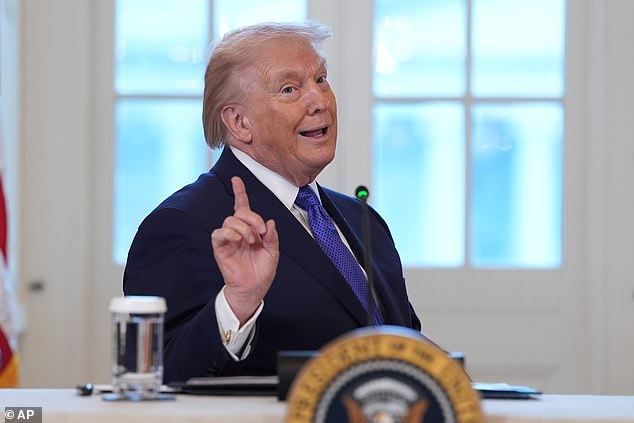
President Donald Trump talks about the White House ballroom construction as he arrives to speak during a meeting with oil executives in the East Room of the White House, Friday, Jan. 9, 2026, in Washington

Flames rise from burning debris in the middle of a street in Gorgan, Golestan Province, Iran, on January 10, 2026, as protesters set fire to makeshift barricades near a religious center during ongoing anti-regime demonstrations

Iranian Supreme Leader Ali Khameni waves during a gathering of the people of Qom in Tehran on January 9, 2026
Back in June, Trump directed the US military to deploy a dozen 30,000-pound ‘bunker buster’ bombs that ‘obliterated’ Iran’s three largest nuclear facilities.
‘The strikes were a spectacular military success,’ Trump said in a late-night address to the nation from the White House the day after operation.
The US military joined forces with Israel to launch military strikes against Iran at the time using B-2 ‘bunker bomber’ planes.
Trump later indicated that his decision to authorize the strikes was influenced by the possibility of renewed diplomatic engagement with Tehran.
The appetite for the US to engage militarily with Iran may not be high, even among capitol hill republicans as Senators are looking to reign in Trump’s ability to act without their approval.
The Senate cast their latest vote on a war powers resolution, which was pushed by a bipartisan duo, Virginia Democrat Senator Tim Kaine and Republican Senator Paul of Kentucky, passed on Thursday after the capture of Nicolas Maduro by US Special forces last Saturday.

Senator Rand Paul (R-KY) speaks to members of the media after the Senate voted on the Venezuela War Powers Resolution at the U.S. Capitol on January 08, 2026 in Washington, DC. The Senate passed the bipartisan resolution 52-47 which will block President Trump’s use of the U.S. military force Venezuela without Congressional authorization

Protesters set on fire a portrait of Iranian Supreme Leader Ali Khamenei as they take part in a rally in support of the current protest movement in Iran, outside Downing Street in London, Britain, 11 January 2026. Since 28 December 2025, nationwide anti-government protests have taken place across Iran despite a heavy crackdown
Senators Lisa Murkowski of Alaska, Susan Collins of Maine, Rand Paul of Kentucky, Todd Young of Indiana, and, most surprisingly, Josh Hawley of Missouri all sided with Democrats on a the move to restrain Trump’s authority which passed 52 to 47.
Thursday’s passage alone won’t prevent Trump from taking further military action without Congressional consent – it only promises to put a vote to limit the President’s power on the calendar at a later date. The measure still faces another vote for final passage in the Senate.
Yet, their action alone was enough anger Trump, who came after the five defiant Senators, calling for them ‘never be elected to office again,’ in a Thursday social media post.