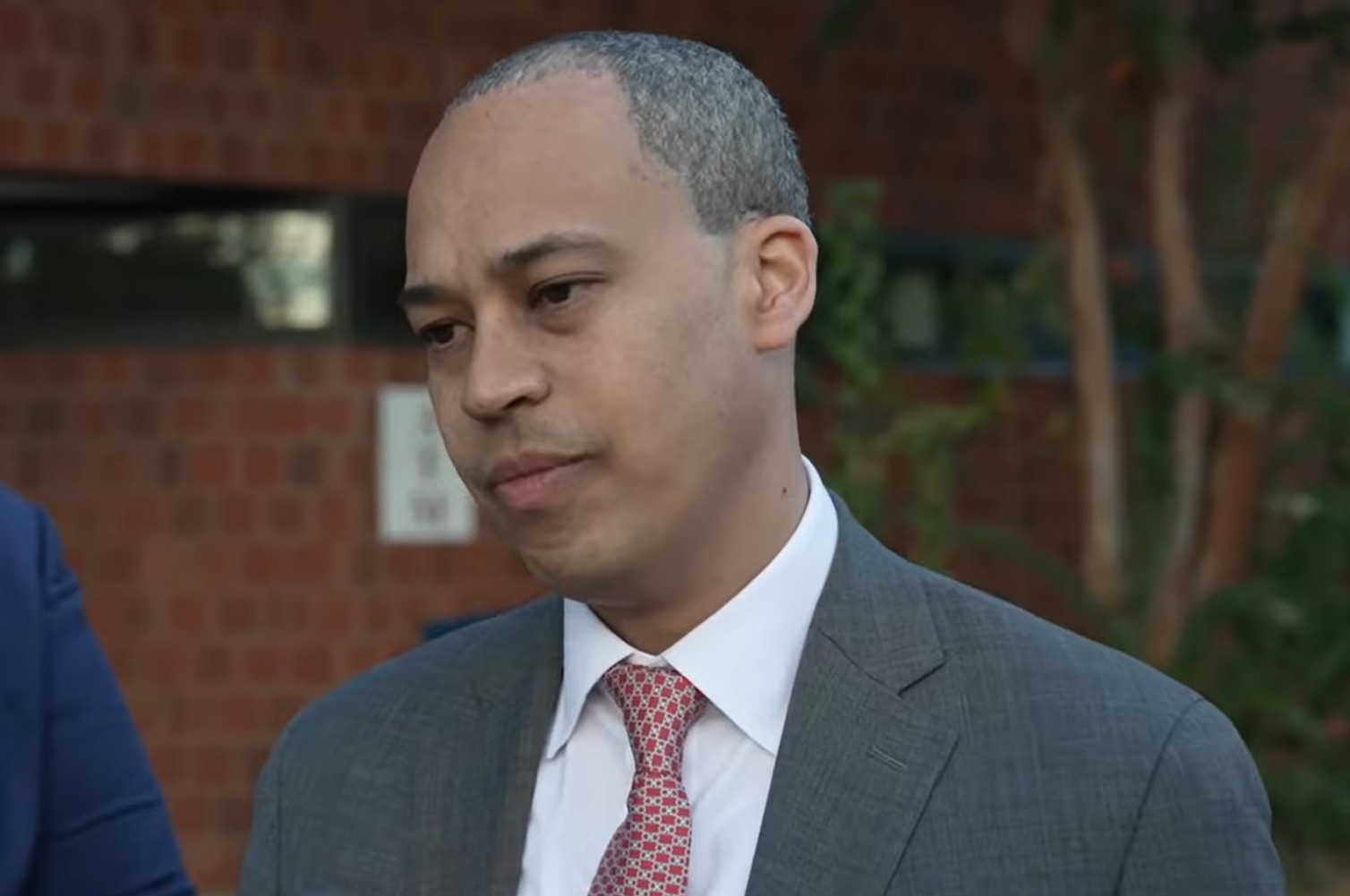

Attorney General Jay Jones, D-Va., attempted to defend the commonwealth’s redistricting ballot initiative in an appeal to the state Supreme Court, while doing his best to dance around the amendment’s misleading language.
In a spring special election Democrat legislators presented Virginians with a constitutional referendum to gerrymander the state’s 11 U.S. House districts, shifting the balance of power in the delegation from six Democrats and five Republicans to 10 Democrats and one Republican. Democrats sold their proposal using the following language: “Should the Constitution of Virginia be amended to allow the General Assembly to temporarily adopt new congressional districts to restore fairness in the upcoming elections, while ensuring Virginia’s standard redistricting process resumes for all future redistricting after the 2030 census?” (Emphasis added.)
Virginia voters voted in favor of gerrymandering, based on that language.
A blanket ruling from the circuit court in Tazewell County nullified the vote and blocked the referendum from being officially certified the day after the redistricting measure passed. The court noted that the language Democrats used on the ballot was “flagrantly misleading” and did not “accurately describe the proposed amendment as it was passed by the General Assembly.”
Jones appealed to the state Supreme Court, but in his motion to stay, he made no effort to address the central language question on the ballot — the phrase “restore fairness in the upcoming election.”
“It asks voters whether to amend the Constitution to allow the General Assembly to ‘temporarily adopt new congressional districts,’ while ‘ensuring Virginia’s standard redistricting process resumes for all future redistricting after the 2030 census,’” Jones’ motion states.
As Republican state Del. Wren Williams noted, Jones “quotes the words before that line. He quotes the words after it. But he selectively skips the eight words that are the entire reason we are in court to begin with.”
“If the language were defensible, he would have defended it. A lawyer who believes in his ballot question quotes his ballot question. What is there to hide from those reading your Motion? Or may be reading the ballot question for the first time,” Williams added.
Jones only makes reference to the “fairness” language once, where he brushes it off as “rhetorical choices,” stating that “reasonable observers may disagree about whether the accompanying reference to ‘fairness’ reflects persuasive framing.” “Rhetorical choices,” however, are a means by which people understand language and ideas, and “rhetorical choices” are the very things that can make something misleading or clear.
Jones further argues that courts have no jurisdiction to decide whether ballot language is neutral, stating the lower court ruling would “cast courts as editors of legislative ballot drafting, reviewing phrasing for accuracy, neutrality, and rhetorical balance.”
The only potential for a court to step in, Jones suggests, is if ballot language “fundamentally misrepresents the choice presented to voters in a way that might confuse them as to the meaning of a ‘yes’ vote or a ‘no’ vote.” But Jones’ defense raises the question: How many voters in the gerrymandered districts who voted for “yes” understood they were effectively disenfranchising themselves?
When asked repeatedly about the ballot language on CNN, Jones answered the same way he did in the motion to the court, by totally circumventing the central issue. Instead of answering whether there was any veracity to the Tazewell judge pointing out the ballot language issues, Jones dodged the question to talk about how the “yes side prevailed” and called the Tazewell judge an “activist.”
CNN challenged Jones to answer the question again, while pointing out other major legal hurdles to the ballot other than just the language. “Well, look, I’m really proud of Virginia. I believe the right to vote is sacred, not just as Virginians, but as Americans. This is the birthplace of democracy,” Jones said.
“I don’t hear you answering the substance of my question,” the CNN host stated.
Ultimately, as some have pointed out, Virginia’s Supreme Court justices are unlikely to overturn the results of an “election,” even if it was illegal for that election to happen in the first place.
That seems to be precisely why those same justices allowed the referendum to go to a vote, despite successful legal challenges prior to early voting. It allows Democrats, and Supreme Court justices, to make the exact rhetorical appeal to how “illegitimate” it might be for courts to overturn “the will of the people.”
That is exactly what Jones did in his motion: “Less than 24 hours later [after the vote], the circuit court swept the entire referendum aside, declaring the amendment ‘void ab initio,’ deeming every ballot ‘ineffective,’ barring certification of the results, and prohibiting the Commonwealth from taking any step to give the vote legal effect. A vote that cannot be counted, certified, or implemented is no vote at all” (emphasis added).
“It nullifies votes already cast, bars certification of the results, and reaches forward into the administration of Virginia’s upcoming congressional elections — prohibiting the State Election Officials from updating voter registration records, adjusting districts and precincts, generating poll books and ballots, or conducting any primary or general election duties,” Jones continued. “That kind of sweeping, forward-looking command bears no meaningful relationship to the procedural defects Plaintiffs claim and is independently improper under Virginia law.”
As The Federalist reported, two justices who were originally appointed by Republican-majority legislatures are up for reappointment soon, and, should they seek it, would likely need the approval of the now-Democrat majorities.
Breccan F. Thies is the White House correspondent for The Federalist. He is a co-recipient of the 2025 Dao Prize for Excellence in Investigative Journalism. As an investigative journalist, he previously covered education and culture issues for the Washington Examiner and Breitbart News. He holds a degree from the University of Virginia and is a 2022 Claremont Institute Publius Fellow. You can follow him on X: @BreccanFThies.