
Not long ago, Whitstable was a slowly dying fishing port. Today, however, this quaint Roman town on the northern tip of Kent is enjoying a resurgence as a hip seaside playground for affluent young Londoners.
Boarding the coastbound trains from St Pancras on Friday nights, they spend decadent weekends lounging on its Blue Flag beach and washing down Pacific rock oysters – fresh from a farm beside the harbour – with local ales and bottles of fizz.
Many incomers have also bought second homes here, or decamped completely, opting to work from cottages and chalets with stunning views of the Swale estuary and with wild swimming, yachting and surfboarding just beyond their doorsteps.
The resort’s newfound prosperity is evident from its soaring property prices (even a candy-coloured beach hut at nearby Tankerton Bay now fetches £60,000), vibrant cultural scene, trendy bars and seafood shacks.
As planners are set to sanction the building of almost 2,000 new houses in Whitstable by 2043, with new residents swelling its 32,000 population by 15 per cent, this historic maritime town’s future might seem assured.
Disgracefully, however, it is being threatened by the shameful ineptitude of the two water companies that serve its residents and businessfolk – or at least purport to do so.
In the 37 years since 1989, when England’s water industry fell into the hands of private investors – whose only interest was lining their pockets – its list of catastrophic failings has grown exponentially.
The latest villains are South West Water, fined £1.8 million this week for allowing cryptosporidium from animal faeces to contaminate drinking water in Devon; and South East Water (SEW), whose woeful inability to cope with increased demand during the recent heatwave caused taps to run dry in 22,000 properties across Kent.

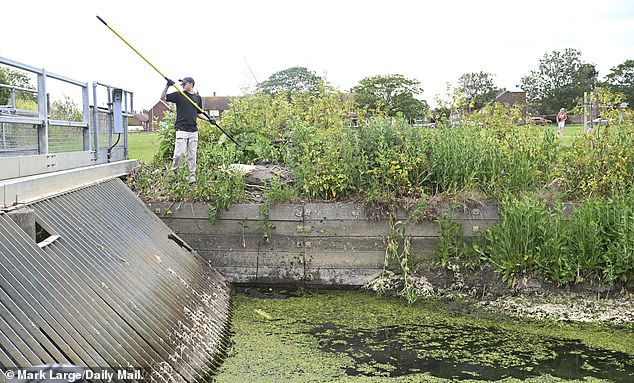
An Environment Agency operative clears obstructions from the barrier at the Swalecliffe Brook close to the sewage treatment works

A candy-coloured beach hut at nearby Tankerton Bay now goes for £60,000
Among the towns to thirst and rage through last week’s unforewarned ‘outage’ was Whitstable – which surely epitomises the scandalous state of our water industry more starkly than anywhere else in England.
For this newly chic resort is being caught between two serially failing water companies: SEW – the devils who repeatedly leave residents and businesses without supplies – and Southern Water (SW), which handles its waste disposal with similar ineptitude, and is quietly turning its seemingly pristine bathing water into a dirty brown sea.
This week, local anger was trained on the former company, whose ludicrous inability to provide water during a mini heatwave that brought tourists flocking has cost traders an untold fortune.
On Tuesday, however, just as the tap water was beginning to flow again, another ongoing scandal was returning to haunt Whitstable with a filthy vengeance.
Strolling eastward along the gently curving coastal path to Tankerton Bay, the vista was glorious and quintessentially English.
I passed a flotilla of moored racing yachts, and those expensive beach huts, and marvelled at the distant Maunsell sea forts – tripodic towers built to repel Luftwaffe bombers during the Second World War.
Then I reached Long Rock, a salty wilderness designated a Site of Special Scientific Interest for its colonies of roosting plovers and purple sandpipers, and a rare species of estuarine moth that lays its eggs in the thick clumps of fennel.
It all looked so reassuringly unsullied – a place to reinvigorate the people who had gravitated here: dog walkers, families picnicking in the shelter of wooden groynes as their children paddled in the shallows, and one or two hardy swimmers.
Regrettably, however, this stunning stretch of the Swale estuary is not nearly as pure as it appears.
Join the discussion
Should water companies face jail time for polluting beaches while leaving homes without running water?

A dried up pond at Swalecliffe Brook Nature Reserve close to the sewage treatment works

Fed-up residents of Whitstable took to the sea in protest at a week of water shortages across the area
Only those who had troubled to log on to Southern Water’s website to check its Rivers and Seas Watch portal would have known it, but anyone splashing in the tide there on Tuesday could have been risking their health.
A few yards from Tankerton Beach lies the company’s Swalecliffe Wastewater Treatment Works, the stench from which fugs the sea air on breezy days. And it takes only a modest amount of rain to expose its ineffectiveness.
Late on Monday, the hot weather broke. Records show that 10.74mm of rain fell. Even this was enough for raw sewage to start spewing into the sea at 7.55am on Tuesday, via a locally notorious outfall pipe called Swalecliffe No.1.
As the run-off water from roofs and street drains mingled with waste from toilets and sinks, a safety valve was triggered to avoid it backing up and flooding properties.
This caused a Combined Sewer Overflow (CSO), which disgorged the foul brown soup at a rate of about 205 litres a second.
Since Southern Water admits that the first CSO on Tuesday lasted for 68 minutes, 836,400 litres of filth (enough to fill one third of an Olympic pool) could have been pumped out through Swalecliffe No.1, which – even after a recent extension – empties just 1,800 metres out in the estuary.
A second discharge, prompted by heavier rainfall in the afternoon, lasted for 80 minutes, more than doubling that amount.
The company’s website, with its euphemistic jargon, advised that these overflows – which were seen all along England’s southerly coastline that day – might have ‘impacted’ the bathing water quality of two nearby beaches.
We need only examine their own statistics to see that CSOs from Swalecliffe No.1 are a worryingly regular occurrence.
Though environmental regulations state they are only acceptable very rarely, after extreme rainfall, this rogue pipe has already pumped untreated effluent into the sea more than 60 times this year.
In January and February, the toxic sludge cocktail, which could cause gastric and respiratory illness, poured out for 400 hours.
‘If you look out at the sea, you’d have no idea this was happening and think it looks lovely for a dip,’ remarked Whitstable Green councillor Stuart Heaver, as we gazed at a not-too-distant buoy believed to mark the end of the outfall pipe.

Ed Acteson (pictured), a local all weather swimmer who is part of the SOS Whitstable swimming campaign group which protest against the water pollution and illegal sewage spills

Water was covered in green algae and other pollutants
‘But local people will tell you their children have fallen ill, and dogs have died, after going into the water here.’
So how could Tankerton Beach have been awarded a coveted Blue Flag, which requires good quality bathing water? The award was ‘meaningless’, Heaver claimed, because tests were carried out only in spring and summer when rainfall was light.
‘The fish are still out there in the winter,’ he said caustically. ‘The Blue Flag is the biggest con because it just gives people more confidence.’
Ed Acteson, a member of SOS Whitstable – a local sea swimming group that campaigns against pollution – agrees.
He claims a woman bather was poisoned so seriously by contaminated seawater here that she needed strong antibiotics and her doctor warned her she could contract stomach cancer.
‘The two water companies who operate here are both terrible,’ he says, adding with a hollow laugh, ‘So we’ve got this incredibly ridiculous situation where s**t is chucked in the sea because one company can’t handle the rain . . . and our water supply stops because the other says there isn’t enough rain.’
The irony is not lost, either, on James Green, whose Whitstable Oyster Company grows eight million Pacific rock oysters on a huge bed in the estuary.
As he also runs a hotel and a string of restaurants and seafood shacks in the town, he has been caught in a crab-like pincer between Southern Water and South East Water.
Green’s battles with Southern Water date back to 2013, when E.coli bacteria was detected in his shellfish on the eve of the annual Whitstable Oyster Festival.
Embarrassingly, the tens of thousands of visitors – among them the then Prince Charles – had to be served oysters from Ireland. Admitting that the contamination had been caused by untreated sewage pumped from Swalecliffe, SW was fined £500,000.

Whitstable Green councillor Stuart Heaver (pictured), questioned how Tankerton Beach have been awarded a coveted Blue Flag, which requires good quality bathing water

The contamination had been caused by untreated sewage pumped from Swalecliffe

Polluted water at Swalecliffe Brook Nature Reserve close to the sewage treatment works
If this transgression cost Green’s company dearly, his losses were far higher after officials in Hong Kong found traces of the norovirus in a consignment of Whitstable oysters in 2020.
At the time, the company was selling one-and-a-half tons to the Chinese territory each week, but officials imposed a ban which still exists.
Green says he lost contracts worth hundreds of thousands of pounds, forcing him to change his business model. He now prioritises quality over quantity and sells only in Britain.
Relations with SW have since improved, Green tells me. He has met its chief executive Lawrence Gosden, and is something of a rarity in having a favourable opinion of him.
Last year, when SW was second only to Thames Water for causing the most ‘serious pollution incidents’ (despoiling beaches in East Sussex with millions of plastic pellets in a spill from its Eastbourne Wastewater Treatment Works) Gosden’s pay package doubled, to an eye-watering £1.4 million.
This sparked fury in parliament and prompted eco-warriors to perform an unsettling ‘citizen’s arrest’ on him at an event in London. He is now escorted by bodyguards.
However, Green says Southern Water subsidise the cost of safety tests carried out on every batch of Whitstable oysters at the University of Kent. As a result, there have been ‘no issues for two or three years’.
Slurpers of his famed oysters, which retail for £2 each, will doubtless be relieved to hear this. Yet with Swalecliffe No.1 lurking, barely more than a mile from his breeding beds, the threat of an inclement tide is ever present – as Tuesday’s sewage outflow showed.
Thankfully, 45,000 oysters had been harvested the previous day but, Green says, had the CSO happened on Sunday – before the four-ton batch was gathered – it ‘would have caused more problems’.
In February, when it rained incessantly and sewage pumped into the sea for 14 days, harvesting had to be paused for ‘three or four weeks’.
Then, on Wednesday last week, came the double water company whammy. As the mercury rose above 30C, trippers flocked to Whitstable in numbers seldom seen so early in the season.
Green says it promised to be the most lucrative few days of the entire summer: his 25-room hotel, fishermen-style chalets and eateries were ‘rammo’.
But around 5pm, when kitchen staff turned on the taps, nothing emerged. Cue pandemonium.
In scenes that were replicated throughout the town, angry visitors demanded to know why the water supply had stopped and how long it would take to return. But, Green says, as it was impossible to get through to South East Water, he had no answers.
‘We are the biggest hospitality employer in Whitstable and we have still heard nothing from them,’ he told me.
‘Where is the ops manager? Where is the CEO? Where are they? ‘I’m no PR guru, but the least they should have done was come and say, ‘We haven’t done our homework and we’re really sorry. We’re going to make sure this doesn’t happen again.’
Green hasn’t yet counted the cost of the two-day shutdown. But, as he says, how can anyone gauge the number of people who will choose to spend their daytrips and breaks elsewhere, for fear the waterless nightmare will return? The full cost of the catastrophe may not be known until the end of season.
As he contemplates all this, his latest water bill has just landed heftily on his doormat – a £2,500 charge for supplies to his oyster shack on the South Quay.
Belatedly this week, Nick Price, SEW’s head of water resources, has apologised for the fiasco, urging customers to ‘think of the water network like a motorway’ that became gridlocked by excess traffic.
Yet it has happened twice before in recent months – and Price admits there is no guarantee it won’t happen again.
Perhaps he ought to go further and concede that it is bound to happen again. That much seems patently clear from data SEW presented to Canterbury City Council – which incorporates Whitstable – on March 4 this year.
This matched the number of new houses due to be built in the council area by 2044 under the Local Plan against the water company’s capacity to supply them with water. The shortfall was truly jaw-dropping.
Unless a huge network of new pipes can be laid – highly improbable given the company is already £1.3 billion in debt thanks to its greedy bosses and offshore stakeholders – 10,412 new homes housing almost 24,000 extra residents will not be connected to the water mains.
No one seems to have a clue how this disaster will be averted. Even SEW’s director of operations, Douglas Whitfield, admits it will be ‘a struggle’ and new water sources can’t be ‘magicked out of the ground’.
The company says it will work with councils to accommodate new housing requirements in its water supply plans and intends to invest £2.1 billion over the next five years to ‘improve operational resilience’.
In response to last week’s problems, Whitfield apologised ‘unreservedly’ to all affected customers and said more than 667,000 texts were sent to them.
Southern Water said it would need more information to investigate ‘serious allegations’ of bathers and dogs falling ill from its sewage spillages.
It says it has reduced Swalecliffe’s overflows by 36 per cent since increasing storage at the treatment works in 2023 and is investing £25 million in further improvements as part of its £1.5 billion Clean Rivers and Seas Plan for the next decade.
According to singer-turned-campaigner Feargal Sharkey, as England’s population increases and new housing estates proliferate, the entire country will soon be confronted with the same alarming scenario.
‘We, as taxpayers, have been subjected to the largest criminal fraud ever inflicted on the British public,’ he told me. ‘They [the water companies] have paid themselves £85 billion since privatisation, and during that time not a single reservoir has been built.
‘The law allows for individuals to go to prison for two years and face unlimited fines if they are found to be illegally dumping sewage.’
Hard words, but many people in Whitstable – the town where the fundamental human right to clean and plentiful water has become a broken pipe dream – would no doubt wholeheartedly agree.
– Additional reporting by Tim Stewart