
Socialist Los Angeles City Councilwoman Nithya Raman appeared to concede defeat Tuesday night after it looked like Spencer Pratt would advance to the November runoff election against incumbent Mayor Karen Bass. But then votes kept pouring in days after the Tuesday election, and by Sunday evening, Raman had taken the lead over Pratt.
The 180-degree-turn has left many scratching their heads: How does a candidate who was down by roughly 40,000 votes suddenly jump to second place after she herself publicly signaled her path to victory had all but disappeared? (Raman currently leads Pratt by more than 20,000 votes, after post-election ballot dumps have gone overwhelmingly in her favor.)
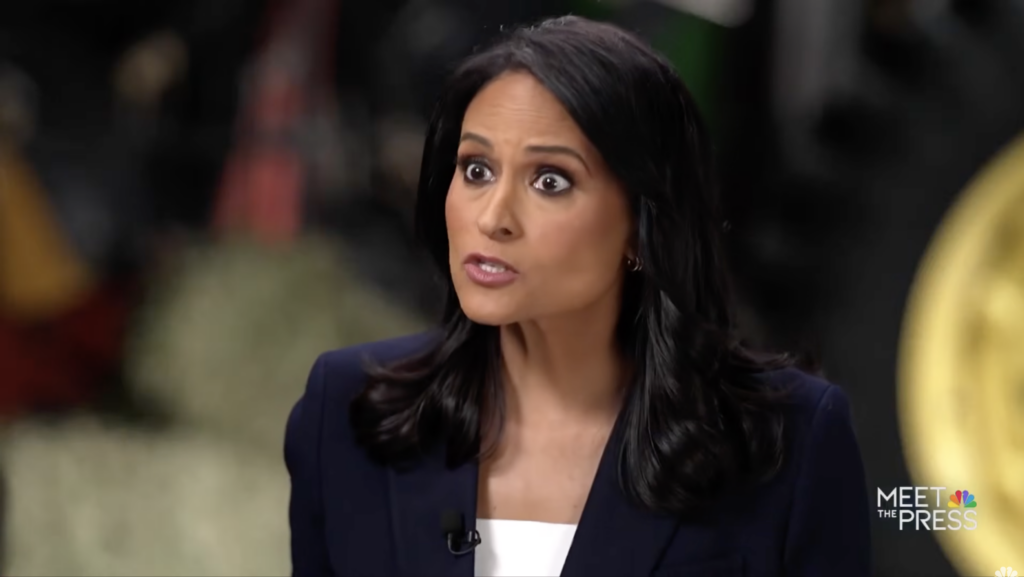
For NBC’s Meet the Press host Kristen Welker, however, questions about such outcomes are apparently evidence of nothing more than public ignorance. During a Sunday interview, President Donald Trump said the 2020 election was “rigged” (and he’s right — but more on that later) and that the same rigging is happening in California.
“Where’s the evidence to that?” Welker asked, repeatedly claiming the days-long vote counting is just how California does elections. But in Welker’s eager dismissal she glossed over some glaring flaws in California’s electoral system that raise the concerns of any American capable of critical thinking.
As of Sunday, Raman had seen a swing of roughly 43,000 votes since election night. Pratt questioned the ballot dump on X: “43,000, huh? Where have I seen that number before…? Probably nothing.” Below that message, he included a screenshot from a March article stating there are roughly 43,000 homeless people in Los Angeles.
Regardless of whether the two numbers are related, California has a history of irregularities when it comes to homeless persons voting or registering to vote.
Notably, 64-year-old Brenda Lee Brown pleaded guilty in May to one felony count of paying a person to register to vote after she allegedly paid homeless people on Skid Row to “help get initiatives on the ballot,” the Los Angeles Times reported. According to her plea deal, Brown “would give people on Skid Row two to three dollars — or, sometimes, a cigarette or a phone cord — in exchange for their signature to help qualify a measure for the ballot,” the Times reported. Armstrong “would also register neighborhood residents to vote, sometimes using her former home address, according to court records.”
In 2020 two people were charged for allegedly submitting thousands of fraudulent voter registration applications on behalf of homeless persons in Los Angeles County, according to NBC 4 Los Angeles.
While none of that means it’s happened now in this race, it does prove that concerns about election administration and integrity shouldn’t be automatically dismissed — unless, of course, you’re Welker.
As a whole, California’s own election rules raise skepticism by design. The state allows all ballots postmarked by Election Day to be accepted up to seven days after the election, creating an election process in which counting can go on for days long after Americans believe an election is over. If a ballot is missing a postmark or if the postmark is disputed, officials can “just go by whatever date the voter wrote inside the envelope,” election expert Hans Von Spakovsky told Fox News.
California has also allegedly blocked federal prosecutors from accessing voter registration records that the Department of Justice said were necessary to audit the state’s voter rolls to ensure the state is complying with federal law, KTLA reported. Notably, California’s loose election laws permit individuals missing a driver’s license or Social Security number to register to vote using something as simple as a gym membership for identification, which does not allow the state to check for citizenship or residency.
Late arriving ballots, long counting times, and dramatic shifts in margins create curiosity, to say the least.
There may be reasonable explanations for how Raman — who has trailed Pratt in the polls and barely had name recognition in the campaign and underperformed in her own city council district — suddenly is No. 2 in the race. But Welker’s “that’s how they count the votes in California” argument is hardly compelling. Reasonable people can observe a candidate who was trailing by tens of thousands of votes suddenly see that deficit disappear and ask questions without becoming conspiracy theorists.
Welker’s dismissive attitude is the same attitude Welker had when Trump brought up how the 2020 election was “rigged.”
“Where’s the evidence to that?” Welker asked.
The evidence “to that” was in Trump v. Raffensperger, to give just one example. In that suit filed in Georgia, Trump alleged specific violations of state election law and the casting of ballots by ineligible voters, such as 66,247 underage voters, 2,423 persons not registered, more than 1,000 voters who illegally listed a P.O. Box address as their address, more than 8,000 voters who died before their votes were cast, amongst other irregularities. Notably, Georgia’s presidential race was decided by fewer than 12,000 votes.
But the merits of the case were never actually heard. As election integrity activists like Cleta Mitchell pointed out, “We never were able to present our evidence to the court, however, because the chief judge of Fulton County, Chris Brasher, failed to appoint a judge eligible to hear the election contest for a month.”
Another difficulty, as described in these pages by Bob Anderson, was that the counsel for the state “demanded in a Jan. 3 letter that all lawsuits against [Gov. Brian] Kemp, [Secretary of State Brad] Raffensperger, and the State Elections Board be dropped in order to ‘cooperatively share information.’”
“Trump’s counsel accepted the offer of dismissal to get information they had requested, but it came as the timeframe to use it ended on Jan. 6. The suit was withdrawn on Jan. 7,” Anderson wrote.
The 2020 election also saw Mark Zuckerberg pour hundreds of millions into turning out the vote in Democrat-heavy areas, brazen left-wing censorship, unlawful changes to election law, weakening of election procedures, and the proliferation of mail-in balloting, among things.
Given California’s extremely questionable election processes, documented cases of voter-registration fraud, and the fact that many 2020 election challenges never received full hearings on the merits despite having good cause, Americans — and Trump — don’t need to be lectured by Welker and other “journalists” about the questioning of those races and their outcomes.
If anything, Trump’s (and the public’s) skepticism about the California races is far more understandable and justified than Welker’s (and the media’s) insistence that every concern can be dismissed with a shrug because it’s just “how they count the votes in California” or because there’s not enough “evidence” to suit Welker.
Brianna Lyman is an elections correspondent at The Federalist. Brianna graduated from Fordham University with a degree in International Political Economy. Her work has been featured on Newsmax, Fox News, Fox Business and RealClearPolitics. Follow Brianna on X: @briannalyman2