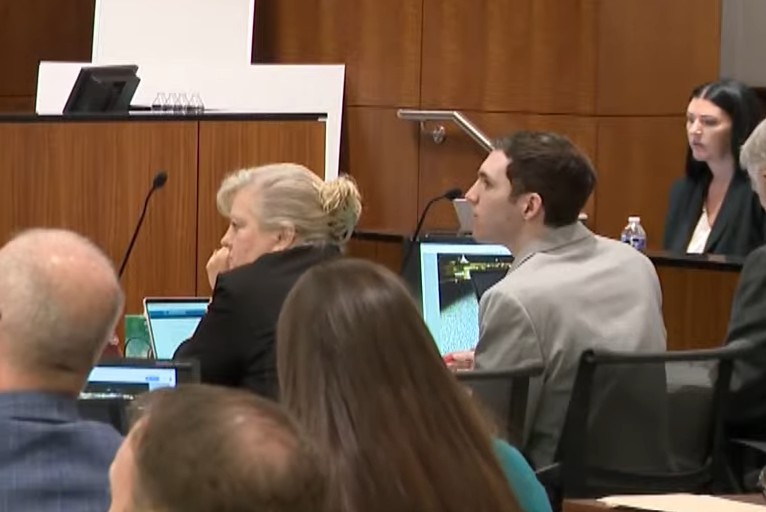
Preliminary hearings for the trial of Tyler Robinson, the man accused of assassinating Charlie Kirk, started Monday as Utah state prosecutors presented exhibits and sought their admission into the actual trial.
Utah prosecutors brought expert witnesses to the stand to testify about their involvement with the police work surrounding the assassination at Utah Valley University (UVU) on Sept. 10, 2025. They also presented multiple exhibits, including affidavits, video footage, and images. Nearly every exhibit was admitted into the trial over the objections of Robinson’s attorneys, but in one case the judge said alterations made to a compilation of videos made it inadmissible.
Before covering the exhibits presented at the hearing, here are some of the personnel introduced on Monday who are sure to be part of the hearings, which end Friday, and the subsequent trial.
Personnel
The judge presiding over the trial in the Utah court is 4th District Judge Tony Graf.
State of Utah
- Chad Grunander, Chief Deputy, Utah County Attorney’s Office. He is a “veteran prosecutor with over 22 years of experience in criminal law,” according to his bio, and he “oversees the Major Crimes and General Crimes Divisions.”
- David Sturgill, SVU Section Chief, Utah County Attorney’s Office. He is a “veteran prosecutor and legal educator with over 25 years of experience in Utah’s criminal justice system. He currently serves as Section Chief of the Special Victims Unit (SVU) in the Utah County Attorney’s Office, where he leads the prosecution of sexual and violent crimes against women and children,” his bio states.
Robinson Defense
- Kathy Nester, a partner at Nester Lewis whose bio says she “has been trying cases in federal and state courts for over thirty years. Her sixty-plus jury trials have included a wide variety of complex cases including capital murder, murder, complex fraud, sex offenses, drug and weapons cases in criminal courts and wrongful death, civil rights violations, employment discrimination and serious personal injury cases in civil courts.”
- Richard Novak, a Southern California defense attorney brought in to defend Robinson. “He is a former Los Angeles Superior Court judicial officer and has represented defendants, witnesses and individuals under investigation by law enforcement and other government agencies for the past two decades. He has vast experience in federal and state criminal investigations, prosecutions and appeals,” according to his bio.
Witnesses
- State witness 1: Officer Chris Bagley. Bagley is currently an officer with the Spanish Fork Police Department, but was with the Utah Valley University Police Department on Sept. 10, 2025, when Kirk was shot. He was assigned to cover security for the event and was a first responder to shots fired.
- State witness 2: David Hull, a 12-year veteran of the Utah Department of Public Safety. At the time of Kirk’s assassination, he was an investigator with DPS’s State Bureau of Investigation Major Crimes Unit, and ultimately became the lead case agent for the Kirk assassination investigation in the state of Utah.
Monday’s hearing laid much of the groundwork for what is to come in the trial, which started with rules and regulations about what kinds of information could be shared publicly, and to what extent. Judge Graf had already allowed a pool camera in the room, but he also put that camera under certain restrictions depending on the kind of information contained in each exhibit.
After blocking news reporters from having portable electronic devices, Graf also divided the admissibility into three different levels: 1) that it is admitted as evidence to the record; 2) that it is published for the view of the courtroom; and 3) that it is published in a way that can be captured by the media, and therefore the broader public.
Graphic videos, such as the ones depicting Kirk being shot, have only been allowed at level one, meaning only Graf, the legal teams, and other officials allowed to have computer monitors in the courtroom have been allowed to view them. Graf directed those with monitors to ensure the screens cannot be seen by the courtroom gallery.
Bagley testified to his experience on the UVU security team of officers on the day of the event, and described his view of Kirk, whom he saw fall to the left after hearing shots fired. In addition, he described students screaming and running and his attempt to preserve the crime scene in the commotion.
He also said that he heard a person had been taken into custody shortly after Kirk was shot, but that he later determined that person was unlikely to have been Kirk’s assassin after seeing a “disturbance in the gravel” on top of the Losee Center building that he described as a “sniper pad” with clear elbow and knee marks.
Nester objected to every exhibit presented by prosecutors, including video of Kirk being shot, but was overruled every time except one, where a compilation of videos was not allowed in because it contained what the prosecution admitted were “minor” edits.
According to Hull, the footage depicts an individual Hull identified as Robinson visiting UVU four times between Sept. 10 and 11. The first two visits were before the shooting, the third was at the time of the shooting, and the fourth was around 12:38 a.m. on Sept. 11, returning to the scene of the crime. Hull also identified what he believes was Robinson’s silver Dodge Challenger using neighborhood footage from a Ring doorbell camera.
Some of the edits included zooming in, red marks directing viewers to look at particular parts of the video, and the like. Graf said that even minor edits were enough to block admission of the video, so after a recess, Sturgill asked to recess until the morning to allow the prosecution to obtain raw, unedited footage.
Breccan F. Thies is the White House correspondent for The Federalist. He is a co-recipient of the 2025 Dao Prize for Excellence in Investigative Journalism. As an investigative journalist, he previously covered education and culture issues for the Washington Examiner and Breitbart News. He holds a degree from the University of Virginia and is a 2022 Claremont Institute Publius Fellow. You can follow him on X: @BreccanFThies.