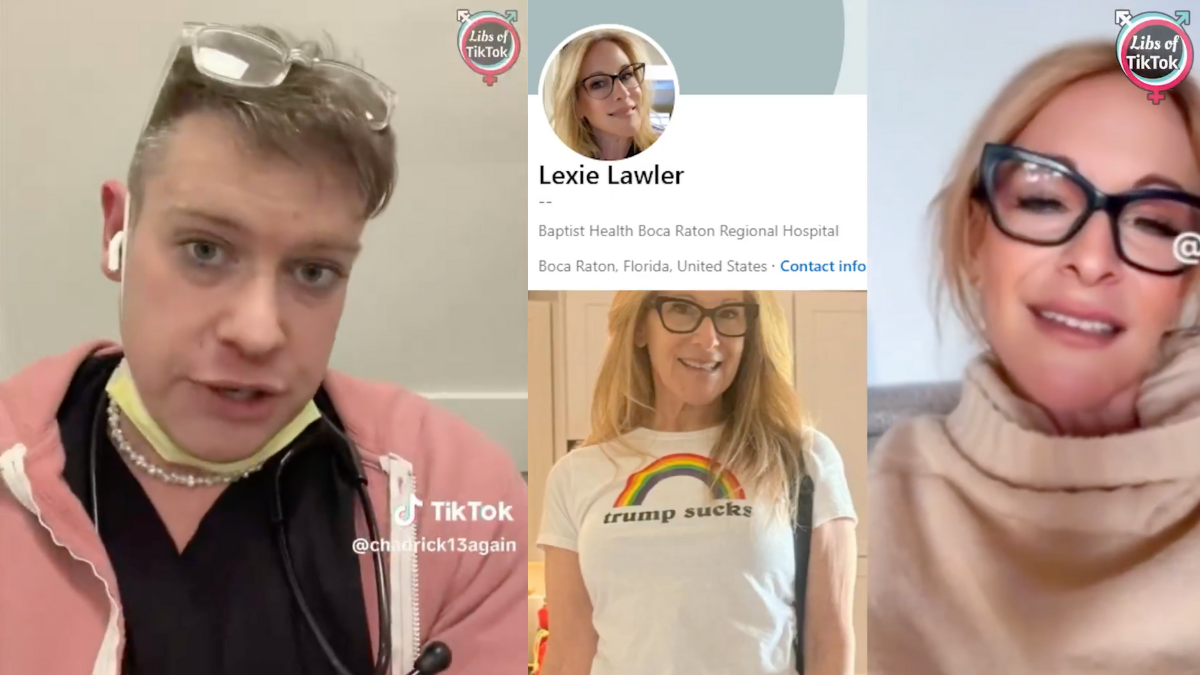

Social media has been abuzz for more than a week over the cruelty on display by some disturbing nurses. Marvel at how brazen these “selfless care workers” are in suggesting that colleagues let agents with Immigration and Customs Enforcement just die. You may especially enjoy nurse “Chadrick13again” who sounds exactly like the stereotyped gay guy from the cartoon Family Guy but more murderous:
That compilation from LibsofTikTok is just the latest in a wave of grotesque postings from the heirs of Florence Nightingale. In the past week, three other nurses have posted videos on social media wishing harm and injury on people they see as their political opponents. One urged fellow nurses to put a paralyzing drug into syringes and stick them into Immigration and Customs Enforcement (ICE) officers.
Is this truly shocking? Five years after the world saw dancing “TikTok nurses” making music videos at their supposedly overrun hospitals, the public may be less willing to give medical professionals the benefit of the doubt. There’s also evidence that long-overdue consequences for this kind of behavior are coming; one of those three nurses mentioned above was fired, and the state of Florida suspended the license of another.
This raises the question: Is there something about the caregiving professions that attracts not just the altruistic, but also a minority of the sadistic? Published literature on this is mixed, and there aren’t very many papers or studies that look at the issue of dark personality traits in medical and related professions. But some of that literature suggests the healing fields may be attractive to a minority of people who would rather hurt than heal.
Let’s look at what caused the online furor last week. Labor and delivery nurse Lexie Lawler of Florida donned her chunky black glasses to look into a camera and wish disfiguring injury on White House Press Secretary Karoline Leavitt. She expressed the hope that the upcoming birth of Leavitt’s child would result in disabling genital injuries:
That came after a nearly identical display of bloodlust from another nurse, Chanda Petrey-Czaruk. She told the world on camera that she hopes the baby’s head will tear Leavitt “from bow to ____ing stern.”
Florida Surgeon General Joseph Ladapo issued an emergency suspension of Lexie Lawler’s nursing license in the state of Florida. Chandra Petrey-Czaruk was apparently fired from her administrative role at an Ohio health care organization, though the company’s statement uses vague language that makes it hard to know exactly when she became a “former” employee.
Another nurse, Virginia Commonwealth University nurse Malinda Cook, urged fellow medicos to put laxatives in the beverages of ICE officers. “Get ‘em sick,” she advised. She also urged nurses to fill needles with a paralyzing agent, succinylcholine, to carry out their ministrations on immigration cops. That drug is a favorite of medical professionals turned murderers, as it has traditionally been almost impossible to detect at autopsy. There are at least five known cases of nurses later convicted of serial murder using the drug.
It is difficult to find much scientific work on the prevalence of dark personality characteristics among those in medicine. What does exist can only be described as “all over the place.” One article rounded up studies that found a high rate (17 percent) of narcissistic personality disorder among medical students. An Indonesian study claimed to find that 30 percent of medical students had a diagnosable personality disorder (caution is warranted with studies from cultures very different from Western societies).
Yet other studies claim the opposite. A 2015 study in the Canadian Medical Journal claimed that “Health care professionals scored significantly lower on narcissism, Machiavellianism and psychopathy than the general population.” One can be forgiven for wondering about in-group bias. As a famous Star Trek episode asked in its title, who watches the watchers?
Whatever the reality may be, it is reasonable to ask whether negative personality traits among medical professionals may be underreported or soft-pedaled. Even taking into account the magnifying distortion lens of social media algorithms, it is clear that medical professionals feel very comfortable publicly expressing sadistic and violent impulses at odds with the Hippocratic Oath. That such people feel safe expressing these views so publicly is new, it is alarming, and it demands attention.
But abusers and even serial killers have long existed in medicine. “Access and Attention: Why serial killers like Lucy Letby often work in healthcare,” published in The Conversation, uses the recent case of a convicted UK serial killer nurse as an illustration.
The author notes that medical professionals like nurses have access to drugs and treatments that can harm or kill. Stir in a dark personality and the danger is clear. Of the known doctor/nurse serial killers, most of them committed their crimes for years under the noses of their colleagues. This paper on medical serial killers notes that “Hospital administrators are often uncooperative with prosecutors and may even obstruct the investigation with reasons being fear of negative publicity, civil suits, and poor record keeping.”
Given the widespread abusive rhetoric and actions of medical professionals against those who refused the Covid vaccines or who tried to refuse dangerous treatments, reasonable people might wonder if there’s a bigger problem in medicine than the field is willing to admit. Part of the problem in trying to answer this question is our confused ideas about what constitutes “real” data. Covid showed us that millions of Americans were willing to close their eyes to medical lies, dangerous medical advice, and mistreatment of patients because authority figures (including the President of the United States) told them to. Obey “the science,” they commanded.
It turns out that “the science” was being manipulated by people like Dr. Anthony Fauci, who was caught in so many dishonest and contradictory statements that many people have lost trust in formerly vaunted institutions such as the National Institutes of Health.
Then consider the widely known replication crisis in psychological research — a majority of studies simply can’t be reproduced with the same results.
If we refuse to entertain the possibility that we may have a problem with sadistic personalities in medicine because “the science” doesn’t say it’s true, then we will repeat the costly mistakes we made listening to authority figures during Covid.
There’s cause for hope and for worry. From this writer’s perspective, too many Americans still cleave to the idea that if someone works in caregiving, they must be trustworthy. And too many Americans still place their trust in “the science” or “the literature,” despite overwhelming evidence that much of it is biased, false, or corrupt.
However, it is heartening to see the swift action taken by Florida to de-license the nurse who smirked at the camera while fantasizing about grave injury to Karoline Leavitt. It’s reassuring that the Ohio nurse who put out a similar grisly video was almost immediately fired. Are proportionate punishments for grave violations of the duty of care making a comeback?
We can hope. But we should not rely on any authority figures or institutions to make our judgments for us — the medical field has covered itself in shame over the past five years. Adults should keep their eyes open and apportion trust and suspicion accordingly.