
How long have you got?” is Professor Owen Epstein’s response when I ask what the vagus nerve does. A pioneering consultant gastroenterologist, his areas of special interest include the role of the vagus nerve in gastrointestinal health and disease.
Like everything else in life, parts of our physiology tend to become “fashionable” in line with genuine medical breakthroughs that advance our understanding of their importance and function. Take the gut microbiome – seemingly overnight, it went from something almost no one had heard of to a mainstream buzzword bandied about by professionals and civilians alike.
Now, it’s the turn of the vagus nerve to undergo the trendy treatment. Never heard of it before? Just you wait – now that you’ve seen it once, you’ll see it everywhere, as dictated by the Baader-Meinhof phenomenon, aka the frequency illusion. It’s only in the last 10 to 15 years that the uniqueness of this remarkable internal communication superhighway has really been appreciated, and only in the last five that chatter has gone from niche to nearing critical mass.
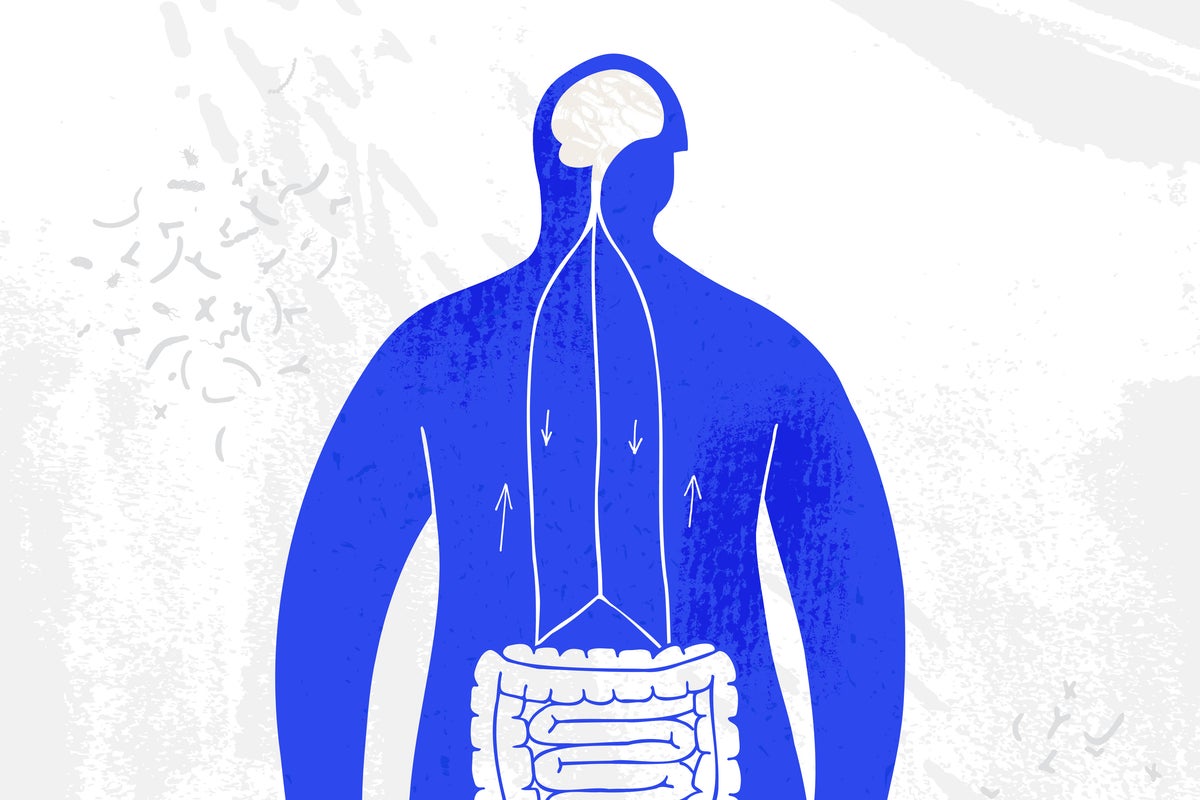
Though there’s still much we don’t understand about it, the vagus nerve is, in essence, the body’s intranet: an incredibly complex information-sharing system that connects our brain to nearly every one of our internal organs. Just as our external environment is constantly being monitored by the radar of our eyes, nose, ears and other senses to check for approaching danger to ensure we can react appropriately, so the vagus nerve is the internal surveillance mechanism for inside the body.
“It has now been reasonably recognised that it is the key to providing our consciousness with information about our internal organs,” says Professor Epstein. “By providing that information in a very precise and very beautiful way to the subcortical area of the brain, the vagus nerve actually orchestrates communication between the organs to try and maintain stability and wellbeing.”
The vagus nerve is constantly modulating the tuning of the organs, he says, “a bit like the conductor of an orchestra” – telling you, if we take the specific example of the gastrointestinal tract, whether you’re hungry, whether you’re not hungry, whether you need the loo, whether you feel bloated. And the same thing is constantly happening across all the organs.

It’s one of 12 cranial nerves – although even the term vagus “nerve”, singular, is somewhat misleading. We’ve actually got two, one on the right side and one on the left, each comprising a bundle of some 100,000 nerves. “So you don’t technically have a vagus nerve – you have 200,000 vagus nerves,” explains Dr Kevin Tracey, a neurosurgeon and scientist whose upcoming book, The Great Nerve, outlines how a whole new area of medicine is being unlocked by an increased understanding of how to harness this powerful system. “Each and every one of those 200,000 fibres has a specific origin in the brain or the body, a specific destination in the brain or the body, and it does a specific thing in the brain or the body – and that specific thing, that path of that fibre to do that job, was moulded and honed and refined by millions and millions of years of evolution.”
Tracey first became fascinated by the vagus nerve’s incredible influence by complete accident. It was the 1990s, and he was interested in how inflammation works and how it can be stopped. His team ran an experiment where they took an anti-inflammatory molecule they’d developed and put it into the brains of animals who’d suffered strokes. The inflammation in the brain stopped; so far, so expected. “What we were surprised by was that the inflammation in the body was also stopped by having this anti-inflammatory drug in the brain – and that made no sense,” says Dr Tracey.
They were stumped until they came to the conclusion that the vagus nerve was connecting brain and body. This communication pathway was acting like a transatlantic cable between the nervous system and the immune system, “which, frankly, just had not been considered before”. No one had anticipated that something as complicated as inflammation could be regulated by the nervous system using a similar sort of mechanism that’s used to regulate every beat of our hearts. “But it is the same,” adds Dr Tracey. “It’s more complicated, but it’s the same.”
Understanding this connection and its potential is already having incredible real-world results on health outcomes across a variety of conditions. It’s led to the development of what’s been dubbed “bioelectric medicine”, treatment using devices that enable vagus nerve stimulation. By sending a specific level of electrical current through the nerve, you can “wake up” or reset the system, similar to rebooting a computer.
It’s only in the last 10 to 15 years that the uniqueness of this remarkable internal communication superhighway has really been appreciated
Clinical trials have already shown positive results in using this technique to treat a wide range of conditions including epilepsy, diabetes, Crohn’s disease, fibromyalgia, irritable bowel syndrome and recovery from stroke, while more large-scale studies are planned for its use in treating multiple sclerosis and obesity-related metabolic syndrome. Vagus nerve stimulation has also been shown across various pieces of research to cure depression – but only in around 50 per cent of patients. Scientists have yet to understand why.
With his specialism in inflammation, Tracey and his team have developed a device that stimulates the vagus nerve to treat rheumatoid arthritis. The small implant, called the SetPoint System, received FDA approval last year; it delivers daily one-minute stimulations to the vagus nerve to offer relief from symptoms, minus the risks associated with immunosuppressant drugs.
Other medical-grade devices to stimulate the vagus nerve have been developed in recent years, including non-invasive wearables such as Nurosym. This type of vagal neuromodulation therapy (VNT) is delivered through the skin of the ear, sending electrical impulses to the nerve via the conch or tragus.
The vagus nerve is also very important in keeping the immune system balanced, and robust experiments have revealed that interfering with the nerve – blocking it or cutting it, for example – produces an inappropriate immune response, leading some experts to theorise that autoimmune diseases may be in part a result of a faulty vagus nerve that’s lost control of its modulating effect. The upshot is an overactive immune system that attacks its own tissues.

In the same way, it could be linked to long Covid and post-viral fatigue syndrome, says Professor Epstein. Continuing on the computer theme, most people presenting with a health problem will be checked for what he calls a “hardware” issue – something that can be seen on an MRI or CT scan. But if that’s ruled out, it could well be a “software” issue.
“Take cardiology, where people go along with chest pain, but there’s nothing wrong with their hearts, or people have lung symptoms and all the tests turn out to be normal,” he says. “For every organ, if there is no hardware explanation, it seems very reasonable to consider that there’s some aberration of the communication superhighway. The information travelling up and down is corrupted in some way, or it has changed in some way.”
This also relates to PTSD and chronic anxiety, linking to the wider “Polyvagal Theory” developed by American psychologist and trauma expert Stephen Porges back in the Nineties. This theory describes the role the autonomic nervous system – especially the vagus nerve – plays in regulating our health and behaviour.
Porges posited that our nervous systems have three main states that we move between: “fight or flight”, termed “mobilisation”, which is our body’s automatic way of responding to threat; “immobilisation”, also known as “dorsal vagal shutdown”, when we feel unsafe but overwhelmed, powerless and unable to act (sometimes known as a “freeze” response); and “social engagement” or “ventral vagal”, activated when we feel safe, relaxed, connected to others and open to social interaction.
The key hypothesis underpinning all of this is that movement between these states is outside of our control. People can, after suffering trauma, get “stuck” in what Professor Epstein calls “reptilian mode” – the immobilisation phase, under the direction of the ancient vagus nerve, which makes them numb or dissociated.
It cheapens very important and sophisticated science that has revealed how the vagus nerve works
The trouble is, alongside all the genuine medical breakthroughs that are having real impacts on people’s health conditions, inevitably there are just as many people bandying about this zeitgeist terminology in the murky world of “wellness”, with very little in the way of hard scientific evidence to back up what’s being presented as fact. Misinformation is rife on social media and YouTube amid the millions of posts and videos relating to the vagus nerve and polyvagal theory.
In some cases, legitimate devices are being used by unregulated practitioners on people who may not need vagus nerve stimulation in the first place. “These modalities are being used left, right and centre by anybody, without any training, without any real knowledge,” says Professor Epstein. “But there’s no point in using vagus nerve stimulation on every Tom, Dick and Harriet. It’s not a panacea. Ideally, with individuals who don’t have hardware disorders, there should be an attempt to evaluate the ability of their vagus nerve to conduct the body – to see whether there is objective evidence that the vagus nerve is actually in cahoots with the body or not.”
Then there are the unproven devices that have not been approved for use in any official medical setting but are being flogged to individuals via spurious claims of vagus nerve stimulation. These are, at best, “highly indirect and off-target” and, at worst, “not stimulating the vagus nerve at all”, says Dr Tracey. “But they’re called vagus nerve stimulators anyway.”
When I mention the topic to a colleague, she immediately mentions the name of a device she’s started using, currently retailing at more than £300, that claims to “tone the vagus nerve” and reduce anxiety and stress by emitting infrasonic waves through the chest. Several other devices work in a similar way and make similar health claims. All cite “scientific research”, but a brief investigation reveals that the studies have been commissioned by the tech companies themselves, rather than being independent; are not peer-reviewed; have rarely been replicated; sometimes don’t include a control group to account for the placebo effect; and usually involve very small clinical trials of 25 people or fewer. In one “scholarly paper”, a little digging reveals that the study only involved six participants.

And that’s before we even get to the range of claims that deep breathing, cold-water immersion, humming, gargling water, singing and yoga somehow “wake up” the vagus nerve.
“It doesn’t mean that people are lying, right?” says Dr Tracey, “but sometimes they’re selling something, and in those cases, I say: buyer beware.” Sometimes they’re making assumptions about cause and effect based on data that doesn’t support cause and effect; sometimes they are “just waving their arms in the air.”
The good news is, using either unproven techniques and wearables or the real deal when you don’t actually need vagus nerve stimulation is not going to have an adverse effect on your health; none of this is unsafe. The bad news is, there is still real harm, says Dr Tracey, that comes with lumping wishy washy “treatments” in with authentic, revolutionary science that’s been clinically proven under rigorous conditions.
“Eventually you get to the point where people don’t believe anything any more,” he warns. “People can wave their arms in the air on social media, and people can sell things on social media, and I’m not opposed to those things – they have their role in the world.
“What I am opposed to is when things that are overstated or factually incorrect are ‘justified’ by millions of likes, because it cheapens and undermines very important and sophisticated science that has revealed how the vagus nerve works. And that’s not good for progress.”