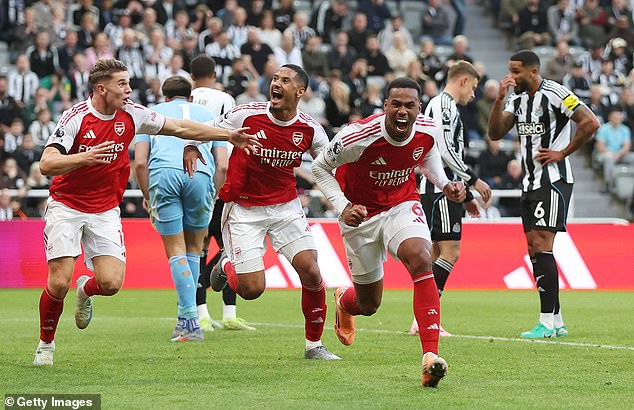

Arsenal’s King of Brazil is back — and how badly they have missed him.
Since Gabriel Magalhaes pulled up with a hamstring injury in a friendly at Arsenal’s Emirates Stadium against Senegal on November 15, the Gunners’ defensive aura has quietly withered. Not collapsed, yet softened around the edges.
That snarling, hostile authority has been harder to summon. Opponents are less frightened when a Gunners corner kick arrives in the area. Undoubtedly, without a central defensive axis of William Saliba and his mate, Arsenal have just not been the same.
It made his return off the bench against Brighton last Saturday an important one with crunch Premier League fixtures for his side on the horizon — starting with Aston Villa on Tuesday.
Before the 28-year-old’s injury, Arsenal had kept seven clean sheets in 11 league matches in the league, 64 per cent. Since then, that figure has plummeted to two clean sheets from nine, less than half as often (29 per cent).
Injuries to a plethora of other defenders have played their part too – Saliba, Ben White, Cristhian Mosquera and Riccardo Calafiori have all missed brief period, and it’s hard to build solidity when there’s a lack of continuity.

Gabriel is back after six weeks on the sidelines in an enormous boost to Arsenal’s title hopes

He suffered the injury on home soil at the Emirates Stadium while playing for Brazil in a friendly against Senegal in November

Without Gabriel, Arsenal have only kept two clean sheets in nine league matches – having kept eight in the preceding 10 games
But the constant is Gabriel, and it is also a reflection of how blunted the defensive element of Mikel Arteta’s side has become when their big Brazilian is absent.
It was only early last month, after Arsenal had conceded five goals across 11 league matches, that comparisons were being made to Chelsea’s 2004-05 season defensive record of conceding just 15 across a campaign. Six goals shipped in the next seven matches has blown that talk out of the water.
Much of the control Arsenal enjoyed earlier in the season arguably stemmed from Gabriel’s presence in both boxes. The Gunners were the most effective set-piece team in the division before his injury, scoring 10 times from dead-ball situations.
Without him, those goals have dried up. Only one has followed — Wolves goalkeeper Sam Johnstone’s own goal from a Bukayo Saka corner earlier this month. That is quite a stark drop-off.
At the other end, he is Arteta’s dominant aerial defender, the one who sets the tone when crosses are delivered or corners are swung in under pressure.
Among his team-mates, he is involved in the most aerial duels per 90 minutes (5.7), with Saliba the only colleague anywhere close (5.1), and boasts the highest aerial success rate in the squad at 60.9 per cent. It is these areas which are foundational for Arteta.
Without him, the Gunners have still been defensively tough to break down — but more vulnerable when games turn chaotic. Look at the recent narrow wins over teams Arsenal might expect to beat comfortably – 2-1 v Wolves, 1-0 at Everton and 2-1 at home to Brighton when they were cruising until Diego Gomez halved the deficit on the hour. It is in these scenarios where opponents have sensed opportunity, which Gabriel usually thrives in.
Of course, it is not just the Gabriel show. He massively benefits from his sidekick Saliba in their formidable pairing. They need each other, Gabriel thriving off confrontation, while Saliba is better at anticipation and recovery tackles. Arteta’s first-choice centre back pairing over the last three and a half seasons forged a bond and understanding which is unrivalled across the league.

Piero Hincapie has stepped up well into Gabriel’s place but the Brazilian offers another level

Gabriel has scored twice this season, including a vital late winner at Newcastle and the opener in a 4-0 thrashing of Atletico Madrid

Of course, it is not just the Gabriel show. He massively benefits from his sidekick Saliba in their formidable pairing
Sources say that neither player is viewed superior over the other at the club, rather that they are a formidable package which has grown through regularly playing together for a period of years. They know each other’s games inside out and sources believe that the recent increase in goals conceded is as much because of how strong they are as a pairing, rather than a lack of ability in their replacements.
Gabriel’s expected return to the starting lineup on Tuesday comes with Arsenal facing a familiar problem in Ollie Watkins, a striker back in form and long accustomed to troubling them.
Watkins has scored four goals in his last five league appearances — and six in 11 matches against the Gunners for Villa. Since the England striker joined Villa at the start of the 2020-21 season, only Son Heung-min has found the Arsenal net more often.
That is where the individual battle becomes compelling. Watkins thrives on space and runs in behind, Gabriel relishes contact and confrontation. It is a clash of instincts, and one that will demand the Brazilian at his sharpest.
There is also the added edge of revenge, having been beaten 2-1 by Unai Emery’s side earlier this month. It will only motivate him further.
More than anything, he will bring the presence Arteta has missed at the back. Gabriel is vocal and his celebrations after blocks and headers can feel as loud as goals. Team-mates feed off it, his manager values it.
With their King of Brazil back, Arsenal regain not just a centre back, but the feeling that the box belongs to them once again.