
The pyramid’s tapestry will never appear richer than across Aston Villa’s festive games over the next few days.
Four supreme Premier League talents up against each other. All attacking, all English, all harbouring ambitions of being the man to provide that moment of banishing World Cup despair.
Today at Stamford Bridge, it is the pair of close friends who met with England’s Under 15s and share a celebration routine: Morgan Rogers and Cole Palmer. On Tuesday night, Rogers goes to the Emirates Stadium where Bukayo Saka and Eberechi Eze await.
A quartet that Thomas Tuchel will surely be taking to North America next summer, all battling for similar spots and all with their own stories of how a place on that plane is deserved.
Saka, the beacon of Arsenal’s academy, on track to becoming a one-club man. Eze, rejected by the Gunners as a kid and a slow burner in the EFL. Palmer, rightfully impatient at Manchester City and a big-money transfer.
And then there is Rogers, whose stunning brace against his mum Deborah’s beloved Manchester United last weekend – twice finding the far corner with powerful curl from the left edge of the box – took him to double figures for goal contributions in the Premier League this season. The first Englishman to manage that, with Phil Foden one behind.

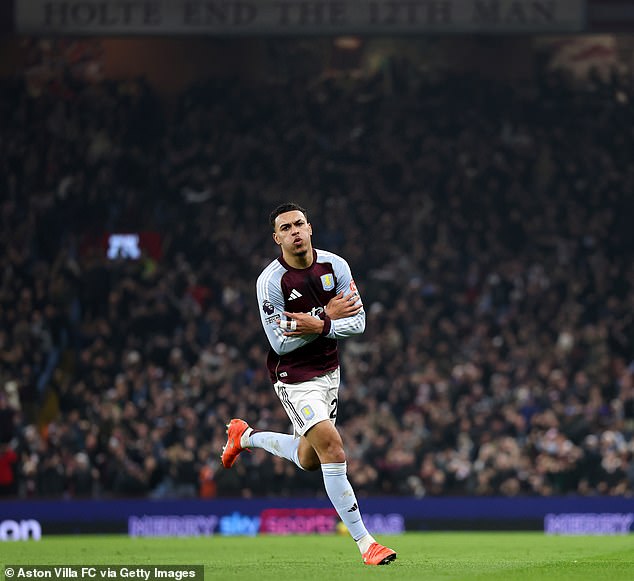
Morgan Rogers has become the boy wonder of English football at Aston Villa

His copycat double against Manchester United last weekend took him into double figures this season for goals and assists in the Premier League

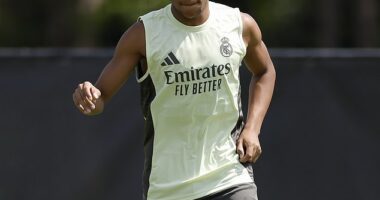
Eberechi Eze (left), Cole Palmer (second right) and Rogers (right) will face off over the next few days, all pushing for England places having all made very different journeys to the top
The Rogers path is different still. One of the most sought-after wingers in the country as a teenager, too good for his age at West Brom. Scouts regularly flooding to the West Midlands, City there on countless occasions from Under 14s onwards. When he and Palmer debuted for England’s age group sides, Rogers took the glory by scoring.
City were so sure of his talent that Rogers was not signed as an academy prospect, instead in the ‘emerging talent’ group – a halfway house between the youth setup and Pep Guardiola’s squad. The plan was first team as quickly as possible.
A deal – difficult to negotiate, according to those around it – rose to £4million. For somebody who had barely turned 17, the figures were enormous. His final appearance for West Brom was netting against City’s Under 18s from the left wing.
Within weeks of arriving, those who matter at City were asking serious questions of their judgment. Reports going back four years had earmarked Rogers as a very real possibility for Guardiola but staff looked puzzled as, in their words, Rogers showed ‘no energy’ and ‘wasn’t the same player’. Lethargic. The idea of a ‘bad mistake’ was privately banded about.
Rogers, the bright light of English football, scored only seven goals in 32 appearances in his first year across the Under 18s and Under 23s, effectively going backwards as others pushed on. Showing a serious amount of self-awareness, he now recognises that he struggled to countenance no longer being the best player in a dressing room – one including plenty of talent from the continent.
‘I didn’t know how to shine, I didn’t know how to get the best out of myself,’ he has reasoned.
City insisted that despite these travails, he could succeed – although the expectations of where that might be had shifted. And this is why Rogers could easily be heralded as a dream FA player, with the different experiences and adversity in both the second and third tier, fighting a way to the top and now being valued by Villa at £100m.
Three loan moves. Rogers describes them as one good (Lincoln City), one a struggle (Bournemouth) and one indifferent (Blackpool). He arrived at Lincoln ‘quite quiet and shy’, according to manager Michael Appleton, who believes Rogers had been lost in the City system – an assessment that is broadly hard to disagree with.

Within weeks of Rogers arriving in 2019, those who matter at Manchester City were asking serious questions of their judgment

It took Rogers a long and winding route back to the top, via loans at Bournemouth, Blackpool and Lincoln
But he retained self-confidence and an inquisitive mind, asking questions in team meetings. And a physicality that meant League One wouldn’t be a tough transition, with Rogers regularly marking the biggest team-mates at set pieces in training as practice.
‘He didn’t really know where to turn, needed a bit of love,’ Appleton told Daily Mail Sport. ‘We allowed him a bit of freedom to enjoy himself. He asked really detailed questions about the press, opposition players.
’Even post-match stuff, he’d question other players in the group, whether they’d made the right pass or cross. Not to be smart, but he was a confident kid.’
That positivity saw Bournemouth come calling in the summer of 2021 as they plotted a promotion charge from the Championship. Just one league start and the spell went so poorly that Scott Parker omitted him from the 25-man squad in January.
Living alone, he leant on centre half Chris Mepham. Rogers credits Mepham – who’d regularly invite him around for dinner – as a reason he didn’t go under.
‘I probably grew up the most there,’ Rogers told Daily Mail Sport. ‘I was focusing on myself more, rather than blaming other things. Bournemouth helped me to become more open to getting better regardless of what people think of you. It’s not just one person’s opinion, loads matter. That was big.’
Family equally so, brother Daniel possessing a Master’s degree in counselling and having worked with Chelsea and Tottenham. Another brother, Ash, would later organise individual training in Miami and the Algarve. The unit is strong.
‘His story should give hope for a lot of players who might need to take a step back,’ Appleton added. ‘That’s the best thing about him, the setbacks. I don’t think there is ever a bad loan.’

He suffered play-off final heartache with Lincoln against Blackpool, the team he would go on to join

Back at City, he was training with the ‘loans group’ – basically those who don’t really have a home
Back at City, he was training with the ‘loans group’ – basically those who don’t really have a home – and how Rogers muscled a way up to Europe’s top table thereafter is testament to mental fortitude.
In January of the next season, 2022-23, Appleton offered respite at Blackpool. Reuniting with a man who Rogers described as a ‘perfect manager’ should have been the tonic after 18 months of barely playing. Especially as he’d actually failed a medical at Blackpool six months earlier, the scans picking up a stress fracture.
But disaster: Appleton was sacked 14 days after signing Rogers, who then spent the rest of the season having his attacking instincts curbed by Mick McCarthy, a coach whose three months at Bloomfield Road ended with him becoming an internet sensation for a pathetically defeatist press conference answer and the team rock bottom of the Championship.
‘Mick toughened me up,’ Rogers said. ‘I found a way to be effective in a way I didn’t think I could be.’
Under a year later, Rogers was an £8m Premier League footballer, rising to £15m. Under two years later, he was being complimented by Guardiola on the pitch after starring as Villa beat City, revealing his pride at the youngster’s development.
Under three years later, he has featured in a Champions League quarter-final and has a hat-trick to his name in that competition, a night when the watching Tuchel first truly noticed his ability. And he is somebody who many are tipping to nestle himself into Tuchel’s starting XI next summer.
To do that would probably require nudging aside his old mate Jude Bellingham, who he used to compete with in local matches as a child in the outskirts of Birmingham.
The launchpad for Rogers’ rise was Middlesbrough, who took a gamble after the Blackpool stint. Even in McCarthy’s losing team, there were signs that his aggressive ball-carrying could be a major asset and, unbelievably, he was at the Riverside with Michael Carrick for just six months.

The launchpad for Rogers’ rise was Middlesbrough, who took a gamble after the Blackpool stint

His final act for Boro was to score against Chelsea and Palmer in a 6-1 Carabao Cup defeat
Villa players were raising eyebrows at how much detail Unai Emery went into on Rogers before an FA Cup tie with Boro. And with good reason, he was through the Bodymoor Heath doors later that transfer window.
The last Rogers act at Boro was to score a sumptuous goal in a 6-1 Carabao Cup semi-final defeat at Chelsea. Palmer performed the ‘cold’ celebration that night, something Rogers himself had started a month earlier. Rogers doesn’t appear bothered that Palmer has trademarked ‘Cold Palmer’.
Like Mepham at Bournemouth, there were others who positively coloured experiences elsewhere and have acted as significant influences – whether they realise that or not. Liam Bridcutt at Lincoln. At Boro, it was Jonny Howson. As with Mepham, he bounced between the top two divisions for much of his career.
‘You see highly experienced players, what they’ve done to get where they are and what it takes,’ Rogers said. ‘It is a big shock to you when you’re younger. I didn’t realise how many games Jonny had played but when you see that and what he does you understand why.
‘You don’t realise until you play with them what kind of people they are. I want to do that, play as many games as they have and do what they’ve done in the game. People have loads of ability but to play that many games is mentality.’
Howson ended with 754 games under his belt and is now, unsurprisingly, a coach and mentor with the Under 21s at boyhood club Leeds United.
There was something refreshing about hearing Rogers talk so glowingly of Howson. Still only 23, he is a bit of an old soul. Those who have worked with him label him an anorak, with knowledge about every player and team under the sun honed on the FIFA (now EA Sports FC) games and doing quizzes as a child with dad, Howard.
At City, coach Brian Barry-Murphy – now halfway to leading Cardiff City back up to the Championship – attempted to improve his finishing and the explosion in every facet of his game under Emery is a triumph of coaching by the Spaniard. The presence, the grace, the game intelligence.

Rogers is now a fully established England international, with 12 caps and a goal against Wales in October

He also has a Champions League hat-trick to his name, against Celtic in January
Rogers has 40 goals and assists in the last 18 months at Villa. In the league, it’s a goal contribution every 151 minutes at the moment. Emery has Rogers down as his most tactically adept weapon, while also ‘a fighter’ and ‘protagonist’.
Despite being jeered by Villa supporters in a Europa League fixture against Bologna three months ago – an uncharacteristically poor night when he was sarcastically applauded for completing a pass – Rogers is on a consistent trajectory of improvement. He is the boy wonder who became lost and used those problems to his advantage. It’s flipped now, he’s been the gate crasher at club and international level.
In September last season, Emery was publicly hammering England for selecting Rogers in the Under 21s: ‘I respect that they are not calling him for the first team, but the second team? He is not a player for the second team.’
Rogers had no qualms in doing media on England duty then, putting things straight, calmly saying he’d discussed the issue with Emery but that there was never a danger of him turning down a call. A senior bow would have to wait until November, although that was down to withdrawals.
‘At this time Morgan is a crucial and important player to the Under 21s,’ interim boss Lee Carsley said days before the call-up. ‘If we can regain the Euros title in the summer with the 21s, he will be a really important part of that.’
He wasn’t. Rogers became too important to Tuchel for that.