
There isn’t a prescriptive guide for how to defend the Premier League title. How to create a dynasty, how to go again. How to back it up.
Keep the same squad? No guarantees. Spend big? It helps but money can’t buy you silverware. Look at Liverpool, 10 points behind the leaders going into the Christmas fixtures having splurged £446million on new signings, twice eclipsing the Premier League record first on Florian Wirtz, then on Alexander Isak. Although not an insurmountable gap, it looks a tall order.
Arsene Wenger never managed it. It was beyond Jurgen Klopp. In fact, only three managers – Sir Alex Ferguson, Jose Mourinho and Pep Guardiola – have been able to mastermind consecutive Premier League titles.
There are some general rules: Do not stand still. Keep moving forward, keep spending, don’t rest on your laurels. Find ways to motivate the players. Capitalise on what has gone before.
But it’s hard. Title winners are almost always outgunned in the market by rivals desperate to topple them, making it even harder to retain that crown. Champions have a target on their backs. Everyone ups their game.
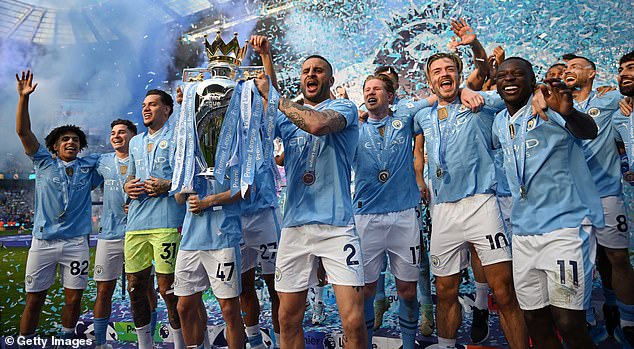
It all makes Guardiola’s four in a row, etched into the record books in 2024, an incredible feat, one that’s unlikely to be matched any time soon. The scale of the achievement will only be truly recognised when Guardiola’s left our game.

Manchester City celebrate winning the title in 2024, a remarkable achievement as it was an unprecedented fourth in a row

Pep Guardiola has been the architect of City’s dominance and is one of just three managers to win back-to-back Premier League titles, along with Sir Alex Ferguson and Jose Mourinho
At the start of that period, 2021, Manchester City had curated a spine they could rely on – albeit a spine that observers felt was not quite as strong as some others. From there, they made yearly splashes, as United had done under Ferguson. Jack Grealish and Erling Haaland: both integral in the third title and the Treble. At £77m, Josko Gvardiol proved the big upgrade for the future, playing in the majority of the march to a fourth crown.
There were a handful of misses as well, Kalvin Phillips primary among those, but City absorbed them until finally falling away last season. Guardiola has put that drop down to injuries but knows that motivation became an issue.
The remarkable thing about their run is that the human nature bits, the motivation, usually rears its head in year one of defending, not four.
His ability to keep training fresh has been a factor. City’s sessions are full of seemingly childish competitive games – always with a ball, always for points in a leaderboard style with teams often decided by where players hail from.
The ‘England’ team won one year, to much surprise and joviality given they’d been described as a ‘disaster’ at head tennis and crossbar challenges. Their successes were the talk of the training ground that season.
Guardiola’s coaching staff often changed, so too the captain. The likes of Kevin De Bruyne and Kyle Walker complaining about standards in training was seen as positive leadership until adverse results last season morphed their vocals into grating criticism.
‘We proved it in the past many, many times,’ Guardiola said. ‘After you win you go down, and we were not, always we were there. I know what we have to do to be there. I have experience for that.’
Nobody around City expected to win a fourth title – particularly as Ferguson’s Manchester United never achieved it. In the league’s history, the slumps usually come far earlier. With the summer spend, Liverpool have attempted to guard against that under Arne Slot, mindful that four years ago they finished a whopping 30 points behind their title-winning total.

Claudio Ranieri led Leicester City to their amazing title triumph in 2016

But he was sacked the following season when his attempts to defend the crown fell flat
Only Chelsea in 2016 and Leicester City in 2017 have overseen worse title defences from a points perspective than Jurgen Klopp’s in 2021, both registering 37-point deficits. Of the last 25 years, only City (twice) and United (twice) have ended the following season with more points.
‘Sustaining a level of performance over a long period of time naturally isn’t easy because sometimes there is a tipping point where it comes down,’ Frank Lampard, part of the Mourinho side to win consecutive titles, tells Daily Mail Sport.
‘When we did it at Chelsea (in 2005-06), there was a real core of a group who were very, very driven. When we won it once, we really wanted to win it again and we did everything we could. And we had a manager who led us. On the first day of pre-season he was saying we need to work harder than last year and we did. It’s not always that simple.’
Chelsea had John Terry, Lampard himself. United: Roy Keane, Gary Neville. City: De Bruyne, Ruben Dias. All three managers possess their motivational quirks.
A fear of failure kept Ferguson going, the old boss seen working in his office at 7am a matter of days after defeat by Barcelona in the 2009 Champions League final. His trick of presenting an envelope to the group, with the concealed names of players who United staff believed had lost their hunger after the 1993 title, was a stroke of genius at the time.
No names were inside, and squad members have since recounted that it had a positive psychological impact. ‘Complacency is a disease,’ Ferguson wrote in his book Leading. He used a similar tactic years later, one subsequently borrowed by Brendan Rodgers at Anfield.
‘I told the mature players who had begun to acquire a taste for United’s victory habits that they could not consider themselves to be a United player until they had won 10 medals,’ Ferguson wrote.
‘I remember saying to Rio Ferdinand that he could never think of himself as a United player until he’d attained the level of Ryan Giggs. Of course, that was mission impossible.’

‘There was a real core of a group who were very, very driven,’ says Frank Lampard (centre) of Chelsea’s title winners under Jose Mourinho in the mid-2000s

A fear of failure motivated Sir Alex Ferguson, who used ingenious psychological stunts to keep his players hungry
While Mourinho galvanised a group to dominate again in 2006, his attempts at new tricks during his second spell at Chelsea – for that ugly title defence in 2015-16 – blew up spectacularly.
Mourinho gave players a month’s holiday and a shortened pre-season but they were badly undercooked and from there, things spiralled. Picking an explosive fight with physio Eva Carneiro on the opening day, a one-match stadium ban for unloading on referee Jon Moss. Another ban for criticising refereeing standards. FA fines up to £90,000, a broken squad, a disenfranchised Eden Hazard and the sack in December.
As proof that one size does not fit all, Guardiola routinely offers lengthy summer breaks and uses the opening weeks as their pre-season to keep his squad happy and engaged. It’s worked fine for him, suggesting that the theory behind Mourinho’s idea was far from flawed. All of the ingredients need to work.
As Mourinho self-combusted, Leicester City’s 5000-1 shot came off yet when the party stopped, they could not handle the champions tag. Claudio Ranieri’s authority within the dressing room diminished, his man-management style of not offering reasoning behind team selections upsetting players who had been used to one game a week and struggled with the Champions League workload.
‘We didn’t understand our bodies,’ Danny Simpson told the football podcast Undr the Cosh. ‘We weren’t ready. The dynamics changed (with Ranieri). If a manager doesn’t speak to you, it gets in your head. It’s the not knowing. It’d be mixed teams and then you’d lose and that horrible negativity would creep in. That love story had been broken up.’
Leicester’s heroes were left upset that the club didn’t renegotiate N’Golo Kante’s contract to remove a £35m release clause. He went on to win the title with Chelsea as Leicester languished in the bottom half.
The recruitment hadn’t been strong enough; Mourinho suffered the same issues 12 months earlier when Chelsea failed to land John Stones, despite the Everton defender handing in a transfer request.

Liverpool’s Arne Slot is also finding it hard to go again having led the Reds to glory last season

Despite heavy investment in the summer Liverpool, so far, have struggled to defend their crown
Roberto Mancini – who unlike his peers, never altered his messaging to triumphant players – found this to his cost in the 2012-13 season, too. Trying to plough on, City identified younger projects to enhance and future-proof the team. Jack Rodwell, Javi Garcia, Scott Sinclair and Matija Nastasic goes down as one of the least impressive summers ever. Maicon added experience but struggled badly.
Gareth Barry, integral in the 2012 title charge immortalised by Sergio Aguero, believed that City ‘missed a trick’ in asserting their dominance. ‘Looking back, there were players that came in, good players that were probably just squad players, so there wasn’t that extra push the players need to keep them on their toes,’ he tells Daily Mail Sport via OLBG.
‘Signings made that summer probably let us down to push us again to the next level. Maybe there was a hangover with stuff, but it’s such a skill for a manager to be able to get a group to go and win another title. It’s so hard and probably hasn’t been done that much.
‘All the hype, all the media attention about being champions, it’s there every game. You can feel it when you’re going out.’ Premier League history suggests that very few deal with that properly.