
There’s more than one way to qualify for a World Cup these days – as Sweden found out this week.
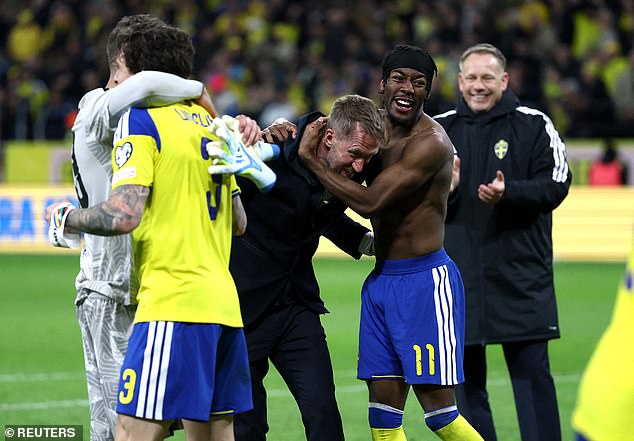
Graham Potter’s side were in ecstasy when they beat Poland on Tuesday night, courtesy of Viktor Gyokeres’ 88th-minute winner. The scenes after were heartwarming – and Potter was chuffed.
‘We weren’t perfect, but who cares?’ he said. ‘We’re going to the World Cup, baby. Wow.’
That’s one way to describe it. In qualifying, Sweden picked up two points from their six games – four defeats and two draws – finished rock bottom of their group, and North America seemed a mile away.
Step forward the Nations League. By virtue of winning their group, Sweden found themselves with another shot at reaching the summer’s tournament.
Quite a lot had to go their way. The four best-ranked Nations League group winners – based on the Nations League interim ranking – that failed to qualify for either the tournament or its play-offs would be granted a pass – and Sweden fit the criteria.

Sweden qualified for the World Cup via the play-offs, despite failing to win a game in their qualifying campaign

Viktor Gyokeres and Graham Potter steered the Swedes to the tournament at the expense of others who had better qualifying campaigns
Potter’s side were ranked 10th out of the 14 winners. But Spain, Germany, Portugal, France, England and Norway qualified, and Wales and Czechia were in the play-offs – that allowed Romania, Sweden, North Macedonia and Northern Ireland a virtual tap-in.
So what exactly is qualifying and the point of it? Why should Kosovo, who finished on 11 points in Sweden’s group – beating them twice along the way – but lost in the play-offs, miss out at the hands of the Swedes, who picked up nine points fewer in actual qualifying?
An incentive to take the Nations League seriously? A way around finding more teams to compete in the play-offs? Probably the latter. Whether it’s the right way is a different question.
There have been plenty of critics of the format as a whole. Italy manager Gennaro Gattuso, whose side also failed to reach the World Cup – for the third time in a row – had some harsh words in 2025, but for a different reason.
‘In my day, the best runners-up went straight to the World Cup (sic, not all of them did), now the rules have changed,’ Gattuso said in 2025. ‘Italy’s record of six wins? You’d have to ask the people who make the groups and the rules.
‘In 1990 and 1994, there were two (sic, there were three) African teams, now there are nine. It’s not a controversy, but there are difficulties, and we know it well.
‘If we look at South America, where six out of 10 teams go directly to the World Cup and the seventh heads into a play-off with a team from Oceania (sic, not certain), that does give you regrets and a certain sadness. That is the disappointment. The system needs to change in Europe.’
Essentially, Gattuso was suggesting that stronger sides are missing out on the World Cup because they are in Europe. It’s essentially an argument of how many teams from each continent should be there. Something consistently monitored and consistently changing.

Kosovo are one of the sides who missed out on qualification despite finishing nine points ahead of Sweden in the same group

Italy will also miss out for the third World Cup in a row, with Gennaro Gattuso (right) also critical of the process
But looking at Sweden’s qualification isn’t necessarily a good look. Some may argue that World Cup qualification should be World Cup qualification full stop. Without the Nations League.
‘The look of this is just sad and disappointing,’ one fan wrote on social media.
Another added: ‘It leaves a sour taste.’
Like anything, this will likely get clearer with time. This is the first World Cup with 48 teams, and things may be adapted in terms of qualifying for future tournaments.
But that is no silver lining for the likes of Kosovo, the likes of Italy. There is little they can do now, though, but look forward, and hope things either change or they themselves get better.
That’s football, eh.