
It was two years ago this week that Jurgen Klopp dropped a bombshell and announced he was leaving Liverpool.
Klopp’s team were dubbed the ‘Mentality Monsters’ due to their never-say-die approach, with high-octane, bang-bang-bang football to go with it. The 58-year-old, who now looks 10 years younger in his new role at Red Bull, was always going to be a tough act to follow.
Arne Slot made a mockery of that concern in his first year at Liverpool, winning the Premier League at a canter. Now, though, the Dutchman is feeling a delayed onset of that expected hangover as fans’ grumbles mount about his football, public persona and, well, the fact he is not Klopp.
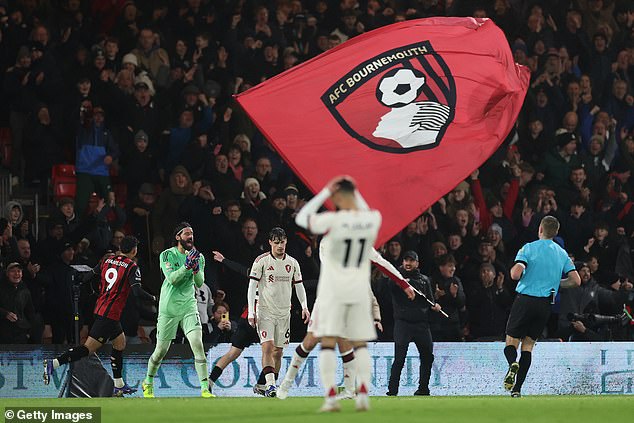
Chief among the concerns are how his team seems to wilt in games. After the 3-2 defeat at Bournemouth on Saturday, Slot talked about how his side ‘ran out of energy’, a sentiment he echoed in his press briefing yesterday.
Indeed, it was their third defeat via a stoppage-time goal this season, after suffering the same fate at Crystal Palace and Chelsea, while wins turned into draws after 90 minutes at Leeds and Fulham. Away teams growing in confidence in the second half at Anfield seems to be another worrying trend – as seen with Burnley, Wolves and Sunderland in the last six weeks.
So, are fans right to moan about fitness – or is it all just a bit of bad luck? Daily Mail Sport has been at every game, spoken to sports science experts and taken a deep dive into the underlying numbers to find the answer…

Liverpool’s trip to Bournemouth on Saturday saw their third defeat thanks to a stoppage-time goal this season

The Reds’ vulnerability to late goals should be of major concern to boss Arne Slot, who has a difficult task in managing all of his players’ minutes
What is the ‘red zone’ – and why are Liverpool always in it?
‘It is safe to say we had a few players who ran out of energy,’ said Slot at Bournemouth, listing three players – Hugo Ekitike, Jeremie Frimpong and Milos Kerkez – as three who were in the ‘risk zone’.
This is a phrase often used by managers, sometimes also called the ‘red zone’, and it essentially means that players are at heightened risk of pulling up injured.
Mark Leather was a head physiotherapist at Liverpool, Sunderland and various rugby clubs before leading a university course in football science, and has more than three decades’ experience in the field.
And he tells Daily Mail Sport: ‘The red zone clearly is the danger zone, red for danger. It does not mean a player will break down, it means he may break down. Maybe in that game or in training two days later.
‘It is a bit like going through a traffic light on a red signal. Will there be an accident? There could be, but there might not. Data is not necessarily the be all and end all, because some can cope with being in the red zone for longer than you think.
‘If players have had previous histories of injuries, or spiked into that zone after four or five matches in a row, that can put them in there.’
The issue Liverpool have is that the problems are the solutions. Theirs is a catch-22 situation: the most-used players will be the ones to drag Liverpool out of this topsy-turvy run of form… but they all look pretty shot of energy and confidence right now.
Leaving top scorer Ekitike out of the starting XI might not be a popular decision, likewise Florian Wirtz lasting the full 90 in just eight of 30 appearances so far – but Slot knows these players are at risk of breaking down if they aren’t managed.

Jeremie Frimpong is one of the players Slot admits is in the ‘red zone’ and therefore at increased risk of injury

Hugo Ekitike was left out of the starting XI at Bournemouth — an unpopular decision with fans — but the Frenchman could easily break down if overplayed
How unlucky have they been with injuries?
There is a theme occurring with bad title defences. Look at 2024-25 and Manchester City, who had Ballon d’Or winner Rodri out for the season and a litany of injuries. It was the same for Liverpool the last time they tried to defend a title, with availability issues wrecking that season.
According to the industry-leading online database on Premier Injuries, five teams have more absentees than Liverpool in the top flight. However, their issue is less about the quantity of blows but the severity, and their concentration in a few positions.
Summer recruit Giovanni Leoni ruptured his anterior cruciate ligament on his debut and is out for the season, as is Conor Bradley, also with a significant knee injury. British record signing, £125million man Alexander Isak, has a fibula fracture and is likely to be out until at least March.
Defender Ibrahima Konate missed the last two games after the passing of his father and, to compound Slot’s worries, his replacement Joe Gomez now has a hip issue. Neither trained on Tuesday ahead of the Champions League match against Qarabag.
There is a vicious cycle, as Leather explains: ‘You are constantly playing game after game after game. If you pick up three or four muscle injuries, which is very easy to do, all those are playing catch-up and the other squad members end up playing more and more.’

Defender Ibrahima Konate (right) missed the last two games after the passing of his father and, to compound Slot’s worries, his replacement Joe Gomez now has a hip issue

Meanwhile British record signing, £125million man Alexander Isak, has a fibula fracture and is likely to be out until at least March
What do the statistics say?
Liverpool are running more than last season, averaging 108.7km per game compared to 104.5km per game, and also sprinting more. This would indicate the fitness levels have actually improved, not decreased.
Slot has used 23 players in the league and only one team, Everton, have used fewer. In terms of XI changes match to match, they are middling, and the same is true of the average age of their starting players (26 years and 248 days).
Liverpool are achieving fewer high turnovers (defined as winning possession in the opponent’s defensive third) and are also down on direct attacks (vertical attacks starting in a team’s own half).
What does this jargon mean? Though the effectiveness and aggressiveness of their press has decreased slightly, their underlying numbers are not too dissimilar from last year, which indicates Liverpool’s issues run deeper than just not being fully fit.
But one stat holds more importance and that is the seven points chucked away in stoppage time.
It is in complete contrast to the opening weeks of the season, that saw them win six of their first eight games after the 80th minute, with four of the winners coming in stoppage time.
Are the new boys still not up to speed?
New signings Jeremie Frimpong, Ekitike, Wirtz and Milos Kerkez have arguably been Liverpool’s best players in 2026, alongside Dominik Szoboszlai.
But it is equally fair to say none of the new faces are fully accustomed to the intensity of this demanding schedule just yet. Players often talk about how England is a different world to leagues on the continent, while the grind of midweek European fixtures is new to the likes of Kerkez.
Last week, for example, Liverpool trained on Tuesday then flew to France, played in Marseille on Wednesday, flew back on Thursday, flew to Bournemouth on Friday, played on Saturday then had to turn their focus straight away to securing a top eight spot in the Champions League.
After Qarabag, they will recover on Thursday, train Friday and play again on Saturday. It is hard for Slot to get any meaningful time on the training pitch and this is a recurring theme, hence why new signings from foreign leagues often do not hit the ground running.
Frimpong, it is understood, has put on around 4kg of muscle mass since his move from Bayer Leverkusen, similar to Wirtz. He has been working on trying to improve his already snappy sprint speed, practising hot yoga and pilates to help aid muscle recovery.
The fixture pile-up means it is hard for new signings to become accustomed to a league, as Leather explains: ‘There is the principle of overload and that is not overuse, it is basically when you can train at a higher intensity and level than you would be required to do in a game.
‘You do that in short blocks then you offload them. You can do that in the pre-season.
‘Through the competitive season you can have little windows where you can overload. It basically means you should have built the resilience to cope with what you do in games because you have done more than that. These windows have become almost non-existent.
‘Football has reached capacity. People physically can’t do much more than they are doing. It’s play, recover, train a little bit, play again, recover again… that’s all you can keep doing. The international “break”… what are they doing? Playing and recovering again. It’s constant.’

Florian Wirtz is one of several new signings having to adapt to the intensity of life in the Premier League

‘Football has reached capacity,’ explains physio Mark Leather. ‘People physically can’t do much more than they are doing. It’s play, recover, train a little bit, play again, recover again…’
So, does Slot share these concerns over fitness?
Sort of – but he has asked for patience and said fans would have more sympathy for him if they understood the problems he faces.
‘If you are not aware of the information (around how fit players are) it is not strange to criticise decisions,’ he said yesterday. ‘But if people knew the struggles we are facing, they would be more understanding of the decisions I make.
‘It’s very hard. Especially with the problems we have with long-term injuries. If I would have started Alexander Isak to give Hugo a rest, no fan would complain. Now I have to adapt the system or put players in different positions. Taking Jeremie off, no one would complain if I brought in a similar player.
‘But I had to end the game with four defenders where only two were real defenders. That does not help with the narrative. That I am completely aware of.

Defender Conor Bradley is out for the season with a knee issue — Slot insists he must be careful to avoid risking his team-mates picking up an injury
‘What would be worse, and Conor Bradley is a great example, is if I gave him two games in a row when he wasn’t ready for that, then he got injured. Before people say I don’t listen to performance staff or medical staff, I am listening and sometimes I make my own decisions.
‘There has been a player who was on the pitch and made a goal at the end of a game where it would have been better to take him off earlier. It is not always that you listen, but you use your eye.
‘I speak to my players and know how they feel and if they are ready to go again for 90 minutes. You take all that into account, make a line-up and decide on your substitutions. For people who don’t have all the information, that could lead to scrutiny. I am aware of that.’