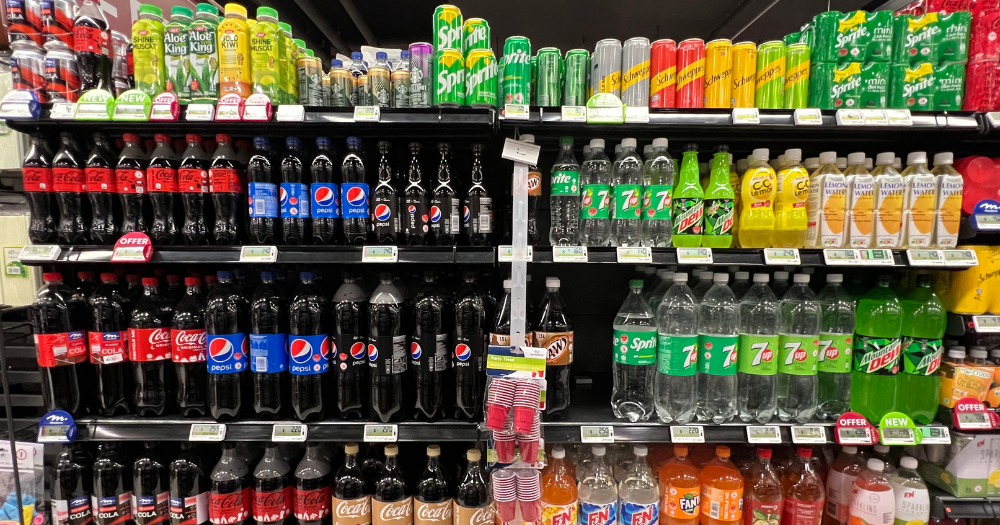



Some producers expect prices for canned or bottled beverages to go up once the beverage container recycling scheme (BCRS) kicks in from April 2026.
This price increase might range from 25 cents to 60 cents, CNA reported.
This is due to fees that manufacturers, importers and distributors may have to pay to ensure that products comply with regulatory requirements for the scheme.
Passing on costs to consumers
Under the scheme, beverage containers will have to carry special barcodes that can be read by beverage container return machines.
Consumers get back 10 cents, which serves as a deposit for the containers, if they return beverage containers at these machines.
As such, international barcodes that are currently printed on the containers may not work, and there will be logistical costs associated with ensuring the containers carry scheme-compliant barcodes and labels.
Devang Bafna, Director of Tian Ma Group Holdings, told CNA that companies like Tian Ma may have “no choice” but to pass such costs to the consumers.
Tian Ma Group Holdings runs a chain of convenience stores and brings in products from countries like Thailand to keep prices low.
Beyond consumer-facing impacts, Bafna also said that smaller-scale companies like Tian Ma might lose out to larger-scale local producers on price.
“We are forced, or we have no cards to play. We have to take whatever cost is given to us and impose them on the consumers. So, as I said, it’s a domino effect. If one does it, the other has to do it, and it falls all on the consumer,” Devang told CNA.
“For example, a can of 100 Plus, if it goes from 70 cents to 85 cents, instead of buying three or four, they might only buy one or two,” Devang also said.
Corrine Chia, co-founder of craft beer supplier The Drinking Partners, relayed to CNA a similar story.
“We need to go through this whole process of product registration, waiting for 12 to 16 weeks before we can sell it… Having to manually sticker everything, all over again, for every single new label that we bring in,” Chia said.
Chia expects there to be higher costs, but said it is currently unclear how much that will be and how they will affect business.
Fees and scheme details
There are also administrative fees associated with the scheme.
The National Environment Agency has issued a license to BCRS Ltd., a consortium of beverage producers comprising Coca-Cola Singapore, F&N Foods and Pokka Pte. Ltd., to operate the scheme.
Under the scheme, anyone who manufactures, imports or distributes beverage products in Singapore is considered a producer.
Producers are to first register as a BCRS member, which entails a S$500 one-time fee.
They will then have to ensure that their products carry the deposit mark and a barcode that can be read by the BCRS machines.
This process might entail packaging or sticker costs.
They will also have to pay a producer fee and a 10 cents deposit for each beverage affixed with the deposit mark.
The producer fee per unit comes in at S$0.031 for aluminium and metal containers and S$0.037 for plastic containers.
According to BCRS Ltd., fees for plastic containers are higher due to the lower market value of plastic scrap material.
There is also a registration fee of S$5 for each product registered.
An additional refundable security fee will be imposed if producers decide to use international barcodes rather than Singapore-specific ones.
According to BCRS Ltd., this security fee is meant to protect the integrity of the BCRS and covers collaborative investigations with NEA on potential fraud cases, monitoring and analysis of suspicious activities and swift response to scheme violations.
These fees are paid by producers to BCRS Ltd. to operate the scheme. BCRS Ltd. is a not-for-profit organisation.
By law, importers or manufacturers of beverage products are required to maintain records of their goods and submit this information to the scheme’s operator.
Producers are given a transition period until Sep. 30, 2026, to clear stocks which are not scheme-compliant.
This transition period was previously scheduled for three months, but has been extended to six following feedback, Senior Minister of State of Sustainability and the Environment Janil Puthucheary announced.
This means that while the scheme officially begins on Apr. 1, 2026, most beverage containers with the refundable 10-cent deposit are likely to hit the shelves only closer to the later part of the transition.
During the transition, consumers can expect a mix of containers on the shelves – some with the refundable deposit and others without.
After Sep. 30, 2026, it will be illegal to sell beverage products without the scheme’s deposit mark.
Top image via Mothership