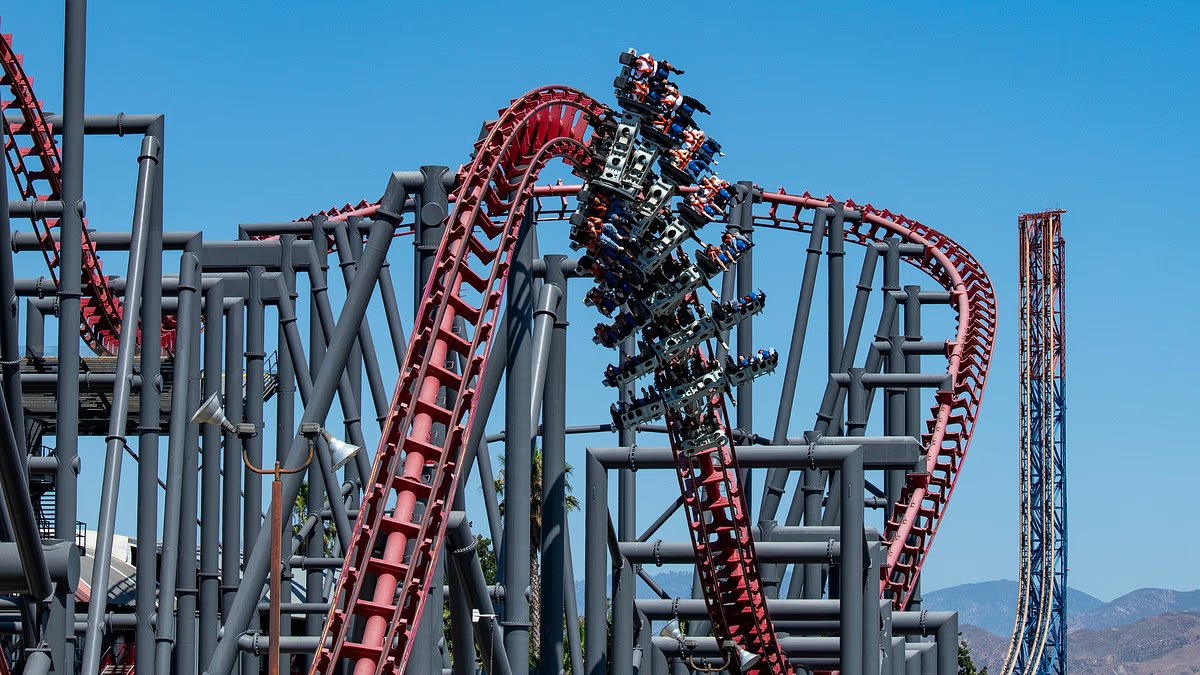

A major theme park has closed its high-tech rollercoaster after two severe brain-injury incidents were reported within days of each other, along with a wider history of serious injuries and deaths allegedly connected to the ride.
X2 at Six Flags Magic Mountain in Valencia, California, was once marketed as a rite of passage for “the ultimate daredevil.” But a new investigation suggests the ride’s violent spins and accelerations may place forces on the body that some passengers cannot withstand.
The attraction was taken out of service on July 12, one day after the second of two catastrophic incidents reported less than a week apart.
CNN found that the cases were not isolated. Its investigation identified a decades-long trail of incidents allegedly involving permanent disabilities, comas and fatalities.
Pamela Guillen, 40, from Hawaii, reportedly lost consciousness shortly after riding X2 during a family trip.
Doctors at the hospital found brain damage similar to injuries seen in high-speed crashes. Guillen remained in a coma for two weeks.
Only days later, Naomi Greer-Wilkinson, 25, of Los Angeles, was hospitalized after riding X2. At the time of CNN’s report, she was still in a coma.
A park spokesperson told Our News Outlet: “The ride remains closed at this time.”


Six Flags Magic Mountain has closed its popular X2 rollercoaster after an investigation linked the attraction to more than a dozen serious injuries.
What injuries have been linked to X2?
Medical records, depositions and court documents indicate that X2 has been associated with more than a dozen serious injuries and hospital visits since opening in 2002.
One case involved Selena O’Neil, who was 17 when she rode the attraction with friends in 2014.
Soon after leaving the ride, O’Neil developed a severe headache, blurred vision and difficulty walking in a straight line.
Her right leg began shaking whenever she placed weight on it and became fixed at an unusual angle.
Although she had previously been healthy, doctors discovered a subdural hematoma, meaning blood had collected on the surface of her brain.
In 2019, doctors published details of her case in a medical journal without identifying X2 by name. They attributed the injury to the acceleration produced by a rollercoaster.
The doctors cautioned: “Advances of rollercoaster technology and industry competition for thrill–seeking patrons may ultimately improve acceleration and performance beyond the passenger’s physical ability to tolerate them.”

Medical experts say the extreme forces generated by X2 can produce brain injuries (pictured) more commonly associated with high-speed collisions.
Court filings submitted by O’Neil’s family and reviewed by CNN indicated that at least five other riders had gone to hospital after using X2 before her injury.
Among them was a 62-year-old man who sued the park in 2009, alleging that the attraction had caused him to suffer a traumatic brain injury.
Has anyone died after riding X2?
In 2022, 22-year-old college graduate Christopher Hawley rode X2 alongside his brother and cousin.
Court records later stated that the three family members were tossed around like “rag dolls,” with Christopher striking his head against his seat several times.
As the ride neared its end, Christopher said he felt light-headed. He was taken to nearby Henry Mayo Newhall Hospital.
Doctors found extensive bleeding in his brain. The swelling was so severe that it forced his brain toward one side of his skull, causing it to bulge when surgeons opened the skull to relieve the pressure.
Christopher had reportedly been in excellent health before boarding the ride, but he died less than 10 hours later.
SEE ALSO: Learjet Engine Parts Found in Wreckage After Florida Street Crash Kills 9

Christopher Hawley (centre) died in June 2022, one day after visiting the park and riding X2.

The LA County Medical Examiner ruled that Christopher died from blunt head trauma less than 10 hours after riding X2.
Another death occurred in 2010, when 28-year-old single mother Hilda Farias died after riding X2.
Experts believed her death may have resulted from a brain abnormality that ruptured under the extreme forces generated by the attraction.
What makes X2 so dangerous?
For most rollercoasters, the forces placed on the body are considered to fall within safe limits.
X2, however, uses a distinctive “four-dimensional” design that can expose riders to much more demanding movements.
The ride reaches speeds of up to 76mph (120km/h), includes a 215ft (65m) drop and places passengers in seats that rotate independently from the track.
During two maneuvers known as “raven turns,” the cars rotate upside down while looping, sending riders backward into steep drops.
Only two other rollercoasters worldwide are understood to use a broadly similar design: one in China and another in Japan.

Researchers say the forces produced by most rollercoasters are lower than those generated by football headers, but X2’s unusual design creates a far greater impact.
The additional rotations and changes in direction introduce extra forces that can trigger extremely rapid movement of the brain inside the skull.
That movement can cause “very rapid deformations in the brain, which can lead to diffuse axonal injury, tissue tears, and vascular disruptions.”
Are rollercoasters safe?
Around 300 million people ride rollercoasters worldwide each year, while the proportion who suffer injuries remains relatively small.
Even so, serious injuries and deaths do occur.
A 2005 study recorded 39 rollercoaster-related deaths in the United States between 1994 and 2004. Fifteen were attributed to brain bleeding or cardiac problems.
A separate 2013 study found that an average of 4,423 children visited US emergency departments each year between 1990 and 2010 for injuries “resulting from amusement park rides.”
Head and neck injuries were among the most common, often occurring when children fell from, onto or against a ride.

Research suggests that the peak velocity exerted on the brain by a rollercoaster is comparable to sprinting and below that of a football header, although unusually intense rides such as X2 require more study.
Most of these injuries are minor, and fatalities are generally isolated rather than part of a repeated pattern such as the incidents reported in connection with X2.
Overall, rollercoaster hospitalisation rates remain low at about 1.5 per cent annually, with an average of 4.5 deaths each year.
Research also indicates that the forces produced by a typical rollercoaster are usually not strong enough to cause brain trauma.
A 2017 study found that rollercoaster rides produced brain strains lower than those caused by mild football headers and similar to the forces experienced while running.
Professor Lyndia Wu of the University of British Columbia, a co-author of the study, told CNN: “I personally don’t think head injury should be an expected risk from going on a rollercoaster ride, and there is no reason a ride can’t be properly designed to prevent injuries like this.”
The researchers nevertheless said that attractions generating unusually high forces, including X2, warrant additional investigation.