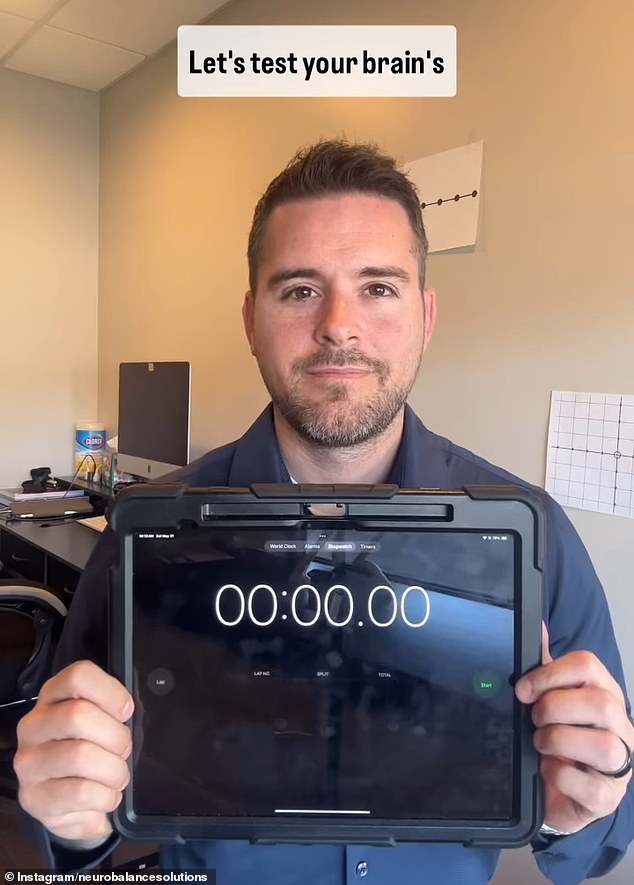

A neurologist has sparked widespread fascination online after sharing a simple 30-second test that he says can reveal how your brain is really functioning.
The test is deceptively basic and relies purely on instinct by closing your eyes and opening them when you think 30 seconds have passed.
According to the specialist behind it, how early – or late – you open your eyes can offer clues about alertness, anxiety, fatigue and mental processing speed.
The exercise was shared by Dr Ryan Worley, a Clinical Neuroscience and Brain Rehabilitation Specialist from the US, who posted the test to Instagram so followers could try it themselves, with wildly mixed results.
‘How accurate is your brain’s internal clock? This is a quick test that can give us insight into how your brain is functioning right now,’ Dr Worley said.
‘Your perception of time is influenced by things like: stress and anxiety (which can speed up your sense of time), fatigue, brain fog, or poor sleep (which can slow it down) and neurological function in areas like the cerebellum, basal ganglia, and prefrontal cortex.
‘This is the kind of thing I use in clinic to get a better read on brain function. How your brain perceives time often reflects how it’s processing the world around you.’
In the video, viewed more than eight million times, Dr Worley explains that the goal is to estimate 30 seconds without mentally counting, instead trusting the brain’s natural perception of time.

Dr Ryan Worley (pictured), a Clinical Neuroscience and Brain Rehabilitation Specialist from the US has revealed a simple 30-second test can offer clues about alertness, anxiety, fatigue and mental processing speed
After the first attempt, he suggests repeating the test while counting to see whether accuracy improves.
‘By doing this with and without counting, you’ll notice how much your brain relies on external structure (counting) versus internal regulation,’ he said.
He says opening your eyes significantly too early may indicate a heightened state of alertness or anxiety, while opening them well after the 30-second mark could suggest slower processing linked to fatigue or distraction.
To avoid panic for those whose sense of time runs long, he reassures viewers that the timer continues for a full 60 seconds – meaning no one ‘fails’ the test.
The comment section quickly filled with people stunned by just how unreliable their inner clock turned out to be.
‘Forcing myself not to count in my head was harder than any workout I’ve ever done,’ one person admitted.
‘Six seconds and I thought I was over the 30,’ another confessed.
‘I thought so many thoughts and ended up opening my eyes at 13 seconds,’ a third wrote.
’32 seconds while not counting has honestly surprised me,’ another said.
While the test feels like a clever social media experiment, neuroscientists say our sense of time is deeply complex, and often far from precise.


He explains the goal is to estimate 30 seconds without mentally counting, instead trusting the brain’s natural perception of time. Opening them too early may indicate a heightened state of alertness or anxiety, while opening them late could suggest slower processing linked to fatigue or distraction
Research from the University of California has shown that the brain doesn’t rely on a single internal stopwatch to measure seconds.
In a study, UCLA scientists trained mice to associate different scents with rewards delivered after either three or six seconds. The mice learned to anticipate the timing accurately, licking earlier when they expected the shorter delay.
By monitoring brain activity, researchers identified two key regions involved in timing – the striatum and the premotor cortex.
While both encoded time, the striatum followed a distinctive pattern likened to a line of falling dominoes, known as a neural sequence.
Rather than counting seconds like a ticking clock, the brain measures time through evolving patterns of cellular activity, with each neuron activating the next.
The passage of time is inferred by which neuron is active at any given moment, which is similar to knowing five seconds have passed when the middle domino falls in a ten-second chain.
Scientists say second-by-second timing is critical for movement, learning and cognition, including our ability to anticipate what happens next.
Unlike the circadian clock that regulates sleep and wake cycles, this short-term timing system is heavily influenced by attention, stress and mental load.
That’s why Dr Worley’s 30-second test can feel wildly different depending on your mood, energy levels or focus that day.
It’s not a diagnostic tool, and it’s not meant to replace medical advice, but it does offer a fascinating snapshot of how your brain is operating in that moment.
And if the comments are anything to go by, it also proves that a mere 30 seconds inside your head can feel a lot longer – or much shorter – than you think.