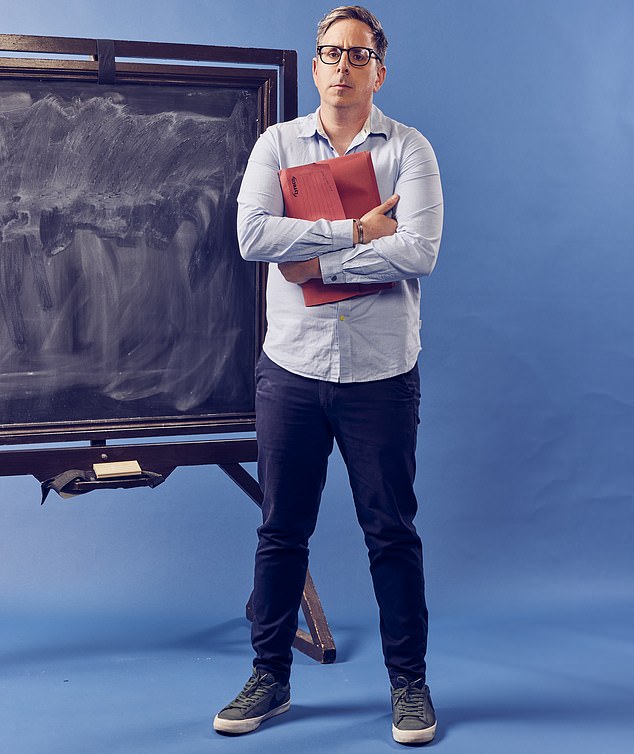

Looking back now, he can see both the horror and humour of it. Francis Foster was then a supply teacher at a notoriously tough primary school in Croydon – one of London’s most violent boroughs.
The word ‘challenging’ had been applied to his class. ‘Never a good sign,’ he observes.
And there was one particular pupil who had ‘behavioural difficulties’. This, he knew, was a euphemism.
The boy, as he was soon to discover, was ‘aggressive, disruptive and had assaulted various members of staff’. ‘Everyone was terrified of him, yet he’d been given carte blanche to do exactly as he pleased, and this really rattled me.’
Jamie, the child in question, was just ten years old. He began by announcing he wasn’t going to work in the maths lesson: ‘And you can f*** off if you try to make me. If you touch me I’ll report you to the RSPCA.’
If it wasn’t so chilling there would be something grimly amusing about it. ‘It was outrageously insulting and also, in a way, funny,’ says Francis now. ‘I knew I had to confront him quickly before the lesson spiralled out of control, so I told him I’d have him removed from the lesson if he chose not to do any work.’
At which point, Jamie hurled his shoe at his teacher’s head. Had Francis not ducked, it would have hit him between the eyes.
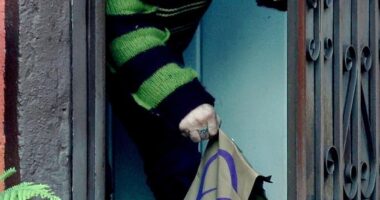
Completely out of control, Jamie made a defiant gesture with one finger at Francis. Yet when the deputy head was called to intervene, it was obvious he felt completely powerless in the face of the child’s swaggering defiance. In fact, the deputy head was ‘utterly terrified and defeated’.

Francis Foster was then a supply teacher at a notoriously tough primary school in Croydon
‘Teaching tends to attract very Left-wing, sensitive, gentle souls who go into it to make a difference to the kids, and slowly – through the crushing weight of pointless admin, a dementedly high workload and atrocious behaviour – they end up completely wiped out and leave.
‘A good percentage of these teachers take the side of the badly behaved kid. It’s true, they’ve often had brutally challenging lives, but that doesn’t mean we put the rest of the class on the scrapheap because of them,’ Francis says.
Jamie was temporarily removed from the classroom, only to reappear later in the day to create more chaos. This time Francis summoned the head teacher, a ‘squat, brutal-looking man’, to whom Jamie declared: ‘You can f*** off and all.’
Two weeks later, Jamie assaulted a female teacher, punching her with such force that she was concussed and taken to hospital.
So what happened to him? How was he punished? And did the reprimands have any effect?
‘The honest answer is I don’t know,’ says Francis. ‘He reacted in exactly the same way to the spineless deputy head who tried to appease him, and to the alpha male head who tried to physically dominate him. He told them both to f*** off.’
Francis spent 12 years as a teacher, both as a supply and in permanent posts, before quitting in 2020, aged 37. ‘I had nothing left to give anyone. I was burnt out – a few months away from mutating into one of those bitter and frustrated teachers that kids despise and colleagues resent.’
Now he has written a book, (Un)Educated: My Life as a Teacher, and Why You Should Never Become One. Part black comedy, part gory memoir, it is also a brutal indictment of an education system that is failing both children and teachers.

Francis walked into a south London classroom as a fight was breaking out between two boys (posed by models)
Violence in our classrooms is escalating. Disturbing statistics just released by the Centre for Social Justice (CSJ) reveal that permanent exclusions for physical assault by pupils – on other children or adults – hit a record 3,320 last spring, up 6.4 per cent on the previous year, and a rise of 21 per cent since before the pandemic.
Even more alarming is the growing aggression among younger children. More primary pupils than secondary ones were expelled for violence against teachers: 281 versus 245.
There were also 130 expulsions for verbal abuse or threatening behaviour against an adult in primary schools. Meanwhile, primary school suspensions involving physical assault against an adult or pupil also reached a record of more than 24,000 last spring, rising by 10,000 since spring 2022, the CSJ reported.
Francis, now 44, agrees such data reveals a spiralling problem. In his book he charts his own classroom experiences with a mix of dark humour and abject disillusionment.
He went on to become a stand-up comedian, opening for acts including Suzy Eddie Izzard, using his years in teaching as source material for his shows.
Now he co-hosts a hit podcast, Triggernometry, with two million followers, which bills itself as an ‘open, fact-based discussion of important and controversial issues’, and is often described by others as ‘anti-woke’. Sir Stephen Fry and Boris Johnson have been among his interviewees.
Indeed, the former PM admitted to him that the lockdown of schools during Covid had been a ‘huge mistake’ and had contributed to the rise in pupils’ anti-social behaviour.
So how would Francis tackle it?

Boris Johnson being interviewed on the podcast Triggernometry by Francis Forster and Konstantin Kisin
‘It’s become a taboo because it’s so hard to solve,’ he says. In the book, Francis is not advocating a return to corporal punishment – though even to mention it as an option in 2026 seems controversial.
‘We need rules in school and they need to be enforced so that the majority can learn,’ he tells me. ‘Hitting kids solves nothing and only causes more damage.
‘Head teachers need to have the power to expel children like Jamie into Pupil Referral Units (PRUs), which are there for children who can’t, or refuse to, operate in mainstream education.
‘The system is broken and if we don’t address it, it will degrade further. We also need to recognise that mainstream schools are not appropriate for everyone, because it’s happening time and time again.’
Indeed, he also attributes blame to the policy of ‘inclusion’ by which children with Special Educational Needs and Disabilities (SEND) are being integrated into mainstream schools. This year, Labour invested £4billion to support the initiative.
‘In a class of 30, in a mainstream school, I’ve taught a profoundly autistic, non-verbal child, as well as Down’s children – one girl in particular who was very angry and violent because she couldn’t cope.
‘I don’t have a clue how to teach Down’s or autistic children. It’s a very specific ability and I wasn’t trained in it. It’s deeply unfair to put these children, along with others who have the potential to go to university, in the same class.
‘We implement these terrible policies and give them a nice, catchy little name – “policy of inclusion” – and everyone suffers, including the super-bright pupil who’s left bored.’
Francis is also a proponent of grammar schools, a position he knows is deeply divisive within the predominantly Left-wing teaching profession.
‘In reality,’ he says, ‘grammar schools offer bright kids from poor backgrounds the chance to prosper academically and enter professions traditionally reserved for the middle and upper classes.’
So strident was the reaction when he wrote an essay in support of them that, ‘I might as well have been arguing the case for eugenics in education. It would have been better received.’

Billy Cox was 15 years old when he was shot dead in his bedroom in Clapham in 2007. Francis came across a boy crying inconsolably in a lesson because he’d been friends with Billy
Francis’s own route into teaching was not straightforward. He grew up in Morden, south London, as the only child of a Venezuelan mother – his first language is Spanish – who worked as childminder, and a British father (a grammar school boy himself) who was a solicitor with the local council.
Francis was diagnosed with ADHD in the 1980s, ‘long before it became cool’, he says wryly. He has a loud, carrying voice – ideal, I’d have thought, for teaching – and boisterous energy contained in a stocky frame.
He also has an appealing capacity for self-deprecation – ‘When my aunt met me for the first time, she said: “This child is clearly retarded.” She was a child psychologist. She clearly knew what she was talking about,’ – but he also recognises his talents.
From a shaky start, he became an inspirational teacher. His blend of humanity, humour and strictness helped even some of his toughest pupils thrive.
His own degree is in drama – ‘a pointless qualification’, he says – and he would not have become a teacher at all had he realised his dream to be an actor. But he failed to get into drama school and took a postgraduate certificate in education (PGCE) instead.
‘Before we started, one of the lecturers warned us that it would be such hard work that we wouldn’t have time to have sex until the course was over. It turned out to be true,’ he laughs.
It’s a subject he returns to: ‘When it comes to the bedroom, a teacher’s only fantasy is sleep,’ he says later.
He’s single now and lives in Crouch End, north London, earning far more as a podcaster and comedian than he ever did as a teacher (he won’t specify how much more). But did he ever have the energy for dating during those exhausting years of teaching?
‘I had a partner for eight years when I was teaching in London. She worked in the therapeutic side of education. She had to be long-suffering, bless her, because you’re always working or stressed and tired.’
Were these pressures the reason the relationship ended? ‘No, it just reached a natural conclusion. But I imagine marriages and relationships do founder when one partner is a teacher.’
Once qualified, he was offered a post at a secondary school in North Wales, ranked by Ofsted as ‘requires improvement’.
He was thrown into his first lesson with the less than reassuring words that his year nine class was ‘rather tricky’. To compound his discomfort, their drama lesson had been re-scheduled to the school gym. ‘Every boy seemed to be swigging from a giant can of energy drink, which had the equivalent in caffeine to a three-shot espresso. Imagine giving that to a 14-year-old boy and expecting him to behave normally.’
These troublemakers ran riot, rampaging over gym equipment, swinging from monkey bars and ignoring his frantic instructions.
‘It was a constant war of attrition and a lot of teachers can’t push through that first year. But I’m stubborn. I’d made up my mind to be a teacher and not to put up with disruptive behaviour in the classroom, and if that meant I was going to go to war with a hard core of kids who wouldn’t behave, so be it.’
After the Welsh school, and a stint at a Hertfordshire secondary – again a ‘challenging’ one – he decided to move to primary school teaching, and made the decision to ‘ease’ himself in by registering as a supply teacher in London.
Over the course of a number of postings he found his favourite age group in Year Six: ten and 11-year-olds ‘without the cynicism and awkwardness of adolescents, but with enough of a sense of humour to banter with, and they still want to learn and use their imaginations’.
Inevitably, however, he found himself standing in for teachers in the most gruelling and heart-breaking of circumstances.
On one occasion, he was rushed to a south London school as an emergency stand-in for a male teacher, ‘who sat crumpled on a chair, sobbing and begging not to go back into a classroom where, after just two days, the class had broken him’.
Francis walked into that classroom as a fight was breaking out between two boys and got between them both ‘just in time to feel the entire weight of an 11-year-old boy’s flying kick hitting me in the crotch’. He says the class was ‘an utter disgrace’ and the worst he’s encountered.
Was there any redress for him or punishment for the boy who had accidentally assaulted him?
‘No one cares about supply teachers. They’re just collateral damage. And I doubt if the boy got more than a stern talking to in front of his parents,’ he says starkly.
After 18 months in supply, he took a full-time post as a class teacher in Dagenham, east London, where the children in his Year Six class were particularly vulnerable to gangs. The situation ‘terrified’ him and he was desperate to help them.
Serious, even fatal, violence is an urgent issue among teenagers, he says. Earlier in his career, in 2007, he’d come across a boy in a south London school crying inconsolably in a lesson because he’d been friends with a 15-year-old lad called Billy Cox who had been murdered the day before in his bed in Clapham.
‘It was a horrific case. The killers still haven’t been brought to justice, and we’re nowhere near solving the problem of knife and gun crime in our inner cities,’ he says.
The rise in gangs, he believes, is rooted in the ‘crisis’ of absentee fathers: ‘When an adolescent boy has no positive male role models, the Andrew Tates of the world fill the void. Fourteen-year-old boys don’t have the maturity to recognise toxic masculinity.
‘A lot of the kids I taught lived with single mums who had three or four jobs to make ends meet.
‘Invariably their sons were OK until they hit puberty, then they became desperate for male approval and sought it via gangs, who tend to target kids with low academic ability and absentee dads.
‘If these boys are failing at school and have low self-esteem, they’re vulnerable to grooming by gangs.’
He recounts the devastating story of a former pupil who told Francis he’d just been expelled from his secondary school and assigned to a different one. ‘I tried to put a positive spin on it and said it would be a fresh start. But he said: “I can’t go to that school in Stratford. They’ll murder me.”
‘He was terrified. He was a 14-year-old boy and it emerged that he was scared of a rival gang. Why should he have to deal with that? It’s just heartbreaking.’
He recognises that ‘teaching is a delicate balance between maintaining authority and keeping the class on your side’.
And there were moments of supreme satisfaction and fulfilment, when pupils surpassed his expectations and excelled, making him feel like he’d ‘just seen England lift the World Cup’.
‘Do you miss teaching?’ I ask him now.
‘No,’ he smiles. ‘Nothing will ever be as important or fulfilling. But I did my time.’
- (Un)Educated: My Life as a Teacher, and Why You Should Never Become One, by Francis Foster (£22, Constable), is out on May 28.