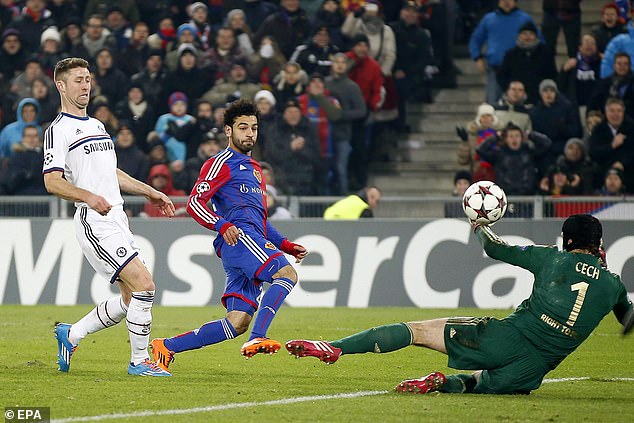

Jurgen Klopp had just three words when he first saw Mohamed Salah play, in a friendly for Basel against the German’s Borussia Dortmund side.
‘What the f***!’
By the time the German manager could ask his recruitment team to look into signing the Egyptian, Salah was already being courted by Chelsea and their significant financial might.
When Blues manager Jose Mourinho first called Salah, he couldn’t answer as he had not paid the phone bill to his Egyptian provider. But when he finally got through via WiFi, the player decided to pick Chelsea ahead of Liverpool.
As we know, it did not work out at Stamford Bridge. Nineteen games, two goals and a pair of loans to Fiorentina and Roma. These 18 unhappy months meant many of Liverpool’s domestic rivals thought Salah was a failure in England, and they were scared to take a gamble on him, even when their eyes and the Serie A goalscoring charts told them otherwise.
The Reds, though, believed he had simply been behind Eden Hazard in the pecking order.

Mohamed Salah first caught Jurgen Klopp’s eye when he was playing in Switzerland for Basel

Chelsea had muscled in first, however, and Salah spent 18 unhappy months there

Salah resurrected his career at Roma, scoring 34 goals in 83 games before securing a £43million move to Liverpool
It is fair to say Salah has now surpassed Hazard’s Premier League legacy. Both won two titles but Salah has more than 100 more goals (193 to 85) and two more PFA Player of the Year and Football Writers’ Player of the Year crowns. The former team-mates are still in touch now, with the Belgian sending a message to Salah recently to wish him well when he leaves Liverpool this summer.
But back in the summer of 2017, this Egyptian was still an unproven quantity in the Premier League. He was progressing nicely at Roma but still had a lot of work to do on his critics.
Salah, it must be remembered, was not Klopp’s first-choice signing. He wanted Julian Brandt, the Bayer Leverkusen winger who did not want to move because there was a World Cup at the end of the season and he thought a change might disrupt his form and fitness. Many fans would have preferred Brandt, too.
But the decision to pivot to Salah, based on data and the fact Roma’s financial woes could be taken advantage of – the Italian club’s chief Monchi, latterly of Aston Villa, later admitted Liverpool ‘got him on the cheap’, even at £43million – has been one of the defining moves of the decade.
It was clear from the early weeks of the season: six goals in his first 10, then three braces in five games in October. He ended up with 44 goals (32 of them in the league, then a record for a 38-game Premier League campaign) and 16 assists in 52 appearances. That’s 1.15 goal involvements per game.
In the league, though, the Reds finished fourth, 25 points behind the record-breaking Manchester City Centurions, the first of Pep Guardiola’s league titles. The Catalan, while we are on the topic, has described Salah as his ‘best ever rival’ and the pair often have lengthy chats after matches between the two teams. Salah has faced City more times (26) than any other opponent in his career and only against Tottenham and Manchester United (both 16) has he scored more than his 13 goals against Guardiola.
City thumped Liverpool 5-0 early in that first season and it was those blips that held back the Reds from being the truly elite team they would go on to become. But by the end of the campaign they had a sense of formidability and invincibility about them that would become a hallmark under Klopp.
They believed that, with Salah in the team, they could win anything. After a disappointing decade, the Egyptian made players and fans dream again.

Salah celebrates scoring his first home Premier League goal, in a 4-0 demolition of Arsenal in August 2017

He would go on to score 44 times in his debut season in all competitions, including 32 in the league – then a record for a 38-game campaign
Soon, the team was like the Red Arrows. Salah flew down one wing and Sadio Mane, who had been signed for a similar fee from Southampton a year earlier, the other. Roberto Firmino, a legacy of Brendan Rodgers’ final transfer window, supplemented the pair from centre forward.
‘He took each sprint like the 100m final in the Olympic Games,’ said Klopp. ‘The team adapts to our strengths. Nobody is talking and saying, “Mo, but you have to…” At the moment, nobody is saying anything to Salah other than “carry on”.
‘But we will not treat him like, “You don’t have to train, Mo – just come on Saturday for the game and we’ll see you there at Anfield”. He doesn’t want that. He’s in the moment of his career but he knows there is a lot for him to come. He wants to learn and he wants to improve.’
Even after their extensive research, Liverpool’s transfer chiefs, led by Michael Edwards who surveyed Salah on undercover scouting missions before signing him, were still surprised at just how good he was. Fans were soon blown away, too. He was soon on the lips of every Red in Liverpool and sales of shirts with his name on were booming around the world.
The head of England’s first Mosque, Mumin Khan, believed Salah changed negative perceptions of the Muslim community in the area. A study by Stanford University in 2019 found that since Salah arrived, there was a 19 per cent decrease in hate crimes in the Merseyside area – and Islamophobic social media posts by fans had halved.
Salah was one of four Muslims in the squad at the time – alongside Mane, Naby Keita and Xherdan Shaqiri – and his goal celebration included performing sujood, the Islamic act of prostration to God, bowing down with his face to the turf.
‘He was the star of the Egyptian national team and our best player but what made Mohamed special, despite other players from Egypt moving to Europe, was that he was very close to us,’ explains journalist Ismael Mahmoud, an expert on Salah.

A study found that since Salah arrived, there was a 19 per cent decrease in hate crimes in the Merseyside area – and Islamophobic social media posts by fans had halved

Salah is a national hero in Egypt, leading his country to their first World Cup in 28 years in 2018

His unstoppable partnership with Sadio Mane (left) and Roberto Firmino (right) was the bedrock of the success of Klopp’s Liverpool
‘He didn’t come from a rich family, just a middle-class one… He was close to the Egyptian people and their nature, so we were absolutely thrilled when he moved to Liverpool. The Egyptian press cared about every single letter written about Salah. That interest multiplied exponentially when he joined Liverpool. It’s a massive club, and it already had fans in Egypt dating back to the 1980s. What Salah did with Liverpool was like a dream every Egyptian lived.’
That breathtaking season truly took off in Europe. After beating City 5-1 on aggregate in the quarter-final, Salah and Co knocked out his old team Roma 7-6 in the last four to set up a tantalising clash with Real Madrid, the most successful team in the competition’s history.
Sergio Ramos – more on him in a minute – stoked the fire in his pre-match press conference when asked how good Salah was.
‘Comparing players with Cristiano Ronaldo and Lionel Messi is something you can’t do,’ he said. ‘Quite frankly, they are in another orbit. There are players who are in fashion, those who come and go and others who stay around. Salah is a top player, that’s clear. He’s shown that this year and he’s got a great chance to show that over the next few years as Ronaldo and Messi have done — but the day after tomorrow!’
James Milner, an experienced leader at Liverpool at the time, took a different approach and got all of the players to lift Salah above their heads when he was named PFA player of the year. ‘You have been carrying us all season,’ joked Milner – it was now their turn to lift him.
The 2018 Champions League final, Liverpool’s first since 2007, was supposed to be the culmination of everything that had come before it with Klopp’s fearless team growing throughout the season with flying full backs, energy and the feared attacking trident of Salah, Firmino and Mane.
It was not to be. After just 25 minutes, Salah was in tears after being yanked to the floor by pantomime villain Ramos, spraining the ligaments in his left shoulder. Even the European Judo Association chimed in, noting that Ramos’ grab and roll would not fly in their sport.
With Salah, Liverpool had taken their first step in transforming from ‘doubters to believers’, to repeat a phrase Klopp used in his first press conference. Without him, it appeared they doubted themselves once more. German goalkeeper Loris Karius made two shocking errors – he was concussed, it was later revealed – and Real’s Gareth Bale came off the bench to score an overhead kick, one of the best goals in Champions League history.

Sergio Ramos drags Salah to the floor in the 2018 Champions League final, straining the Egyptian’s shoulder ligaments

Salah was left in agony and unable to continue, as Real Madrid ran out 3-1 winners in Kyiv
Back home, fans demanded the final be replayed and Ramos be tried properly after escaping punishment. An Egyptian lawyer, Bassem Wahba, launched a lawsuit and said he was seeking damages of £873m.
He said that Ramos had ‘inflicted physical and psychological harm’ upon the country of Egypt. In Jakarta, the Indonesian capital and a predominantly Muslim city, there was a significant demonstration outside the Spanish embassy.
It showed Salah’s reverence within the Muslim world and that supporters, globally, would go into battle for him.
‘Ramos was the most hated person in Egypt at that time,’ explains Ismael. ‘Everyone talked about that injury for days, some people even cried because our hero was at risk of missing the World Cup.’
Salah went to a local hospital, where his shoulder hurt so much that he could not take off his shirt. By the time he rejoined his team-mates, Real Madrid had lifted the trophy and Liverpool’s dream was over.
‘I was devastated,’ says then physiotherapist Ruben Pons, who is now working in Saudi Arabia. ‘I tried to transmit calmness, I told him that nothing could be done and that he should not worry too much, it was time to look for solutions and not to regret because things did not work.
‘We were watching the game, we were looking at social networks and the security was telling us the result. When we came back, the game was over. The whole team had changed and were ready to ride the team bus. We had to help Mo change because he could not do it alone.’
Helping Egypt qualify for the 2018 World Cup, the Pharaohs’ first for 28 years, was one of the highlights of Salah’s career – but the shoulder injury in Kyiv ruined it.

Salah had to sit out the first game of the 2018 World Cup with his shoulder injury and even when he returned Egypt could not get going, losing all three group matches in Russia

But his first season on Merseyside was undeniably a success, winning the Premier League Golden Boot, PFA Player of the Year (pictured) and FWA Player of the Year
He missed the opening game, a late 1-0 defeat by Uruguay, and even though he scored in each of the next two matches he was never fully fit, despite the daily news updates from Pons and the Egyptian FA. Egypt crashed out of Group A in Russia with three defeats from three.
So his first season on Merseyside, despite the immense personal achievements, a first PFA and FWA Player of the Year award and the Premier League Golden Boot, had ended in immense disappointment.
But Salah had been down before. He’d been rejected by Zamalek. Deemed a failure at Chelsea. And he’d always got back up again.
After a glittering individual first year at Liverpool ultimately ended without a trophy and a snub from the Ballon d’Or voters – he finished sixth – Salah knew he had to go again. And that is what he did…
COMING TOMORROW: Read part three of The Salah Files – how Liverpool’s new star turned himself into the ultimate goalscoring machine