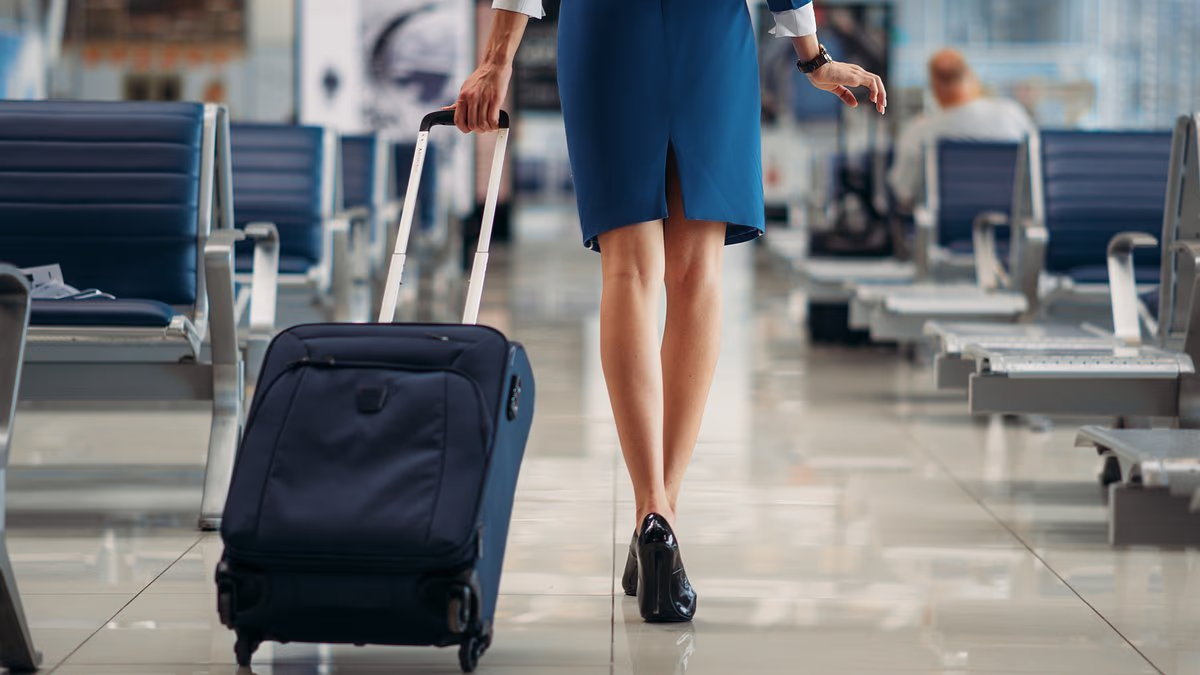

Cabin crew training prepares us for almost anything. We learn first aid, how to reassure anxious travellers and how to respond when something goes seriously wrong.
Unfortunately, that preparation also includes dealing with passengers who slap us while we serve drinks, people taking medication who become aggressive, and the grim task of clearing up after a well-dressed traveller has been sick from drinking too much.
So when I read Unite’s latest survey highlighting the scale of abuse and harassment in aviation, it felt painfully familiar. The union found that 74 per cent of workers at Gatwick face verbal abuse every month, while 42 per cent have experienced physical abuse. During my 25 years in the job, this sort of behaviour was an everyday reality.
Alcohol was identified as the biggest cause by 95 per cent of the cabin crew questioned.
Most adults believe they know their limits. Some are even certain they can combine large amounts of alcohol with prescription drugs intended to calm them, or with other substances, without consequences.
But an aircraft cruising at 35,000ft is an exceptionally bad place to test that theory. Cabin crew are often the first people to deal with the consequences.
In truth, we start monitoring passengers well before they become disruptive. Many travellers assume our attention fades once the drinks trolley has gone through the cabin. In fact, that is when our observations become more focused. Behind the professional smile, I’m working out who may need watching, who should be served more slowly and who must not be given another glass of wine.
After 25 years as cabin crew, I became remarkably good at reading people. I sometimes think I could spot suspicious behaviour faster than a CIA agent.

Cabin crew training prepares staff for everything from first aid and nervous flyers to serious emergencies
A vodka bottle hidden inside a designer handbag? I would notice it almost immediately.
Two colleagues who boarded with their laptops but were now holding hands? That was obvious too.
And if a tipsy couple looked ready to start an argument, I would already be checking whether another seat was available.
These are some of the more memorable incidents I encountered during my years in the air.
Pre-flight drinkers
Generally speaking, I found groups of women less likely than groups of men to become completely drunk before or during a flight.
A woman travelling alone could be different, especially after a delay. Some passengers would spend the waiting time ordering large 250ml glasses of wine at the airport bar beside the departure gate.
Airport staff would occasionally alert us to travellers they believed needed extra attention.
On one flight, we were delayed for 30 minutes before departure. A woman was slumped in her seat, wearing a Panama hat and chatting animatedly to her son on the phone.
She was also drinking from a bottle concealed in her Mulberry handbag, apparently convinced that I could not see it. She was mistaken.
I repeatedly asked her to put the phone away and switch it off. Each time she agreed, only to turn it back on a few minutes later.
The situation became absurdly repetitive. Eventually, I told her she could be removed from the aircraft. That finally worked. I placed the phone in her bag and stored it in the overhead locker. Once we were airborne, she caused no further trouble and slept through most of the journey.
The dangers of cocaine

“He was at least six feet tall and I’m only five foot two. As he reached the aircraft door, it became clear he was about to try to open it”
Passengers affected by drugs can create serious safety risks. On a daytime flight to a Spanish city, I noticed a young man with unusually dilated pupils.
He kept rubbing his nose and spoke rapidly to the passenger beside him. I suspected cocaine use, although I had no way to confirm it.
His behaviour soon became much more alarming. Halfway through the flight, he announced loudly that he needed to get off, then stood up and headed towards an emergency exit.
He was at least six feet tall, while I am just five foot two. As he moved towards the aircraft door, it became increasingly obvious that he might try to open it. I shouted, “You are not going to do that.”
Even now, I’m not sure how I managed to turn him around and steer him back to his seat. I was young, and it was my first experience of dealing with someone so obviously high. Only afterwards did I realise I should have immediately reported the incident to the purser, who was responsible for cabin safety.
I sincerely hope his name and seat details were added to a no-fly list.
Colleagues getting carried away
After an incident like that, alcohol-fuelled romances can seem almost harmless. Two passengers would board together, clearly business colleagues. For the first hour, they worked side by side with their laptops open.
Then the drinks would begin. She ordered Prosecco, he chose gin and tonics, and the mood slowly shifted. Before long, they were noticeably more affectionate and physically familiar.
Sometimes hands disappeared beneath the blankets. On other occasions, the pair would head to the lavatory together.
One couple were staying at the same hotel as the crew. After watching their relationship blossom during the flight, we saw them continuing to flirt in the hotel bar that evening.
CONTINUE READING: Rep. Jim Jordan Defeats Steve Scalise to Lead House Republicans After Promising a Post-Midterm “Fight”
Arguments at altitude
At the opposite end of the romantic scale were the couples whose relationships appeared to be breaking down.
On one flight, a couple travelling with their two children and the grandparents had a spectacular argument in economy class.
She was provoking him before the seatbelt sign had even gone off. By cruising altitude, she was muttering abuse under her breath, and it was clear she had been drinking heavily. I watched anxiously as the dispute escalated into both of them shouting inches from each other’s faces. The other passengers were visibly uncomfortable, but I needed to intervene before it became physical.
Fortunately, there was a spare seat in the premium cabin, so I moved the husband, who appeared less volatile, away from his wife.
The children were seated with their grandparents, while the woman remained apart from them. I was asked to keep watch and make sure she did not go after her husband to restart the argument. When we landed, authorities escorted her from the aircraft.
Celebrities behaving badly

The destination can offer a clue about the atmosphere ahead. Flights to Ibiza are often exactly as lively as you might expect
The destination often gives you a useful preview of the flight ahead. Ibiza services, for example, are frequently as lively as people imagine.
On one journey, we had left the gate and were taxiing towards the runway. The cabin doors had been set to automatic and cross-checked when a celebrity suddenly stood up and demanded that we return. He was convinced he had forgotten his phone.
The man was clearly drunk and made an extraordinary fuss. Other passengers began telling him to sit down, but he would not listen. He insisted that the aircraft turn around so he could retrieve the phone. Eventually, the captain decided the safest and simplest solution was to return to the gate and remove him.
We went back, and about 20 minutes later departed without him. I only hope his luggage was removed as well.
Valium and aggression
On a flight to Orlando, I was sitting in the jump seat during take-off when the woman opposite began repeatedly calling me a “f***ing stuck-up bitch”. She was angry because she believed I was staring at her aggressively.
Once the seatbelt sign was switched off, I moved away. A colleague was left to calm her down and manage her increasingly defiant behaviour for the rest of the flight.
After landing, she apologised and explained that she was extremely nervous about flying. She had taken Valium and drunk a glass of wine in an attempt to make herself sleep through the journey.
Drunken stag parties
From April onwards, flights to Las Vegas are often packed with stag parties. Most groups of men are perfectly manageable, although there are exceptions. On one flight, a male passenger approached me while I was working in the rear galley.
We had made casual conversation earlier. I know the difference between friendliness and flirtation, and nothing about our earlier exchange had crossed that line.
By then, however, he was heavily intoxicated and slurring his words. He tapped me on the shoulder. When I turned around, he had undone his trousers and was clearly encouraging me to look. “Please pull yourself together, sir,” I said firmly, while deciding whether to activate the procedure for inappropriate behaviour. That could have resulted in local police meeting him on arrival. Alternatively, I could send him back to his seat with a suitably icy stare.
I chose the latter and told the crew that he was not to receive any more alcohol. I did not feel physically threatened, but I was appalled that he believed his behaviour was acceptable.

A police officer removes an intoxicated man from a Ryanair flight
One of the main problems with alcohol on a plane is that crew cannot know what a passenger has already consumed before boarding, or what they may have purchased in duty free. On one flight, a group of men kept ordering soft drinks, yet their voices became increasingly loud.
At the end of the journey, we discovered vodka bottles beneath their seats. As we had suspected, they had been mixing their own drinks with alcohol hidden in their under-seat bags.
Drunk golfers
It is not only young travellers heading off for a week of partying who start their holiday drunk. Groups of men flying to Florida for golf trips could be every bit as noisy and inappropriate.
I remember one passenger who walked into the galley to ask for another drink instead of pressing the call button. I turned to collect the bottles and felt him slap my bottom. This was before the #MeToo movement, and the accepted attitude was often that crew should avoid offending passengers. I was expected to laugh it off and continue working.
On long-haul flights, we would sometimes run out of the small spirit bottles. When that happened, I had a discreet way of slowing down passengers who were drinking too heavily.
I would tell them, “I can’t give you another bottle, but I can make you a drink.” The result was almost entirely mixer, with only a tiny amount of alcohol. In my mind, it was two per cent alcohol and 98 per cent soft drink.
First-class wine drinkers
There is a common assumption that first-class passengers will be polished and courteous. That is certainly not guaranteed.
On a flight from London to Washington DC, one affluent woman arrived dressed impeccably, with expensive jewellery and an elegant handbag. She was also extraordinarily rude and patronising. Nothing pleased her, including the meal.
She demanded a dish that had already run out and became furious when told her first choice was unavailable.
Passengers paying thousands for a ticket deserve good service, so I managed to exchange her meal with another traveller who was happy to accept a different option. Even then, she complained, insisting the replacement was not hot enough.
At the same time, she continued requesting more red wine. Before taking my break, I warned my colleagues that she was already becoming intoxicated and asked them to monitor her. By the time I returned, she was completely drunk and had vomited over herself. Red wine covered her clothes, yet she was still asking for another glass. I refused and offered her water instead.
When we landed, she staggered out of the aircraft and nearly fell down the steps, her once-elegant outfit stained with red-wine vomit. I could not help feeling that her behaviour had come back to haunt her.
As told to Samantha Brick