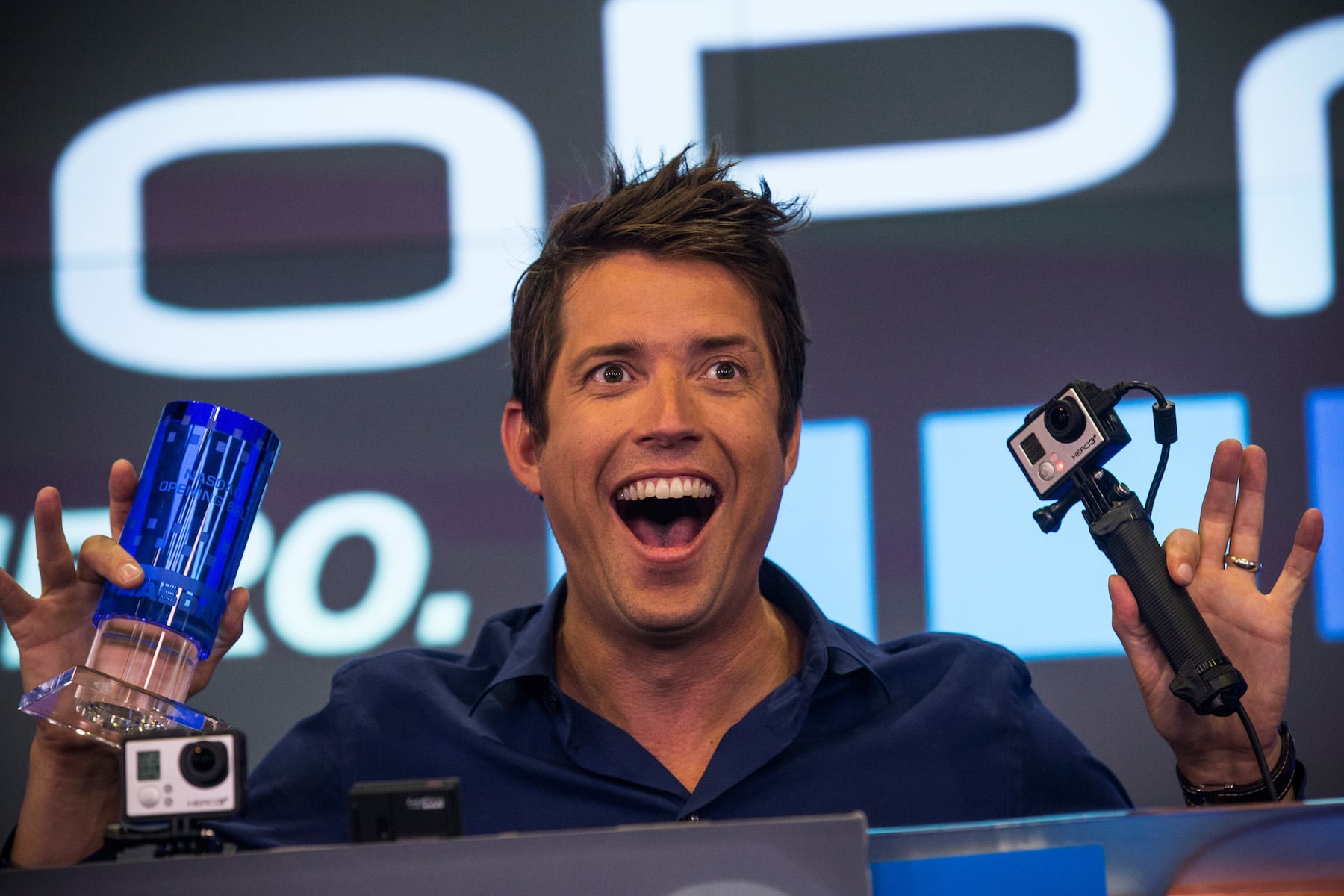

In the fall of 2014, Nick Woodman looked like the coolest billionaire on earth.
He was 39 years old. He surfed. He wore hoodies. He flew around the world chasing waves. His company, GoPro, made tiny indestructible cameras that had become a status symbol for surfers, skiers, snowboarders, mountain bikers, skydivers, scuba divers, YouTubers, and basically anyone who wanted to make life look more extreme than it actually was.
And Wall Street was absolutely in love.
GoPro went public in June 2014. Shares opened around $35 and almost immediately went bananas. By October 10, 2014, GoPro stock hit an all-time high of roughly $85 per share. At that moment, the company had a market cap of around $12 billion.
Nick Woodman owned roughly 45% of the company. That made his stake worth around $5.4 billion.
Not bad for a guy whose billion-dollar idea was born during a surf trip after his first startup crashed and burned. And then the wipeout began.
Today, GoPro trades for around $1 per share. The entire company is worth less than $200 million. In April 2026, GoPro announced plans to cut roughly 23% of its workforce. On Wednesday, after years of shrinking expectations, product stumbles, layoffs, restructuring plans, and collapsing investor confidence, GoPro announced that it was exploring strategic alternatives, including a possible sale or merger.
This is the story of one of the biggest corporate wipeouts in recent history…
Andrew Burton/Getty Images
The Surf Trip That Created GoPro
Before GoPro, Nick Woodman had already experienced one of the most important ingredients in any good tech-founder origin story: failure.
Woodman grew up in Atherton, California, one of Silicon Valley’s wealthiest towns. His father, Dean Woodman, was a successful investment banker who helped broker the sale of Taco Bell to Pepsi. Nick attended UC San Diego, where surfing became central to his identity.
After college, he jumped into the dot-com boom with a gaming and marketing company called Funbug. It did not become the next Yahoo. Funbug imploded during the dot-com crash, reportedly burning through nearly $4 million of investor money. Woodman was humiliated.
So he went surfing.
Woodman spent months traveling through Australia and Indonesia. On that trip, he kept running into the same problem. He wanted high-quality surfing photos and videos, but the available options were terrible. You either needed someone standing on the beach with a camera, or you had to rig up some awkward homemade contraption and hope it survived the water.
Woodman started experimenting with a broken surfboard leash, rubber bands, and a waterproof disposable camera. The idea was crude, but the insight was brilliant:
People did not just want to take pictures of the action. They wanted to be inside the action.
Back in California, Woodman obsessed over prototypes. He worked marathon days in a rental house in Moss Beach. He sewed straps from old wetsuit material. He drilled holes in plastic. He used his mother’s sewing machine. He funded the early company with $30,000 of his own money, $35,000 from his mother, and two $100,000 investments from his father.
The first GoPro was not a sleek digital miracle. It was a 35mm camera mounted to the user’s wrist. But the concept was powerful. By 2004, Woodman was selling early GoPro cameras at trade shows. In the company’s first full year, GoPro generated around $350,000 in sales.
Then the thing took off.
From Surf Shops To Wall Street
GoPro hit at exactly the right moment.
Digital cameras were improving. YouTube was exploding. Facebook was growing. Smartphones were spreading. People were beginning to document their lives obsessively, but the smartphone camera had not yet become good enough to handle the rugged, immersive footage GoPro could capture.
For a while, GoPro owned a lane all by itself.
Surfers strapped GoPros to their boards. Skiers mounted them on helmets. Mountain bikers attached them to handlebars. Divers took them underwater. Athletes, filmmakers, travelers, and hobbyists all used them to capture footage that previously required a professional camera crew.
The product was simple to understand and incredibly easy to market. Every great GoPro video was also a GoPro commercial.
In 2012, GoPro sold roughly 2.3 million cameras and generated more than $500 million in revenue. In 2013, revenue approached $1 billion. By then, GoPro was no longer a quirky camera company. It was a cultural phenomenon. It was a lifestyle brand. It was a media company, or at least it wanted Wall Street to believe it could become one.
Then came the IPO.
GoPro went public on June 26, 2014, under the ticker symbol GPRO. Shares opened around $35 and surged nearly 40% on the first day. Within days, GoPro was worth around $5 billion. By September 2014, its market cap had pushed past $10 billion.
On October 10, 2014, the stock hit its all-time high of roughly $85 per share. The company’s market cap was around $12 billion. Nick Woodman’s 45% stake was worth approximately $5.4 billion.
And Nick was not the only Woodman enjoying the ride.
His father, Dean, whose early investment helped launch the company, owned millions of shares. At GoPro’s peak, Dean’s stake was worth hundreds of millions of dollars. Nick’s mother and sisters also owned meaningful stakes.
Woodman’s generosity extended beyond family. One of the wildest GoPro side stories involved Neil Dana, Woodman’s college roommate at UC San Diego and GoPro’s first employee. In the early days, Woodman reportedly promised Dana 10% of the proceeds from certain GoPro stock sales. Years later, after GoPro became a public-market sensation, that promise became extremely real.
In 2015, Woodman paid roughly $229 million to satisfy that early agreement.
For a very brief window, GoPro looked like one of the great consumer technology success stories of the decade.
The First Cracks
The problem with GoPro was not that people stopped thinking the cameras were cool. The problem was that “cool” did not automatically translate into a durable, massive, recurring, high-margin business.
GoPro was a hardware company. Hardware is brutally difficult. You have to design products, manufacture them, ship them, manage inventory, forecast demand, support retailers, fight competitors, and convince customers to keep upgrading.
GoPro also had another problem: most people do not actually live lives that require a new action camera every year.
A surfer might love GoPro. A skier might love GoPro. A cyclist might love GoPro. But a normal person who buys one for a vacation, uses it a few times, and tosses it in a drawer is not necessarily coming back annually for the newest model.
That made GoPro very different from the iPhone. Apple sells a daily-use product that people touch hundreds of times a day. GoPro sold a special-use product that people used when they were doing something exciting enough to film.
There was also a warning sign hiding in plain sight: the Flip camera.
For a brief period, Flip seemed like the future of easy handheld video. Cisco bought the company behind Flip for nearly $600 million in 2009. Then smartphones improved, and Flip became almost instantly irrelevant. Cisco shut it down in 2011.
GoPro was not the same as Flip. Its cameras were more rugged, more specialized, and more beloved by action-sports users. But the broader risk was similar. If smartphone cameras kept getting better, how many casual consumers would really need a separate camera?
The Hero4 Session And Karma Problems
GoPro’s first major public-market stumble came with the Hero4 Session.
Released in 2015, the Hero4 Session was supposed to be a sleeker, simpler, cube-shaped GoPro. Instead, it became a symbol of the company’s growing problems.
The camera launched at around $400, a price many consumers apparently considered too high. GoPro quickly cut the price to $300, then to $200. By early 2016, the damage was obvious. GoPro announced disappointing sales and layoffs. The stock collapsed. Woodman, who had been worth more than $5 billion at the peak, fell out of the billionaire ranks.
GoPro then tried to expand beyond action cameras with Karma, its consumer drone.
On paper, drones made sense. GoPro cameras were already being attached to drones. DJI was proving there was real demand for aerial footage. If GoPro could build a great drone, maybe it could open a second major hardware category.
Instead, Karma became another disaster.
GoPro launched the drone in 2016, then recalled it after some units lost power during operation. The company later reintroduced it, but it never became a serious challenger to DJI. In early 2018, GoPro exited the drone business entirely and announced another round of layoffs.
This was the deeper problem. GoPro had created one amazing product category, but it struggled to build the next one. The company talked about media, software, subscriptions, and becoming more than a camera company. But the core business remained heavily dependent on selling action cameras.
From $12 Billion To Under $200 Million
At its October 2014 peak, GoPro was worth around $12 billion.
Today, the company’s market cap is around $187 million.
That is not a correction. That is not a rough patch. That is a wipeout.
A company that once had one of the hottest IPOs of the decade became a penny-stock-adjacent cautionary tale.
GoPro has not disappeared. The brand still exists. The cameras still have fans. The company still sells products. It still has technology, patents, name recognition, and a loyal base of creators and action-sports users. But the public-market dream collapsed.
The company’s 2026 position makes that painfully clear. In April 2026, GoPro announced a restructuring plan that included cutting roughly 145 employees, about 23% of its workforce. And now, according to a company announcement on Wednesday, GoPro is exploring strategic alternatives, including a possible sale or merger, after receiving unsolicited interest.
What Is Nick Woodman Worth Today?
At GoPro’s peak, Woodman’s 45% stake was worth around $5.4 billion. Obviously, the vast majority of that net worth has been wiped out. But Nick is still very, very rich! Over the years, Woodman sold and transferred substantial amounts of stock. Woodman has sold more than $540 million worth of GoPro shares since taking the company public. That includes an estimated $86 million in pretax cash around the IPO.
He also still owns a huge chunk of the company’s shares.
As of 2026, GoPro’s SEC filings show approximately 137.9 million Class A shares and 26.2 million Class B shares outstanding, or roughly 164.1 million total shares. Woodman controls virtually all of the Class B shares through family trusts, plus a smaller amount of Class A shares. That gives him roughly 16% to 17% of the total equity. At a company valuation under $200 million, that equity stake is worth only around $30 million on paper.
But because GoPro’s Class B shares carry ten votes per share, Woodman still controls well over 50% of the company’s voting power. In practical terms, any major strategic move, including a sale or merger, almost certainly needs his support.
Total Wipeout
Nick Woodman really did build something extraordinary. GoPro created a product category, changed the way action sports were filmed, became a global brand, and helped define the early social-video era.
But GoPro also became a warning about the danger of confusing a beloved product with a giant platform.
Wall Street wanted GoPro to be the next Apple, YouTube, or Red Bull-style media empire. Instead, it was mostly a hardware company selling specialized cameras into a market that matured, narrowed, and became harder to excite.