The moment my dinner date left the table, I reached out and lined up our empty drink bottles, so all four stood neatly in a row.
When he returned, he looked at me, puzzled, asking: ‘Do you have OCD?’
Yes, was my answer – though given this was only our first date I hadn’t planned on revealing this yet.
He didn’t react badly but it ruined the evening. I felt so embarrassed I could barely look at him, and as soon as we’d paid the bill we went our separate ways. We didn’t speak again.
I know he meant the comment light-heartedly. Most people associate Obsessive Compulsive Disorder with nothing more than being excessively tidy.
But sadly there is far more to my experience of OCD. At times it’s left me feeling desperately ashamed and isolated.
My OCD sees me compelled to perform elaborate rituals for even the most basic tasks, from showering to shopping. It can take me hours to get dressed. It’s not unusual for my rituals to prevent me from leaving the house at all on occasion.

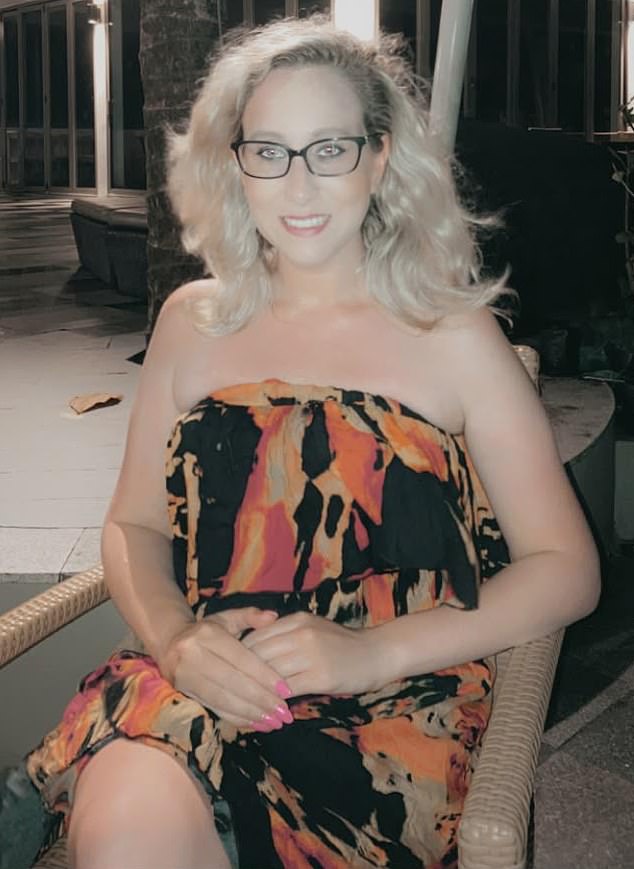
When Emily Newcombe told her date she had OCD, she says it ruined the whole evening: ‘I felt so embarrassed I could barely look at him’

Six-year-old Emily spent hours smoothing her duvet over, so when her cousin creased it she couldn’t stop sobbing. But her family simply thought she was a ‘perfectionist’
I’d always wanted to get married and have a family, but that seems unlikely. I genuinely fear no one will ever love me.
My OCD has affected every date in my life. Now 32, I’ve only had one serious relationship back when I was 21. My OCD was less pronounced then, and during our four years together I managed to keep it a secret.
I first started displaying symptoms in childhood. One of my earliest memories is of the Christmas I was six. I spent hours arranging my duvet and teddy bears, smoothing the duvet over and over until it felt exactly right.
When my cousin came in, he creased the duvet and moved all my teddies. I couldn’t stop crying.
By 12, I had developed rituals around symmetry and straightness. I became obsessed with getting my bedroom blinds perfectly aligned, meaning I was often late for school.
In lessons I was repeatedly straightening books, bags and planners. I certainly couldn’t maintain friendships.
But I was able to hide my struggles enough that my family simply thought I was a ‘perfectionist’.
In adulthood, everything around me had to feel orderly and balanced, with objects in precise positions. I worked as a sales administrator for around a decade and carried out these rituals while constantly worrying colleagues would notice.
In 2020 I was made redundant and started doing freelance work in the events industry. But it was around this time I began to feel like a prisoner to my rituals.
When I was driving to an event, I’d sometimes go around roundabouts three or four times because leaving them too early created unbearable anxiety.
Even going food shopping became incredibly difficult because I would repeatedly reposition my trolley as I walked into the supermarket. If it didn’t feel right, I’d have to leave and come back in again until I got it perfectly straight.
In 2021, everything escalated when my best friend’s mother died. My grief intensified my OCD and I became trapped in repetitive behaviours for hours at a time.
In the morning I’d get dressed but panic instantly because something felt wrong, then undress, put everything away and start again. On really bad days, I’d repeat the process six or seven times.
After my relationship had ended I went on dating apps. But five years ago I gave up after my anxious compulsions meant a first date never led to a second. I never mentioned OCD in my profile, because – rightly or wrongly – I believed no one would want to date somebody with the condition.
At my lowest point, even basic tasks like showering could take two-and-a-half hours.
Eventually, two years ago, things deteriorated to the point where I could no longer work and I went to the doctor.
It was then I was formally diagnosed with OCD aged 30.

Now 32, Emily has only ever had one serious relationship. After they split she tried dating apps, but soon gave up after her anxious compulsions meant a first date never led to a second

Emily’s ‘phone ritual’ sees her stand in the same spot for up to nine hours whilst going online. But standing for such long periods means she has developed swelling in her legs and feet
Though there is no ‘cure’ for OCD, there are methods that can help manage the condition, including cognitive behavioural therapy (CBT), meditation, medication and Exposure and Response Prevention (ERP) – intentionally doing things ‘wrong’ and then sitting with the anxiety or discomfort. I’ve tried them all but nothing has worked.
In September 2024, the month after my diagnosis, I was admitted to Kendray Hospital in Barnsley, South Yorkshire for four months. Doctors told me I had one of the worst cases they’d ever seen.
Today, one of the hardest features of my condition is what I call my ‘phone ritual’. I stand in the same spot for up to nine hours while researching information online.
I’ll search for something ordinary, then become trapped rereading the same information.
If something causes me to lose concentration, like the phone ringing, or my hand so much as twitching, I have to start again.
Standing for prolonged periods means I’ve developed swelling in my legs and feet, so I’m taking anti-fluid retention tablets.
I’ve also gained 7st due to mood-stabilizing medication – which hasn’t been effective – plus just eating too much generally.
The result is that, although my family have been very supportive, I’m practically a recluse.
So is it any wonder I feel a relationship is off the cards? I worry too that I’d pass the condition to my children, or how my rituals might affect a child’s life.
I’ve joined support groups on Facebook and got involved with the charity OCD Action, and it’s been helpful to connect with others in the same boat. I receive weekly therapy, but it’s not helping, so I hope to get funding to stay at a residential unit where I could undergo intense therapy designed for severe OCD patients.
I’ve lost so much of my life to this illness, but I hope one day I’ll be well enough to build the kind of future I’ve always wanted.
As told to Julia Sidwell