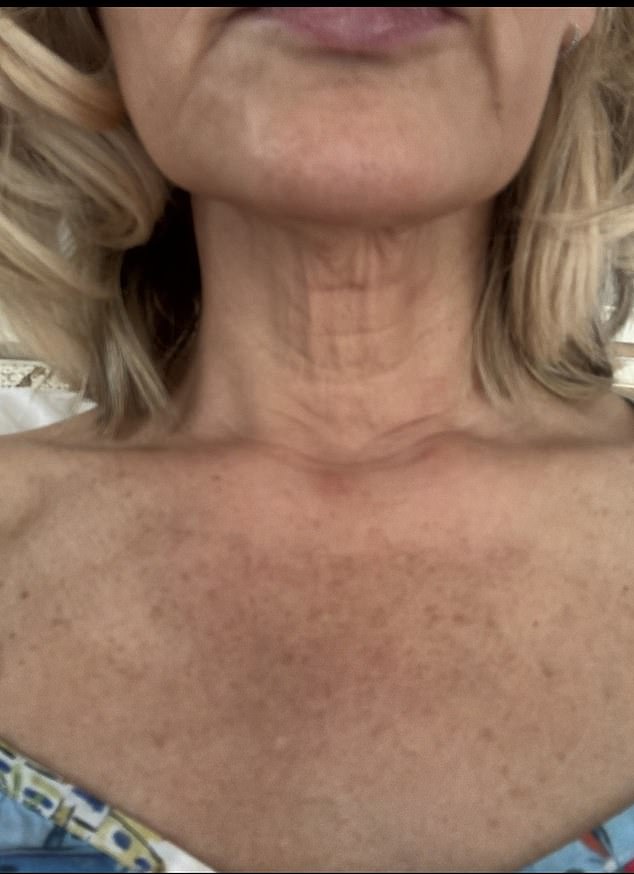
Every morning, as I shower and dress, I can’t help noticing the crepey skin on my chest. Wrinkled and covered in dark spots from historical sun damage, it looks a good ten years older than my 53-year-old face.
Although I have diligently used SPF50 on my decolletage for the last 20 years, my teens and twenties were spent sunbathing – by which I mean lying on tin foil and slathered in baby oil.
The damage from this youthful idiocy now flares into view the moment the sun puts his hat on. It’s not exactly ruining my life, but it’s unsightly, and makes me self-conscious in anything more revealing than a blouse.
As it has got gradually worse over the last few years it’s started to affect outfit choices, leaving me opting for higher necks or thick cover-up foundation.
‘Chest skin is thinner and more delicate than much of the face,’ says Dr Mervyn Patterson at Woodford Medical. On the chest, skin is around 0.7–1 millimetres thick compared with 1–2 millimetres across many facial areas.
‘There are fewer oil glands, so skin is naturally drier and it’s frequently exposed to UV rays, which create hyperpigmentation, damage DNA, break down collagen and form wrinkles,’ says Dr Patterson. ‘The decolletage is also prone to wrinkling from side-sleeping positions.’
As it happens, I sleep on my back, head tilted back, like a vampire, so side-sleeping isn’t an issue, but there’s no question that UV exposure – responsible for the majority of skin ageing – has taken its toll. ‘Sunscreen can help prevent further damage, but it can’t undo pigmentation that is already established,’ says Dr Patterson.

Laser Coring starts at 500 microns, or half a millimetre, and can penetrate up to four millimetres deep

Although Alice says she diligently used SPF50 on her decolletage for the last 20 years, her teens and twenties were spent sunbathing
Even expensive moisturisers haven’t resolved the problem, and I realised that I needed to go a step further than serum.
Last year I opted to have a new, regenerative laser treatment called UltraClear™ on my sagging and wrinkly neck, with surprisingly dramatic results, which I wrote about here in Inspire last autumn. I was so happy with my neck transformation, I wondered whether it would work the same magic on my crepey chest.
So what can you expect in this half-hour session costing from £450, and do you need to brace yourself for pain?
UltraClear™ is a dual-action laser treatment that delivers short, concentrated beams of light to gently remove microscopic circles of damaged skin.
At the same time, deeper layers are heated to stimulate collagen and elastin production from the inside out. Simply put, thousands of minute controlled micro-injuries are created in order to stimulate the body’s natural healing response.
It’s also what’s known as a cold laser, which minimises heat build-up in the skin, reducing both swelling and downtime.
The result? Firmer and tighter skin over the next few weeks and months. On my neck, I opted for the most aggressive setting, called Laser Coring, which punches minute holes, and I had to keep it covered up for a week.
However, the joy of UltraClear™ is that it can be adapted to individual needs. I can’t spare more than three days of downtime, so now I have a less invasive option.
3D Miracle is the lightest setting, and this creates a series of very small circles that look like tiny dots. ‘The standard 3D Miracle setting uses a very light pattern of microscopic dots,’ says Dr Patterson. ‘With you, the settings were increased a little to produce a stronger effect without moving into the longer downtime territory.’
To put this into perspective, Laser Coring starts at 500 microns, or half a millimetre, and can penetrate up to four millimetres deep – alarmingly far when you think about it – and the deeper the setting, the longer the downtime. Neck and chest skin, being thinner and more sensitive, always require a more cautious approach. So my treatment was 20 microns, a tiny depth.
Numbing cream containing the anaesthetic lidocaine is slathered across my chest. Then a handheld nozzle – 15 millimetres by 15 millimetres, and creating 81 minute circles on the skin every time it’s activated – is moved methodically across my chest. There’s no pain, just mild discomfort, like being pinged with an elastic band.
Incidentally, I do know that pain is subjective, but I have a very low threshold!
There is a faint smell of burning, which is unpleasant, but by no means unbearable.

Last year I opted to have a new, regenerative laser treatment called UltraClear™ on my sagging and wrinkly neck, with surprisingly dramatic results
Afterwards, my skin looks pink and rather sunburned, which reminds me of being on holiday in the 1990s. Dr Patterson smoothes on a cold-feeling cellulose Velez Intense Hydration Mask, which is created for healing purposes. ‘It hydrates but also drops the temperature of the skin by at least five degrees.’ This feels chilly and flabby on my chest, but is blissfully soothing.
He suggests that I could wear it to drive home. As I am visiting his Essex clinic and will be driving around the M25 back to Somerset, I demur.
I wouldn’t say this is for the faint-hearted, but it is a treatment that you can have at any time of the year as long as you stringently avoid the sun.
Skin is more sensitive and you risk the damage returning, but I would never (now) go in direct sunlight without an armoury of SPF and hats.
‘Look, by the time you are investing in this sort of treatment, you’re keen not to sustain any more damage,’ says Dr Patterson. ‘There’s no point in having it and going in the sun – it will reverse the treatment.’
Over the next three days I feel only slight discomfort, which I remember from the last time I had this treatment, and some itching. But I am worried about my decolletage, which is bright red, with red square marks. I look as though I’ve fallen asleep in the sunshine underneath mesh garden furniture.
I cleanse it diligently with a Neova Cu3 Gentle Cleanser, and moisturise with the Neova Cu3 Tissue Repair recovery cream, about three times a day. The skin, and the pigmentation, starts to flake away, which is satisfying, if faintly revolting.
After four days I still look a little sunburned, and I also have to go to sundrenched Porto, of all places, for work, where I proceed to spend several days swathed in high-necked dresses in the 20-degree heat.
Genuinely effective rejuvenation treatments are unlikely to deliver overnight results.
Collagen turnover takes at least six weeks, and so patience is needed. However, I had this at the beginning of May and, astonishingly, less than four weeks later my chest was smoother, clearer and dramatically more even-toned. Six weeks on, and the transformation is extraordinary. The sun damage has almost entirely faded and the crepey texture has gone.
Nobody has commented. I think it’s a very personal area – something that bothers you but isn’t something that others would notice.
However, I ask a friend’s daughter who is in her twenties what she thinks, and she looks at me critically. ‘It looks smoother than mine.’
This is obviously nonsense. Equally obviously, I’ll take it.