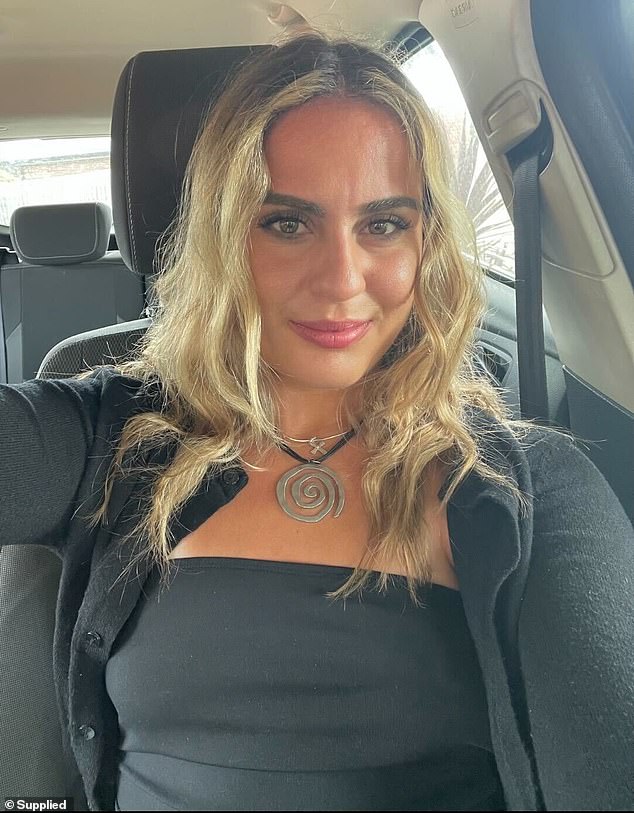
When Klarissa Theophanous found a lump in her right breast in May 2025, she hoped – like many young women – that it would be nothing serious.
At the time she was 23 and a student nearing the end of her social work degree; she had no reason to suspect anything was seriously wrong.
‘I was having a shower and I just noticed a lump in my right breast,’ Klarissa, 24, told the Daily Mail.
‘You could put a finger on either side and just move it around – it felt like a little ball.
‘I was immediately quite scared, so I told my mum straight away and we booked an appointment at our local GP.’
An ultrasound was organised the same week and because of her age, she was told it was likely a fibroadenoma – a benign breast lump common in young women. She was given a referral to a specialist just in case.
‘I was still finishing off my subjects at uni so it was okay for me to put it on the backburner given [doctors said] it wasn’t a health concern,’ she said.
But months passed – and so did her sense of certainty.

When Klarissa Theophanousfound a lump in her right breast in May 2025, she hoped – like many young women – that it would be nothing serious

At the time she was 23 and a student nearing the end of her social work degree; she had no reason to suspect anything was seriously wrong
The waiting period and the creeping uncertainty
Despite repeated follow-ups, Klarissa remained stuck on a waitlist.
‘My mum and I were constantly calling the place I was referred to to see if I had an appointment yet. They just kept saying there’s a waitlist, and you’ll be notified.’
By late November and early December the same year, as she finished the academic year, something shifted.
‘I had noticed that it felt like it had grown a little bit,’ she said.
‘There was always a bit of a fear within yourself. But when you’re reassured that it’s okay, that’s what you listen to.’
It was her mother’s persistence – and Klarissa’s own instinct – that led them to seek another referral.
‘I’m glad we did that,’ she said. ‘Otherwise, I have no idea where I would be now.’

Klarissa eventually booked surgery to remove what everyone still believed was a fibroadenoma, which is a benign lump
Surgery, shock, and a life-changing phone call
Klarissa eventually booked surgery to remove what everyone still believed was a fibroadenoma, which is a benign lump. She met the surgeon on the day of the procedure.
‘He was really lovely. He said, “No need to worry, we’ll get this removed for you”.
Days later, the phone rang.
‘I got a call asking me to come in and bring family members. That was really scary,’ Klarissa recalled.
The biopsy results revealed the truth: Grade 3 breast cancer.
During surgery, doctors removed a 5.2cm tumour from her right breast – not realising they were removing cancer at the time.
‘They pretty much removed the cancer, which they didn’t know they were doing. The doctor was also shocked,’ she said.
A whirlwind of scans, surgery, and fertility decisions
Within five weeks, Klarissa underwent three surgeries: lymph node biopsies, a chemotherapy port insertion, and egg retrieval.
She underwent genetic testing, PET scans, CT scans, and lymph node biopsies amid fears the cancer had spread.
At just 23, she also had to make fertility decisions.
‘The doctor was really great with organising my fertility journey so I could store my eggs, because chemotherapy could potentially never allow you to conceive by yourself,’ she said.
Klarissa later learned she does not carry breast cancer genes, but does have Lynch syndrome.
Lynch syndrome is an inherited condition which gives people an increased chance of developing certain cancers, often at a younger age than the general population.
People with Lynch syndrome are more likely to develop colorectal (bowel) and endometrial cancers.
According to Cancer Council Victoria, Lynch syndrome is the most common inherited cancer risk in Australia, with one in 280 Australians believed to carry the mismatch repair gene deficiency.
However, only 5 per cent of Australians with Lynch syndrome have been diagnosed.
You can find out if you’re at risk through a simple blood test, especially if you have been diagnosed with a Lynch syndrome-related cancer or have a family history.
This test looks for faulty copies of the mismatch repair genes in the DNA of the sample.

Klarissa later learned she does not carry breast cancer genes, but does have Lynch syndrome; an inherited condition which increases the chance of developing certain cancers
Treatment and side effects: ‘It’s a really big shock to the body’
Klarissa has begun an intensive six-month chemotherapy regimen, starting with what she describes as the ‘Red Devil’-type chemo.
‘It’s really strong and does a lot of things to your body, which is quite scary,’ she said.
The side effects have been relentless.
‘Severe fatigue, brain fog, nausea, vomiting, dizziness,’ she said.
Her taste and smell have changed. Food she once loved now feels intolerable – with even a glass of water leaving a sour taste in her mouth.
‘It’s weird at 24 that I’m going through menopause. Hot flushes, night sweats – it’s another thing I’m trying to deal with,’ she said.
Hair loss has been another emotional blow.
‘I’ve had a loss of identity. Cold capping is painful – it’s like a brain-freeze headache for extra hours during treatment – and it’s not guaranteed to save your hair.’
Her skin, nails, gums, and immune system have also been affected.
‘I’m really immunodeficient and vulnerable. I have to inject myself after treatment to raise my white blood cell count,’ she said.
To stay safe, she limits social contact – a lonely adjustment for a young woman used to an active life.

Klarissa credits her family with helping her survive the hardest days
Cancer in your early 20s
Klarissa says the emotional toll of being diagnosed so young has been overwhelming.
‘Everyone around me was in disbelief. Friends, family – they were really shocked and sad.’
She describes a sense of grief for the life she expected to live at this age, and the brain fog has made daily life harder.
‘You become forgetful. Even just going on my laptop or making breakfast feels harder than it should.’
Despite this, she is determined to continue her studies, with 500 hours of social work placement still to complete.
‘I’m going to try my best to work through it. My uni and placement have been really supportive.’
Coping, family, and finding small moments of light
Klarissa credits her family with helping her survive the hardest days.
‘They cook things I feel like eating, go for walks with me, watch TV shows, movies,’ she said.
‘They help get me out of bed when I’m feeling mentally low.’
She has turned to mindfulness, colouring, meditation, yoga, and gentle movement to cope.
‘I’m trying to give myself grace, and trying to stay uplifted and positive.’
Friends have rallied around her, bringing flowers and offering comfort – small reminders that she is not facing this alone.

Looking back, Klarissa believes advocating for herself – and listening to her intuition – may have changed the course of her life
The financial burden: ‘It’s not talked about enough’
Beyond the physical and emotional aspect, Klarissa says the financial strain has been shocking.
‘You don’t realise the financial burden. Different doctors, appointments, time off work – it’s a huge toll.’
Klarissa’s family has set up a fundraiser to help with the costs of her treatment.
In just five weeks, she faced multiple surgeries, fertility procedures, scans, and ongoing specialist visits.
‘The fertility stuff is considered elective. ‘There are ongoing storage costs you don’t think about. I never imagined thinking about fertility at 23.’
Even with private health insurance, many expenses were not covered.
‘It’s not the chemotherapy you’re paying for. It’s everything else – biopsies, constant doctor visits, parking at hospitals, appointments everywhere.’
She says the hidden costs of cancer need more public attention.
‘That’s something that really needs to be spoken about. The financial burden is not talked about enough.’
‘I’m glad I listened to my instinct’
Looking back, Klarissa believes advocating for herself – and listening to her intuition – may have changed the course of her life.
‘There was always a fear in yourself if something doesn’t feel right. I’m glad we pushed to get it checked again.’
Now, just six weeks into knowing her diagnosis, she is navigating chemotherapy, uncertainty, and the emotional upheaval of facing cancer in her early twenties.
‘It’s been a really big shock. I had no symptoms. No warning. It just… changed everything.’