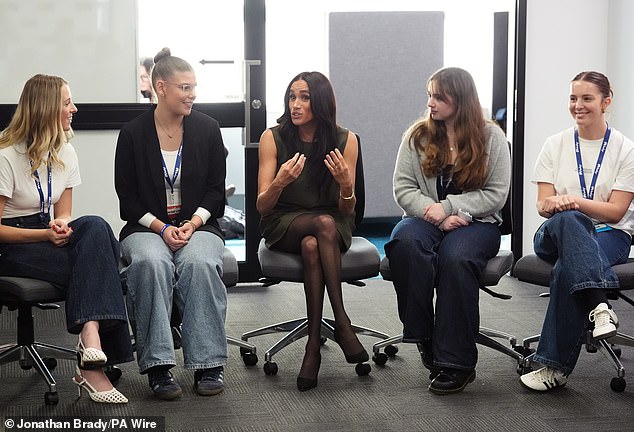
The most trolled person ‘in the entire world’. Man or woman. Bullied every single day for a decade. That is how Meghan chose to describe herself last week, standing on a stage in Melbourne in front of a room full of young people from a mental health charity.
Let that sink in for a moment. Of all the people who have ever logged on to the internet, Meghan Sussex is apparently the one who has suffered most from the cruelty of other people.
Not the teenage girls relentlessly tormented by content fed to them on social media, nor the children hunted by predators in chatrooms. Not the women whose intimate images have been shared without their consent. But the Duchess.
I watched the clip several times, searching for a flicker of self-awareness, but saw none.
Hours later, she stood next to her husband at a £550-a-head summit as he told the audience he had felt ‘lost, betrayed and completely powerless’ for most of his adult life. But I’m afraid all I could see was a pair of multi-millionaire celebrities who flew business class to Australia for a victory lap disguised as a charitable tour and spent the week telling anyone who would listen how terribly they have been treated.
What struck me most as a psychiatrist, however, wasn’t the tin-eared self-pity but the audience she chose for it. Meghan was speaking to young people affiliated with Batyr, an Australian mental health organisation that works with teenagers struggling with anxiety, depression and suicidal thoughts.
Children like these are nowadays repeatedly told by a wider culture (largely but not exclusively online) that their suffering is their identity. Their trauma is their ‘story’. The worst thing that ever happened to them is also the most interesting thing about them.
It’s a deeply unhelpful mindset that we in mental health services are desperately trying to undo.
And yet here was Meghan, in front of them, doing precisely that, framing her entire life in terms of damage done to her.
There is a pattern here that anyone working in mental health will recognise. Call it a victim identity, or a victimhood mindset, it’s the psychological trap where a person, often following a period of real hurt, begins to build their whole sense of self around the injury.

As Meghan spoke to teenagers struggling with anxiety, depression and suicidal thoughts, she was framing her entire life in terms of damage done to her. It’s a deeply unhelpful mindset

She also said that her husband Harry had felt ‘lost, betrayed and completely powerless’ for most of his adult life
I see this frequently among patients, and I do have sympathy for those who fall into it, because the path is so easy to follow. Suffering gets you attention, after all. It explains your behaviour, excuses your mistakes and makes you the ‘protagonist’.
The trouble is, once you’ve built your house on it, you cannot afford to move on and get better. If your suffering is your identity, what happens when you stop suffering?
The slogan of modern therapy culture is ‘my truth’. Clients are encouraged to speak it, own it, broadcast it.
What gets lost is the old-fashioned idea that there might actually be an objective truth, not yours or mine but something that is simply true.
Was Meghan really the most trolled person on Earth for ten years? Plenty of people are horrid about her online, but no. It is not even close to being true.
Her husband, meanwhile, spoke at another event about how he had to ‘cleanse’ himself of his past before becoming a father. Cleanse is such a loaded word: as if his own history, his own family, were a kind of contamination to be washed off.
This, too, is therapy-speak at its very worst. The whole point of good psychotherapy is to help someone integrate their past – the awful, annoying, upsetting and distressing bits included – into a coherent self. Not to purge it. The object is not to treat your own childhood as something to rinse away like cooking grease. Harry, I fear, has had so much therapy he has forgotten what it is for.
Both of them, in their different ways, are modelling something deeply unhelpful for a generation already struggling.
People watching can only conclude that the way to prove you are ‘real’ is to keep announcing how wounded you are.
I fear they are teaching these kids that the correct response to hurt is not to heal it but to monetise it.
The tragedy is that Meghan, were she to take a breath and look around, would see she has everything. A husband, two healthy children, wealth beyond most people’s imagination.
She has houses and staff and invitations to stand on any stage she likes.
But if you have built your identity on being the most wronged woman in the world, none of that is any good to you. You need the trolls to keep trolling or your brand bites the dust.
I worry about the young women in that audience. Some will go home and examine their own lives through this new lens. They’ll catalogue every slight, every bad day, every word flung in anger. And they will imagine their suffering is what defines them and makes them who they are. It is not healthy.
My fear over ’GP’ chatbots
A study released this week should give pause to anyone using an AI chatbot as a stand-in for their GP.
Researchers put five of the most popular platforms, including ChatGPT, Google’s Gemini and Elon Musk’s Grok, through their paces on everyday health questions.
Around half the answers were problematic – with almost one in five highly problematic. The chatbots delivered each response with the confidence of a consultant, according to the study published in the journal BMJ Open.
That last bit is what worries me most. More than 200million people ask ChatGPT for health advice each week. Many of them, I suspect, are doing so because they cannot get an appointment, or because they feel embarrassed asking a human being about something intimate. I have plenty of sympathy with that.
But a chatbot is not a doctor. It does not examine you. It cannot see the mole on your back or hear the wheeze in your chest. It has no idea whether you are the anxious type who catastrophises a cold, or the stoic type who ignores a heart attack.
What it is brilliant at is sounding authoritative – which is dangerous when you’re wrong half the time. By all means use these tools to understand a condition once you have been given a diagnosis. But please don’t let a chatbot be your first port of call.
Dr Max prescribes… a pack of playing cards
Cheap, analogue, and one of the best things you can do for your brain, card and board games give you a good mental workout combined with invaluable social contact. A French study followed elderly players over 20 years and found their risk of dementia was 15 per cent lower than those who didn’t play. So dig out a pack and teach the grandkids gin rummy.