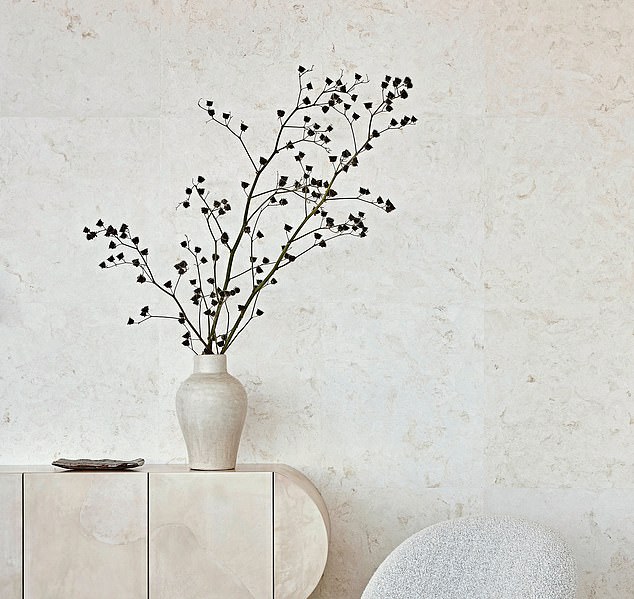
I used to judge faux flowers, and the people who bought them. They were the hallmark of hairdressing salons, budget hotels and that one aunt who’d say, ‘Ooh, you can’t tell, can you?’ while presenting a retina-scorching purple orchid that looked like a piece of Duplo. They were joyless and unmistakably artificial. Real flowers, by contrast, felt like a sign of self-respect and good taste.
But a wave of high-end artificial florists have pulled off a convincing rebrand. There’s Fake It Flowers, whose fans include interior designer Katherine Pooley and luxe wallcovering company de Gournay; the Swedish brand Ett Hem, whose ‘forever flowers’ appear at Buckingham Palace; and Pottery Barn, whose stems are used in luxury hotels.
No longer plastic tat, faux flowers now belong in shops with wafty linen curtains and pricey candles.
What’s more, it’s getting increasingly hard to tell the difference. Today’s faux versions are made from premium silks, polyesters, natural rubbers and even real-touch foam (a mixture of polyurethane and special latex coatings that feel suitably cool). These materials also easily absorb dye, which creates natural gradients to mimic the tone of real petals. Plus, they now have leaves that bend and artfully wonky stems that suggest they’ve been plucked from a Cotswold garden rather than a factory in Croydon.
Even Alan Titchmarsh has softened his once-sceptical stance. ‘Don’t be a snob about faux flowers,’ he said in a recent column for Gardeners’ World. ‘Garden centres sell everything from faux peonies to delphiniums and roses, lupins and lilies. They are undeniably beautiful and will also last for years.’
Who can argue with Alan? Well, not everyone is convinced.

Saying ‘no’ to fauxs
YOU’s deputy digital editor Charlotte Vossen remains firmly critical. ‘I genuinely don’t understand the appeal of faux flowers. Real ones smell better, look better and actually bring something to a space.’ Faux flowers are also excellent dust collectors. ‘You may not have to water them, but you do need to clean them every couple of weeks. Who has time to dust flowers?’

We’ll take the fakes
Features writer Maddy Fletcher (whose convincing faux tulips from TK Maxx are featured in our spot-the-difference), takes a different view. ‘I’ve bought a lot of rubbish from TK Maxx over the years,’ she notes. ‘An LED face mask – used once and never charged again. Swirly glass bowls – cracked by the time I got home – and a water flosser, a mistake I recognised even while queueing to pay. But these tulips are different.’ Purchased two years ago at £10 for seven stems, the tulips continue to deceive. ‘Everyone is fooled by them,’ she says. ‘I think it’s because they’re rubber. They feel sturdier, which is more realistic than the usual silk.’

Flowers cost a bunch
Of course, the appeal is also financial. It’s increasingly rare to find a decent bunch of fresh flowers for under £10 (long-stemmed roses from Waitrose hover at £10 for five stems), while hydrangeas can reach a wince-inducing £15 per stem. You bring them home, they look glorious for 48 hours and then – unless diligently maintained with a misting bottle every day – they begin their steady decline. By day five, they are essentially compost. Faux flowers, by contrast, are a one-off purchase: buy once and display indefinitely.


The eco impact
So which are better for the environment, real or fauxs? Well, an estimated 45 per cent of cut flowers in the UK go to waste before they ever reach the consumer – damaged, discarded, or simply past their fleeting seven to ten-day prime. Then consider the journey: many fresh flowers are flown in (80 per cent of the UK’s come from the Netherlands), only to be wrapped in layers of plastic on arrival. Hardly the back-to-nature fantasy we conjure in our minds when browsing a flower stall.
Faux flowers, by contrast, shift the equation. While manufactured from plastics, their ability to be reused for years, along with lower transport emissions (durable, non-perishable goods can be transported via sea as opposed to air), makes them a sustainable option long-term.
They are also the ultimate low-effort upgrade for anyone, like me, who struggles to keep even a cactus alive or has rooms devoid of natural daylight. Aside from the occasional dusting, they ask nothing of you – no watering, no trimming, no sunlight and no guilt when you realise you’ve let something lovely die.


The verdict
Perhaps the answer is not to choose sides so rigidly, but to strike a more thoughtful floral balance: fresh flowers for the occasional indulgence, when the moment calls for something fleeting and fragrant, and faux flowers for an easy, everyday win. You can also mix and match both types for volume. We won’t tell if you won’t.